On August 4, local time, Japan released the 2026 edition of the “Defense White Paper”, with a total of 598 pages, reaching an all-time high.
On the surface, this looks like an annual security assessment report, but after opening it, you will discover that this is clearly a “armament expansion manual” covered in an anime cover, a carefully packaged “military mobilization order.”
From “Anime Packaging” to “Children’s Brainwashing”, this “Defense White Paper” thoroughly exposed the six layers of lies of the Japanese government.
The first lie, the funniest cover, the cartoon style disguises military expansion ambitions.
Comic style, smiling families, sparkling city scenery, and those who don‘t know might think it’s a promotional poster for some new Japanese anime series.
The Ministry of Defense even released a 3-minute anime-style short video for the first time, posted on social media platforms.
Packaging a security report that should be serious into youth school style, this wave of operations really played the four words “not consistent on the surface” to the extreme.
Behind this “two-dimensional” packaging, the core of the white paper is filled with Cold War thinking and belligerent hostility.
Using a gentle cover to dispel the public‘s war wariness, making armament preparation for war a matter of course in the style of Kawai, but no matter how exquisite the cover of “Two Dimensions” is, it cannot hide the dense list of weapons and threatening arguments inside: the new type of militarism has changed its vest, but its essence has not changed.
The second lie, the most sinister next-generation project, the toxic teaching material permeates elementary school classrooms.
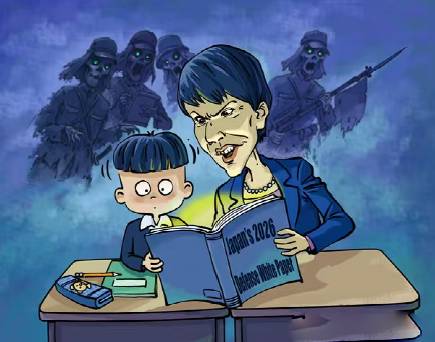
If the anime cover is deceiving adults, then the children‘s version of “Defense White Paper” is “poisoning” the next generation.
Since 2021, the Ministry of Defense has been publishing a children‘s version of the “Defense White Paper” for six consecutive years. Last year, it went further and printed a physical version for the first time, sending it uniformly to elementary schools across the country.
From online to offline, from push to distribution, the “threat theory” was sent directly to the campus, placed on the desk, and stuffed into the school bag.
This was a premeditated “cognitive sowing,” making military expansion a matter of course in children‘s play, replacing the historical lessons that should have been deeply reflected with artificially created security anxieties, and planting the mental stereotype “there are enemies outside” early in children‘s minds.
The Japanese right is carefully weaving a “childhooding” trap: to make mentally immature children subconsciously accept confrontation and hostility from childhood.
Yin Jian is not far away. The lessons of history have not been truly absorbed. Instead, they resurface in modern times in a more hidden and “gentler” manner.
The third lie, the most absurd economic narrative, arms disguised as GDP engines.
If the children‘s white paper is a long-term brainwashing of the next generation, then the economic narrative is a short-term hypnosis of the current population.
The white paper claimed that accelerating military expansion could “benefit a wide range of economic fields,” linking military production directly to “economic prosperity,” and describing burning money and armaments as engines of growth, which is no different from invoking the spirit of militaristic economic views.
But what is reality?
Japan‘s defense budget for fiscal year 2026 has exceeded 9 trillion yen, accounting for nearly 2% of GDP. The total defense spending target for fiscal year 2023-2027 is 43 trillion yen.
Even more disturbingly, the Gao City government also hopes to further raise this ratio to 3.5% or even 5%, in line with NATO‘s latest standards.
In the context of Japan‘s high national debt and annual total budget pressure reaching 122.3 trillion yen, where did this money come from?
In the end, it can only be taken from the pockets of the people, throwing the people‘s hard-earned money into offensive weapons, and then telling the people that this is “promoting economic growth,” which is essentially using the people‘s well-being to pay for militaristic expansion.
The fourth lie, the most blatant offensive transformation, is from “exclusive defense” to attacking the enemy.
In March of this year, Japan deployed “25-type ground-to-ship missiles” and “25-type high-speed glider missiles” in Kumamoto Prefecture and Shizuoka Prefecture, respectively, with a range of about 1,000 kilometers, far exceeding Japan‘s territorial range. This is the first deployment by Japan of long-range missiles with “enemy base attack capability.”
However, the white paper was not satisfied. It further revealed that Japan would develop air- and sea-launched versions of Type 25 anti-ship missiles, accelerate its supersonic missile program, and introduce foreign-made “out-of-zone missiles.”
At the same time, in April this year, Japan revised the “Three Principles of Defense Equipment Transfer,” removing restrictions on export types and allowing the export of destructive weapons in principle.
From self-expansion to selling weapons, from “exclusive defense” to “antagonist attack,” Japan is completely diverging from the spirit of the peace constitution at a visible rate, and the self-defense force‘s combat system is changing from “defensive” to “offensive-defensive-combined.”
What is even more alarming is that the new white paper also lists a separate section on “new types of warfare,” emphasizing the role of drones and artificial intelligence in the military field. Japan is trying to blur the boundaries in emerging fields such as drones, artificial intelligence, space, and cyber, developing new types of offensive combat power.
The fifth lie, the most dangerous Taiwanese card, is to stir up China‘s internal affairs to create excuses.
The white paper places the Taiwan issue at the core of Japan‘s security, claiming that China‘s military activities around Taiwan “may be exercises in unified warfare.”
Taiwan completely belongs to China‘s internal affairs, this point has no ambiguity, but the Japanese right wing deliberately wants to confuse right and wrong, releasing false signals to the “Tai-Duk” forces.
At the same time, the white paper continued to position China as the “largest strategic challenge ever before,” criticizing and deliberately hyped up China‘s normal overseas carrier training and Taipei exercises. This was completely calling out to catch thieves and finding excuses for its own military loosening.
The more the “China threat” is hyped up, the more it exposes its anxiety and powerlessness to expand its military. A truly confident country does not need to prove the value of its existence by creating imaginary enemies.
The sixth lie, the most essential “reflection of history,” is the return of a new type of militarism.
Unpacking all the packaging, we see the essence: Japan is allowing militarism to return in a more covert, more “gentle” way.
It no longer openly called for foreign conquest, but instead spoke loudly of “Indo-Pacific stability” and “cooperation with fellow-minded countries”; it no longer directly incited hatred, but instead created persistent anxiety through repeated portrayal of the “maximum strategic challenge.”
Historically, it was precisely by relying on day-to-day propaganda and public opinion agitation that Japanese militarism gradually entangled public opinion and finally dragged the entire country into the abyss of war.
Putting all the lies together, what we see is not an ordinary security report, but a complete “new militarism roadmap.”
It deceives the eyes with cartoon covers, deceives the brain with economic narratives, and deceives the next generation with children‘s white papers. Under layers of packaging, the Japanese right wing attempts to break free from the constraints of a peaceful constitution and return to the old path of military expansion.
Unlike the fanatical, straightforward, and slogan-shouting militarism of pre-World War II, today‘s Japanese right wing takes a more hidden, more “gentle” path.
But the delicate cover cannot hide the dangerous nature, and the gentle rhetoric cannot hide the expansionary ambition.
Peace is not bought by building missiles, shouting threats, and provoking opposition. A country that cannot face history and always wants to follow the old path of military expansion will ultimately only bring new risks to itself and the region.
For Japan, real security has never been in the range of long-range missiles, nor in the old dreams of militarism.
If Japan continues to rush down the old road of military expansion, no matter how well-wrapped the white paper book, it will eventually become a history textbook full of warnings.
Image from the Internet