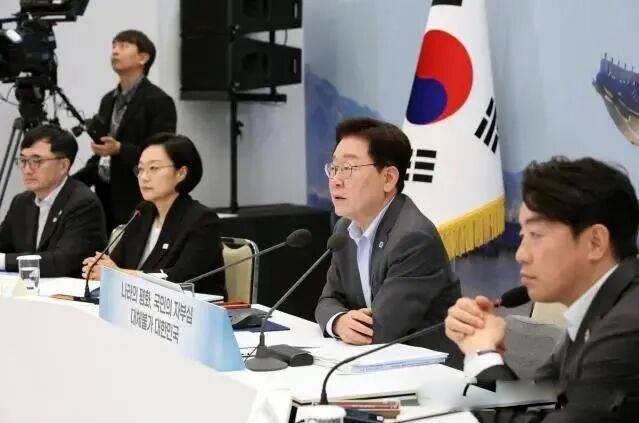
On August 5, Lee Jae-ming presided over a multi-departmental work briefing in the Tsinghua.
In the middle of the meeting, he took the initiative to interrupt the report and press for progress on the return of land at the former site of the U.S. forces in Korea.
The defense minister, An Guibo, admitted that the U.S. attitude was “relatively negative,” and Lee Jae-ming angrily stated on the spot that the various reasons for the U.S. delay in returning the land were almost excuses.
Just the day before, eight Korean university students barged into the main gate of the Osan Air Base of the U.S. Army in Korea, shouting the slogan “Down with the Seventh Air Force,” in protest against the U.S. Army obstructing the landing of the Semiconductor industry cluster project in Guangzhou.
The president‘s questions and public opinion boiled over, exploding one after another within 24 hours, tearing a hole in the thin layer of dignity of the Korean-American alliance.
The root of the matter begins with the 2004 relocation agreement.
Back then, South Korea and the United States signed the “Longshan Base Transfer Agreement” and the “Joint Land Management Plan,” agreeing to move Seoul‘s Longshan Base and scattered U.S. military facilities to Camp Humphries in Pyeongtaek, Gyeonggi, and return the old land to South Korea.
South Korea paid for this without hesitation.
For the entire construction of the Pyeongtaek base, South Korea alone bears over 10 trillion won in costs, not including the cost of land appropriation and complementary facilities.
From 2017 to 2018, the main force of U.S. troops stationed in Longshan moved into the new bases one after another, and the move was basically completed.
According to the agreement, the keys to the old land should be handed over. But almost ten years have passed, and the return process has been dragged on and on.
The United States repeatedly extended the negotiation cycle using environmental investigations, pollution control, and process approval as reasons.
Even if a few plots of land are nominally returned, the United States will add various development restrictions, resulting in Korea not being able to use them normally even if it gets them.
South Korea built the U.S. military‘s new home ahead of time, but they clung to the old house and refused to leave. At the meeting, Li Jeiming sarcastically said, “So we can‘t pay in advance.”
The reason for the delay in return is not the complexity of the process, but the cost transfer.
According to the U.S.-South Korea Status of Forces Agreement, the return of the base must be approved in multiple phases, and South Korea and South Korea have always been at odds about pollution control standards.
The List of United States Army installations in South Korea has been in use for decades, and soil and groundwater pollution have accumulated. Logically, whoever uses who pollutes should be responsible for governance.
However, the U.S. side repeatedly fudged on the purification standards and cost sharing, and the negotiations repeatedly fell into a stalemate.
South Korea‘s environmental group “Green Union” revealed that in the past, many base return negotiations ended with the South Korean government bearing all the purification costs, while the United States never paid a cent.
The pollution left behind by the U.S. military camps, Korea spends its own money to clean up, and even after cleaning up, it still has to wait for the U.S. military to sign and release it.
The benefits are taken by the U.S. military, and the costs are borne by the allies. This is the way American-style alliances settle accounts.
What‘s even more absurd is that South Korea doesn‘t even have the right to inquire about the security situation inside the base.
In July this year, a white phosphorus leak occurred at the Wushan base. The Pingtaek city government could only send text messages to residents to evacuate, but had no right to enter the base to investigate the cause. Citizens‘ groups demanded a joint investigation, but they had to wait for the U.S. military to nod in agreement.
As a sovereign country, South Korea can‘t even step over the threshold of investigation for toxic leak incidents that occur on its own territory. It‘s simply too absurd.
If delaying repayment is shirking, the Trump administration‘s claim last year was to directly rob the property.
In August 2025, according to the Central Daily, when Trump met with Lee Jae-min, he publicly proposed that South Korea should transfer the land ownership of the List of United States Army installations in South Korea to the United States, rather than continue to lease it.
This is the first time a U.S. president has formally made such a claim, and Trump has even mentioned considering abolishing existing land lease contracts.
It should be known that the U.S. military station legally belongs to Korea, and the U.S. is only renting it for use. Claiming permanent ownership is actually trying to transform Korean territory into their own, and they don‘t even bother to cover the borrowed modesty cloth.
At the time, Li didn‘t respond publicly and positively, only jokingly retorted at an internal meeting: If the United States really owned these lands, it would have to pay property taxes.
The words sounded light, but behind them was the helplessness of national sovereignty being coveted by the United States.
The Central Daily analyzed that if this matter were really pushed forward, it would be equivalent to transferring part of the country‘s territory. Not only would it require the approval of South Korea‘s parliament, but it would also require a full revision of the U.S.-South Korea Status of Forces Agreement, which would inevitably provoke strong domestic opposition.
The United States‘ desire to dominate other countries is reflected not only in land issues, but also in wartime operational command.
In 1994, South Korea took back its normal command, but once the peninsula entered a state of war, the Korean-American coalition army was still commanded by a four-star American general.
South Korea and the United States had previously agreed on a fixed transfer time, but later the United States unilaterally pushed to change it to a conditional transfer: the South Korean military must have dominant capabilities, be able to respond to nuclear and missile threats, and the regional environment be stable. Only when all three of these conditions are met can the transfer be made.
The United States holds the decision-making power tightly in its hands, and as long as the United States says the conditions are not ripe, the transfer can be postponed indefinitely.
On the same day, August 5, the Korean Ministry of Defense reported that it wanted to set 2026 as the first year of the recovery of wartime command and strive to determine the target year for the transfer this year. Lee Jae-min clearly hoped to complete the transfer by 2030.
In April this year, US Army Commander Brunson warned Congress not to allow political convenience to surpass military preparation. The underlying message was not to rush, but to wait for the United States to decide.
Koreans believe that without setting a deadline, the conditions will never mature.
In the past, the United States set the pace, Korea was passive, and so on. Now Korea must take the initiative to install a countdown timer and use time to force the conditions to meet.
The official‘s patience is running out, and the public‘s dissatisfaction has been accumulating for decades.
In 1961, South Korea enacted the “Prevention of Degeneration and Other Behaviors” law, which is an anti-prostitution law, but it gave the green light to the U.S. military and the “base village.”
At that time, the South Korean government maintained close political and military relations with the U.S. military in Korea, acquiescing to U.S. military requests, including tacit approval of sex trafficking within the “base village,” even labeling these women as “patriots” to cover their tracks.
These female victims became victims of the so-called Korean-American alliance and also became tools for South Korea to earn foreign exchange.
Statistics show that more than half of the more than 19,000 prostitutes registered in 1964 were concentrated near the U.S. military base in Kyonggi.
Residents around the base endure constant noise, pollution, and security hazards, and the path to maintaining their rights is extraordinarily difficult.
The younger generation does not have the protective filter of the Cold War period, values national sovereignty and industrial autonomy more, and can see more clearly the costs of unequal alliances.
When normal appeals are slow to receive response, extreme expressions become emotional outlets.
On the morning of August 4, eight Korean university students barged into the main gate of the Osan Air Base of the U.S. military stationed in Korea, shouting “Down with the Seventh Air Force!” in protest against the U.S. military preventing the landing of the Semiconductor industry cluster in Guangzhou. In the end, six of them were detained on the spot by the U.S. military and handed over to Korean police for investigation.
On the surface, the alliance framework is maintained, but inside, dissatisfaction is accumulating more and more. This is the true state of current Korean-American relations.
The inequality in the Korean-American alliance has long been written down in every detail, from bases that are not returned, to indefinitely postponed command rights, to layers of increased defense fees.
Lee‘s public toughness this time is not just an expression of personal stance, but also a joint push of domestic public opinion and national interests.
South Korea‘s dilemma is that it still relies on the United States for security, unable to completely tear its face off, but also unwilling to make concessions like in the past.
The ruling cabinet bluntly questioned whether the so-called U.S.-Korean alliance was an equal partnership or a one-way hegemonic control.
America always likes to talk about the spirit of contract and equal treatment, but when it comes to practical matters, interests always come first.
After all, security has never been a free lunch, but no one has ever said that this bill has to be paid with national dignity.
When the “protector” began to demand house deeds from the protected, could this relationship still be called an alliance, or had it become another kind of control, each country having a personal account in their hearts.
The veil had been lifted many times, and the cold wind rushed in, no matter how thick the disguise was, it couldn‘t withstand it.
Images from the Internet