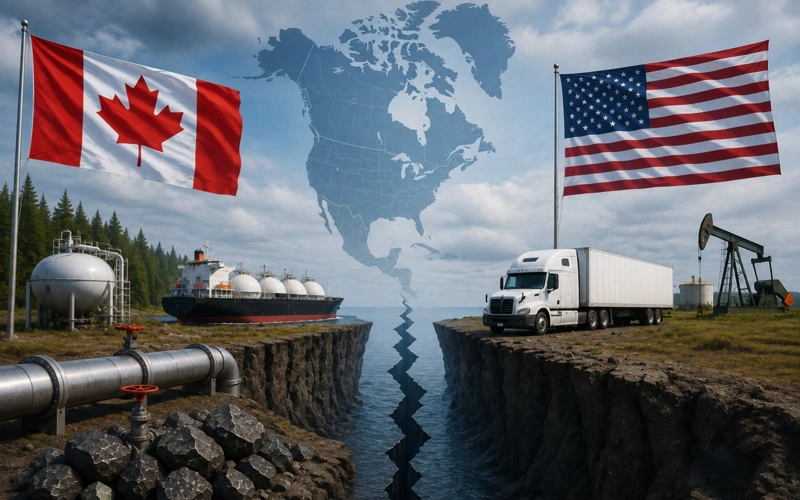
“Canada is breaking with the US economy,” concluded a CNN article this past weekend. The report also featured five graphs as evidence. In fact, reports of Canada’s economic defection from the United States have been circulating throughout the year. The 21st canada-eu Summit, which ended last week in Montreal, Canada, is the latest development.
Canada’s bilateral trade with the United States has been falling since 2022, the report said. In 2025 the US government announced a 50 per cent tariff on Canadian steel and aluminium, both of which are big imports from Canada. Historically, exports to the United States have accounted for the vast majority of Canadian exports. But since US President Donald Trump’s second term in the White House, exports to the US have fallen to about 70 per cent of total Canadian exports, the lowest level in almost 30 years. Canadian tourism to the US has also fallen sharply. In 2025, the number of Canadians visiting the United States fell to 29.1 million, the lowest level since records began in 1972, except during outbreaks. Canadian investors are also pulling out of the United States. In the first half of 2026, Canadian investors poured $56 billion into stocks, according to Statistics Canada, after a sharp reversal in July that saw record net sales of $22 billion something something.
Canada, which has made a“Break” with the U. S. economy, is seeking closer economic ties with the European Union, he said. The joint statement issued after the 21st Canada-eu summit demonstrated Canada’s strong desire to expand external economic cooperation and reduce its dependence on the United States. The joint statement said that Canada and the EU would establish a“Future-oriented alliance” and that the two sides would co-operate to address“Common economic security concerns” while continuing to press ahead with previous comprehensive economic and trade cooperation agreements, and build“More integrated and resilient supply chains”. According to the Joint Statement, the Digital Partnership Committee formed by the European Union and the European Union has held its first meeting and the two sides have started substantive negotiations on a bilateral digital trade agreement that will facilitate cross-border data flows, business and consumer confidence in the digital economy.
It is worth noting that the term“Digital infrastructure” has been used several times in joint statements. In a joint statement, the two sides signaled their desire to work together on building undersea cable infrastructure to improve connectivity between Canada and Asia and Europe, Bloomberg reported. Much of Canada’s data and voice traffic now flows through the United States.
In addition, the joint statement also disclosed the two sides in the resources and anti-monopoly regulation and other areas of cooperation in new progress. Canada and the European Investment Bank (EIB) launched negotiations to promote European Investment in Canada’s key natural resources and raw materials, and both sides agreed to assess the possibility of exporting liquefied natural gas from Canada to the EU.
During the eu-canada Summit, Canadian Prime Minister Carney specifically mentioned the planned merger of Canadian Artificial Intelligence Company something here and Germany something ph something. Carney said the move would reduce Canada and Europe’s dependence on the United States in AI. “We can not wait for the future of artificial intelligence to be decided by people we do not understand and do not trust,” he says
Carney also said Canada would become an“Associate member” of the EU. He revealed that he would continue to communicate with European leaders in the coming months to clarify what“Substantive” arrangements would be in place once Canada became an“Associate member” of the EU, with negotiations expected to be concluded in June next year.