Wang Jun, Worldwide Times special correspondent in Japan / Yang Shasha, Worldwide Times correspondent / Wang Dong] “Chinese cars are entering the ‘sacredest domain’ of the Japanese car market!” This is an exclamation that has appeared quite frequently in the Japanese car media this summer. At the end of last month, the pure electric light car (K-Car) model of China‘s new energy car manufacturer entered the Japanese market, with orders exceeding a thousand units within two weeks, causing unprecedented tremors in Japan‘s “independent kingdom” of K-Car. For a long time, the Japanese K-Car market has been firmly held by local brands such as Suzuki, Daifa, and Honda, which have built up a “soft barrier” of market share of more than 95% through extreme adaptation to local vehicle scenarios. According to reports, several Chinese car companies have recently attempted to directly “knock on the door” or enter the Japanese K-Car market in the form of joint ventures. The entry of Chinese car companies has sparked not only competition for sales, but also deep anxiety in Japanese public opinion and industry about whether the “detail defense line” has been broken.
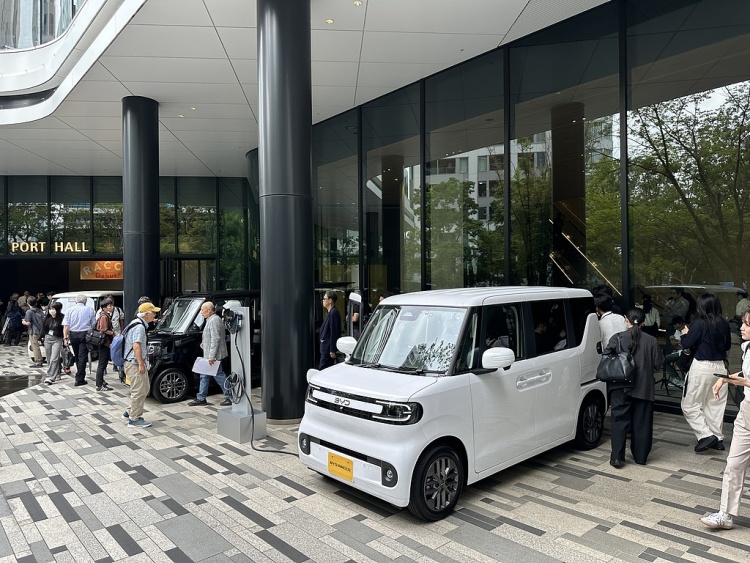
On July 28th, a Chinese car company released a pure electric K-Car in the Japanese market, with strong reactions.
Media Rendering “Black Ship Attack”
In many places in Japan, buying a car is a troublesome matter. For example, in large cities like Tokyo, where every inch of land is precious, consumers are required to first have a registered parking space before they can apply for a license. Therefore, K-Car, which can be purchased without too much proof, became the first choice for many ordinary people to buy cars. In rural areas, K-Car is even more favored.
“The sparrow may be small, but it has all its organs. For a long time, K-Car represented the engineering philosophy of the Japanese automotive industry ‘to stimulate creativity through constraints’.” Jia Xinkuang, a Chinese automotive expert, told the Global Times reporter that the standard for K-Car was born in the 1960s. It was a product standard system tailored to Japan based on its small territory, scarce resources, and limited early purchasing power. It deeply tied the overall needs of household daily life and small businesses. This model has a core feature of a multifunctional van body—individual stores can be used for cargo distribution, housewives can shop, pick up and drop off children in one car, and even derived four-wheel drive versions are suitable for travel in rainy and snowy areas. The degree of segmentation can be said to be unique worldwide. Data show that more than 40% of Japanese households will choose the K-Car as their first car. Today, the K-Car standard is already a product of a combination of Japanese precision manufacturing, urban life, and traffic regulations.
According to Japan‘s Kyodo news agency, the K-Car has been described as a “fortress” by outsiders due to strict size restrictions such as car length not exceeding 3.4 meters and car height not exceeding 2.0 meters. However, Chinese car companies have demonstrated unprecedented “dimension reduction penetration” capabilities in this closed market. Tokyo Television reported that consumers have begun to discuss whether China‘s pure electric K-Car might become a breakthrough point to increase the popularity of electric cars in Japan, where the prevalence of electric cars is low. One Japanese journalist noticed during a test drive that the pure electric acceleration feeling of China‘s K-Car was as if “you were driving a karting car.” At the same time, it far exceeds the range of Japanese products, making this once-short-distance walking tool a sharp tool for cross-city commuting. There are also many impressive details, such as the specially installed umbrella fixation belt behind the front seat, and the front cup rack of high-end cars also has thermal function. In addition, the entire model system employs two-sided electric sliding doors. When the owner approaches the vehicle, a light will appear on the ground near the door to indicate that the foot can be extended to the specified position to automatically unlock and open the sliding door. “Is it not a failure of Japanese manufacturers that overseas manufacturers instead pioneered more rich and advanced configurations on ‘national models’?” The report on the Yahoo Japan website compared the “landing” of China‘s K-Car to the “black ship invasion” event that opened Japan’s national gates in history. The article stated bluntly that even without considering whether Chinese products are “best-selling,” Japanese car companies have already failed in consumer strategy.
Japanese Engineer: Chinese Companies‘ Rapid Response Capacity Is Significantly Different from Traditional Japanese Companies
“K-Car is a model that holds a significant position in the Japanese car market,” Chen Yan, executive director of the Japan Enterprise (China) Research Institute, told the Globe-Times reporter. According to sales data, annual K-Car sales typically account for more than 30 percent of total Japanese new car sales. On average, for every three new cars sold, at least one is a K-Car. Japan‘s information website Nippon previously cited statistics published by the Japan Automobile Dealers Association and the Japan Lightweight Automobile and Motorcycle Association to indicate that total Japanese new car sales in 2025 were 4,565,777 units, of which K-Car sales reached 1,667,360 units, accounting for 36.5 percent.
Previously, it was not that no companies had attempted to enter this segment of market. But when Korea‘s Kia Motors entered Japan, Yahoo’s financial website commented that Japanese consumers had an extremely strong loyalty to local brands. Local car dealers had spent decades operating sales networks, deeply rooted in local communities. Local manufacturers had even “spent generations” carefully calibrating vehicles for Japan‘s narrow urban streets. As a result, the new car market was almost a “self-reserved land” for Japanese local brands, with Suzuki, Daifa, Honda, and other car companies long-term occupying more than 95% of the market share, which also gave the Japanese car market the reputation of being a “foreign brand graveyard.”
In a program on Tokyo Television, a senior Japanese car engineer confessed that Chinese car companies showed extremely high efficiency in product development decision-making mechanisms, and this rapid response ability was significantly different from traditional Japanese companies. Jia Xinkuang told reporters that the strong reaction in the Japanese car industry to China‘s K-Car was essentially due to China‘s new energy industry completing a precise dimensional reduction strike against Japan‘s traditional competitive advantage: first, precisely anchoring the local core just needed, pricing the standard Japanese main fuel K-Car, and Chinese cars achieving range of more than 200, 300 kilometers, far exceeding the general level of local car models; second, the integration of three electric and external discharge functions forming differentiating competitiveness, Japan‘s frequent earthquakes, and cars can be used as emergency power supply equipment in power outage scenarios, many Japanese engineering departments have already bulk-purchased Chinese pure electric car models for rescue operations; third, product iteration efficiency widening the generation gap, the domestic new energy market has been fully competitive for many years, and battery life, fast charging, and intelligent configuration are greatly upgraded each year, Japanese car companies‘ electric K-Car R&D pace is slow, and it is difficult to keep up quickly.
In an interview with the Global Times, Zhou Xiaoyang, a member of the domestic automotive industry, said that today, Chinese automakers dare to select segment models from mature overseas markets, relying primarily on the country‘s leading new energy vehicle technology and complete industrial chain cost advantages. Faced with Japan’s K-Car‘s rigid constraints on body size, output, and power, the ability of Chinese automakers to achieve rich configurations is a dual manifestation of technical strength and design ability. “Under the same functional specifications, Japanese automakers would have significantly higher costs if they were manufactured through their traditional supply chain. Chinese automakers have formed significant competitiveness thanks to the deep integration of the three-electric system and the effects of large-scale production.”
This advantage is also reflected in the R&D pace. Jia Xinkuang told reporters that the domestic new energy market has been fully competitive for many years, with battery life, fast charging, and intelligent configuration upgrading significantly each year. On the other hand, Japanese domestic car companies, due to wavering electrification transformation strategies, have generally lagged behind in their R&D pace, making it difficult to quickly keep up with the technological iterations of Chinese car companies.
Zhou Xiaoyang said that at the moment, many autonomous brands in China have fully opened up overseas customization research and development. In some overseas markets, consumers have higher requirements for vehicle power and intelligent configuration, while traditional car companies often focus too much on chassis and power adjustment, overlooking key functions such as onboard voice interaction and outdoor power supply. However, this point has become an excellent opening for Chinese car companies to differentiate and breakthrough overseas.
“The launch site is even packed with standing spectators”
For the Japanese industry, the entry of Chinese new energy cars into the K-Car market is not only a competition in the commercial dimension, but also touches deep psychological defenses.
Chen Yan said that cars are a pillar of Japan‘s national economy and a symbol of Japan‘s manufacturing capabilities. “Although Japan‘s semiconductors and medical services also have very high standards, it’s impossible for every household to buy a set of medical equipment, and cars are a national industry.” Therefore, once this field was cut into by Chinese companies, the reaction of Japanese society was unusually intense.
Chen Yan said that in major cities such as Tokyo, young people are gradually distancing themselves from car-crowded lives due to the convenience of public transportation, but in the vast rural areas of Japan, cars are indispensable for grocery shopping, going to factories, and doing farm work, and K-Car is still an irreplaceable “just-needed”. However, according to the Nikei Asia Review, over the past decade, under the influence of multiple factors such as inflation, tightening safety regulations, and technological upgrades, Japanese car prices have risen sharply, far exceeding the increase in wages over the same period. Official statistics show that between 2015 and 2025, Japanese K-Car prices rose 33%, hitting an all-time high. At the same time, Japanese domestic car companies are facing a dilemma. Recently, several Japanese car companies have adjusted their automotive electrification strategies. Honda has withdrawn some of its pure electric goals, and Toyota has also announced that it will stop developing the next generation of pure electric cars.
“Reporters flocked to China‘s K-Car launch site, even filling it with standing bystanders. Behind this high level of attention, there is also vigilance towards the sudden change in market competition situation.” Japan‘s JBpress website said that an important advantage of Japanese car companies in the domestic market is their understanding of the subtle needs of domestic consumers and the ability of products to respond. “When Chinese companies start incorporating everything from umbrella position, door opening posture, to Japanese drivers‘ hand habits into product research and development, the Japanese automotive industry facing competition may no longer be able to use battery technology and product prices as excuses for failure.”