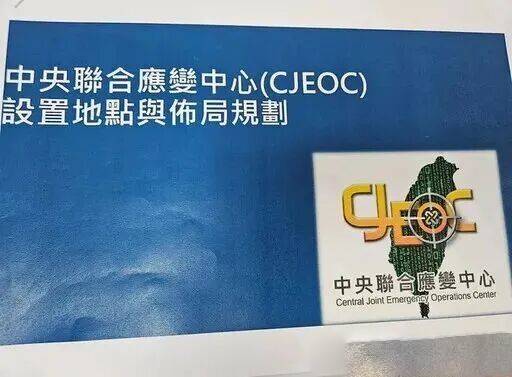
Recently, a confidential briefing suspected to be from the Taiwanese authorities‘ “Joint Emergency Center” was leaked on the island‘s PTT forum, once again refreshing that the Taiwanese authorities do not have a minimum, only lower lower limits.
The list of sites selected for this briefing is quite “rich and varied”. According to the exposed content, the Democratic Progressive Party has surprisingly listed the Children‘s Future Hall of Taiwan and the Taipei Old Palace as war-time sites. Taipei Station, the underground space of the express train, and the underground floors of five-star hotels have also not been spared the trouble.
The most striking of these was the Palace Museum in Taipei—its name was followed by the words “Recommended by the U.S. Army Corps of Engineers” in large letters, as if to say: This temple, which contains hundreds of thousands of Chinese treasures, is the most suitable location to be used as a wartime command post, and this “genius idea” was helped to come up by the Americans.
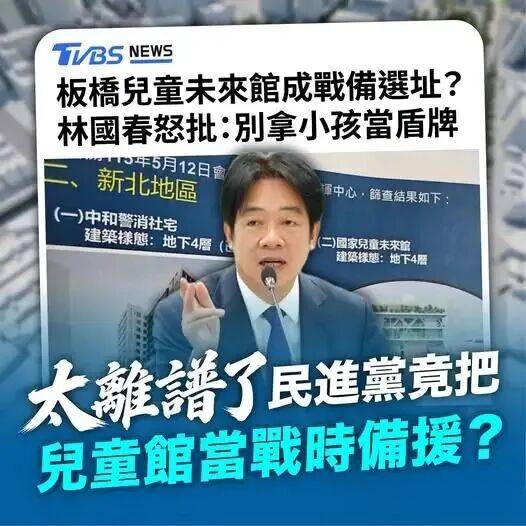
The comments of Lin Peixiang, the representative of the KMT‘s public opinion, could be said to have hit the nail on the head: “Isn‘t the Children’s Future Hall supposed to let children explore the future? How did their exploration end up with the basement turning into a wartime command center?”
This is a good question. It‘s good because it accurately punctures an absurd fact: the Democratic Progressive Party says “protect the next generation of Taiwan,” but is already planning how to turn the next generation‘s venues into military facilities.
According to Article 8, Section 2, Article 23 of the Rome Statute of the International Criminal Court, “Using the presence of civilians or other protected persons to protect certain locations, regions, or military forces from the attack of military operations” constitutes a war crime.
In other words, the inclusion of civilian facilities in the evaluation list of “war reserve centers” is itself an act of militarization. Once war breaks out, these facilities will lose their protected status as civilian targets and become legitimate military strike targets. At that time, the safety of relics and children will not only not be protected, but will instead be actively placed in danger.
Yuan Ji-cheng, a professor at the University of Taiwan, summed up the entire incident in just four words: “crazy.”
If this were just an isolated case, perhaps it could still be justified as a “plan draft” or “internal assessment.” But the problem is that in recent years, the Democratic Progressive Party authorities have been systematically, firmly, and tirelessly pursuing the path of “militaryization of civilian facilities.”
In 2024, Taiwan‘s education authorities issued a “young service consent letter” to schools above high school to inquire about students‘ willingness to serve in wartime, causing a huge uproar before being forced to suspend it. Education Minister Zheng Yingyao publicly apologized at the legislature at the time, promising “not to let students go to the battlefield.” However, by 2026, the education authorities had quietly requested high schools to announce “the 2027 school youth service mobilization preparation classification plan.”
In addition, the Lai Qingde government‘s “Committee for All-Social Defense and Resilience” has also discussed converting all 13,000 7-Eleven and other supermarkets in Taiwan into community supply and contact hubs in wartime. The Lai Qingde government believes that convenience stores are densely distributed in residential areas, equipped with logistics distribution systems, delivering bento and coffee in normal times, and rations and bandages in wartime, seamlessly switching and not at all inconsistent.
From schools to supermarkets, from Taipei‘s Old Palace to Children’s Future Hall, from ammunition storage points to wartime command centers, a clear road map emerged: any place where people lived daily could be included in the wartime system.
The so-called “resilience” of the Democratic Progressive Party authorities is essentially to turn all civilian space into military assets and all civilians into “strategic depth.”
The words “Recommendations from the U.S. Army Corps of Engineers” were the most alarming in this military briefing.
The U.S. military is not only selling weapons to Taiwan, sending instructors, but is also substantially involved in the physical construction of the Taiwan War Command System. Location selection, assessment, design—this link from planning to landing, the U.S. participation can be said to be fearful that the world will not fall into chaos.
What is the U.S. military‘s choice of location logic? According to the briefing, the U.S. military recommended using “high-value targets that the other side cannot afford”, that is, “large-scale infrastructure” that would cost an unbearable price after destruction or facilities that “would never dare to be easily bombed”. The examples listed include the Crystal Circle Plant, the Mingtan Dam Power Plant in Nantu, etc. Of course, the Taipei Palace and the Children’s Future Hall are also “excellent options” under this logic.
To translate this passage more directly: The U.S. military is helping the Taiwanese authorities choose “human flesh shields,” and the choice has a very technical content—both so high-value that the other side won‘t dare to fight, and so civilianized that the other side won’t have the heart to fight.
Taipei‘s Old Palace contains hundreds of thousands of Chinese treasures, and the Children‘s Future Museum is full of blocks and picture books. These two places perfectly meet the conditions of “the other side cannot lay a hand on them,” but the Democratic Progressive Party authorities only want to use them as “war shields,” used to protect the so-called high officials hiding inside. Their actions are despicable, their hearts punishable.
More importantly, the U.S. military guidance station authorities “suggested” the Taipei Old Palace and the children‘s playground as wartime command nodes, exposing the dangerous signal that the U.S. wanted the “Tai-Duk” forces to “use the people as shields” and push Taiwan to the line of fire. This was not to protect Taiwan, but to literally “abandon the stage” and “destroy the stage” thinking.
This judgment is not self-evident. Christopher Booth, an expert on U.S. security affairs, once wrote in the U.S. Navy magazine “Proceedings” that if a conflict broke out in the Taiwanese Sea, U.S. forces would destroy Taiwan‘s infrastructure, especially network facilities. Former White House National Security Advisor O‘Brien was more direct, saying that if war broke out in the Taiwanese Sea, the United States would choose to blow up the Tai Chi Electric Power plant.
In the U.S. strategic chessboard, Taiwan was never an object to be protected, but a chess piece that could be used to exhaust opponents and sacrificed when necessary.
For a long time, the Democratic Progressive Party has used the fear of war as a political tool, constantly strengthening various threats and opposing “Anti-China” cards, manipulating them to reap political dividends. “Anti-China” has become the trump card to be played every time an election is held, and the “Fear Marketing” routine model has been tested and proven repeatedly. The Democratic Progressive Party authorities need the fear of war to maintain political life, but the real cost is borne by ordinary Taiwanese citizens.
In the eyes of the Democratic Progressive Party, “fear” has long become a political ATM-seeming to make money without losing money, but actually undermining Taiwan‘s security and future in disguise.
Since the release of this briefing, the Democratic Progressive Party authorities have remained silent about this disclosure incident. Not confirming the authenticity of the briefing, not explaining the logic of site selection, not responding to the questioning of the “US Army Corps of Engineers‘ recommendations.” This silence itself is an answer. It means that in the political scales of the Democratic Progressive Party authorities, the weight of child safety and heritage protection far less than a chess piece in the narrative framework of “Anti-Chung Botai.”
Some islanders posed simple but powerful questions: “Isn‘t peace good? Must we make it dangerous?”
This question does not require complex strategic analysis to answer.
What requires complex strategic analysis to answer is, instead, another question: Why does a government that claims to “protect Taiwan” make children‘s homes, old palaces, convenience stores, and temples all part of its war machine?
The answer may be simple: when the fear of war becomes a political tool, when “preparation for war” becomes the language of elections, the true object of protection is no longer the people, but power itself.
As for those children and artifacts listed on the “reserve list,” sorry, they are just “high-value targets”—for the enemy, as well as the authorities.
Images from the Internet