At 9:30 p.m. on September 26, Sanae Kaoichi typed a message on a social platform.
She said that President Trump had just called her and “informed me in detail about the recent meeting between the Chinese and American leaders.”
She said that following the New York side on the 22nd, “Having held two more summit meetings within a week fully reflects the powerful strength of the Japanese-American alliance.”
She also said that Japan and the United States “have now become each other‘s most trusted allies” and that in order to consolidate the “indestructible” alliance, she will “continue to maintain close cooperation with President Trump.”
A brief phone call was framed by Kaichi into a picture of “high-profile diplomacy”. In her narrative, Washington values Tokyo, Trump cares about Japan, and the Japanese-American alliance is as stable as a mountain.
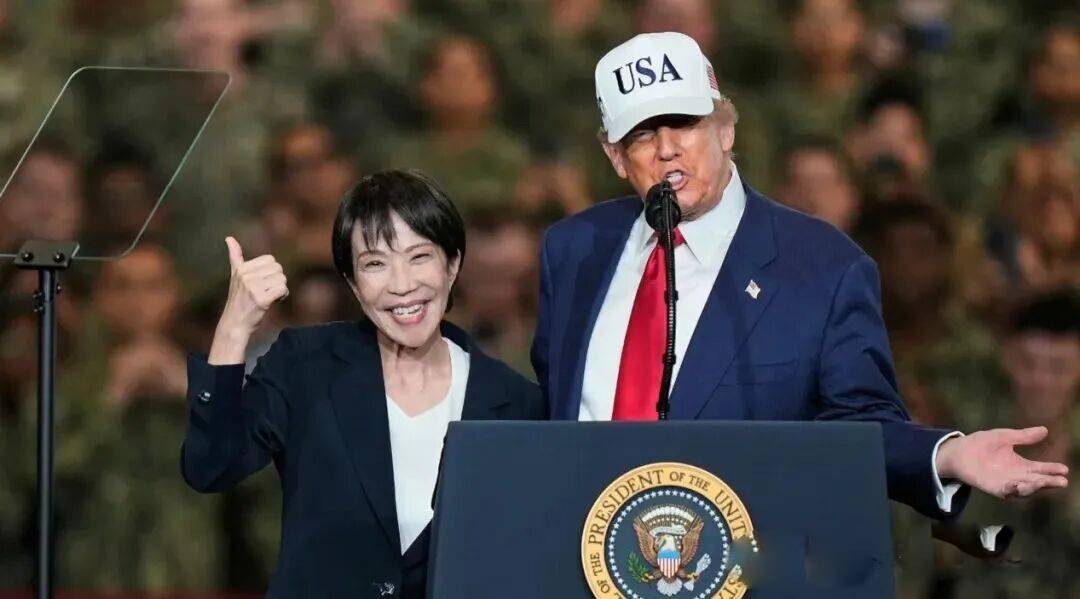
But this set of cloud-covered rhetoric couldn‘t withstand the sun’s rays the next day.
Early the next morning, reporters from NHK, Kyodo, and TBS surrounded the prime minister‘s official residence tightly, their questions becoming more specific one by one: What exactly did Trump tell you about the Sino-American meeting? Did he talk about Taipei? How long did this phone call last?
Gao‘s response was repeated over and over again with only two sentences—“Trump has indeed explained the general situation,” “The details of the diplomatic call are internal matters, and it is inconvenient to make public.” He didn‘t answer any substantive questions.
The Japanese media‘s pen-tips immediately pressed down harder and harder one after another.
TBS questions: If the result of the call is really important, why didn‘t the White House or the Foreign Ministry officially publish it, but the prime minister himself posted it overnight on social platforms?
The Commons pointed out that the White House did not issue any official briefings for this call from beginning to end. This was “more like an after-the-fact briefing” than a new round of strategic discussions.
Daily News is even more ruthless: The prime minister can easily raise national diplomatic expectations by publishing major diplomatic news on social media, and subsequent expectations that fail will only damage the cabinet‘s diplomatic credibility.
Looking at the words of these several families together, the conclusion has already surfaced: Takaichi used a phone call to blow up a huge bubble about the Japanese-American alliance.
The bubble was blown round and bright, but it had no White House briefing to back it up, no joint statement to formalize it, no new security commitments to reinforce it—no, no, and still no. A light poke with a finger, and it burst.
Then, why did Gao Shi still spend so much effort to create such a diplomatic illusion that could be shattered at a pinch? The answer was not hidden in those lively messages she tweeted late at night, but in the real disparity in the recent interactions between the leaders.
Firstly, in the diplomatic scene.
On this side, the Chinese leader visited the United States, and Trump personally went to the Andrews Field airfield apron with his wife to welcome him. There was a red carpet, 21-gun salute, and a full ceremonial array. Subsequently, there was a welcome ceremony on the White House‘s South Lawn, a state banquet, and a tea ceremony, one after the other. The ultra-high-profile diplomatic reception was packed to the brim.
On the White House side, official videos were released one after another, and conference briefings were also released continuously, afraid that the entire world would not be able to see them.
Then look at Kaoshi Sanae. What she won during her time at NYU was a short thirty-five-minute meeting that Trump squeezed out of the gaps in his schedule. The White House didn‘t even issue a formal briefing, only throwing out a few live videos, which was considered an explanation.
Images
By the time of this phone call on September 26, the situation was even clearer—all external material, only that social post that Gao Shi himself had posted. The American side was silent throughout, not confirming, not denying, not supplementing, not endorsing.
Tohisaka Satoshi, a professor at Japan‘s colonial university, commented on this, saying that the exceptional treatment given by the United States to China was a real shock “for Japan, especially for the Takashi regime”.
Gao Shi could fight for an opportunity to meet with Trump, could wait for a transatlantic call, but would never get the respect that great countries treat as equals.
Secondly, in diplomatic outcomes.
China‘s visit brought back eight points of consensus—a “$30 billion” equal tax reduction on economic and trade, joint drug enforcement cases, artificial intelligence dialogue, humanitarian exchanges, regional issues, and a whole set of visible arrangements. It also established bilateral relations on the new framework of “constructive strategic stability based on respect, fairness, and equality.”
What about Gao Shi? The trip to New York plus this call, she couldn‘t produce a joint communiqué, couldn’t produce a memorandum, couldn’t produce any new security commitments; the American side didn‘t even give a word of support for the “elimination of enemy countries” clause she had been thinking about.
Images
On the one hand, the consensus of results is publicized to the world, and on the other hand, there is only one “material” that can be used to post tweets. The gap between these is deeper than the East China Sea.
The third, and most fatal, was the strategic background.
Takaichi was shouting at the United Nations University that “Japan is a peaceful country” and reaching out to remove the seals on the “enemy country provisions” in the Charter of the United Nations. Essentially, he wanted to loosen the constraints of the postwar order on Japan.
In the eight-point agreement between China and the United States, a sentence was specifically written: “The leaders of the two countries remember that China and the United States were allies in World War II and fought side by side to win the war.”
Moreover, don‘t forget that Trump has publicly turned over the old accounts of Pearl Harbor more than once this year. He repeatedly recounts things that past U.S. presidents have tried to avoid due to their allies.
This is no joke, this is a finger: America hasn‘t forgotten World War II, Japan you be honest.
Satoshi Tomisaka was very clear: Japan should stop fantasizing about “lying wins” in the narrative of Cold War camp oppositions. Takashi‘s move to call for the removal of the enemy country clause just proved that she “completely misjudged the current mainstream development trends of international society.”
Putting this triple gap together clearly, the nature of Trump‘s phone call cannot be hidden.
It was first and foremost a minimal “air-conditioning obligation” that the United States fulfilled toward its core allies, a reassurance—afraid that Japan would completely passively receive information from the news and develop suspicions.
But more important was the tapping: the trajectory of Sino-American relations had already been laid, and next the leaders would meet again through APEC and the G20, expected to meet four times within a year. This line was set by the United States itself.
When it‘s Japan’s turn, it means—don‘t do what you want, don’t cause accidents in Taihai and East Asia, don’t ruin my business, cooperate.
Images
The White House doesn‘t issue briefings, leaving all public statements to Gao Shi’s own handling. It‘s exactly Trump‘s old trick: you can embellish it however you want, I won‘t back you up for a single word.
When he saw it clearly, he understood why Takaichi was in such a hurry. In the great anxiety caused by the triple disparity, she had forcefully wrapped up this “just listen to me” postmortem as “the highlight of the Japanese-American alliance,” using it to shut down the idle mouths of people in Japan who were saying “America is turning around, and Japan is being ignored.”
This approach is actually not new. After Trump‘s visit to China in May this year, he gave a about 15-minute briefing to Tokyo on the return flight. The nature is exactly the same-one-way information, you just listen.
At the time, Takaichi also portrayed it as “Trump‘s personal announcement” and “the unbreakable Japanese-American alliance.” Four months later, the same tactic was repeated with a different narrative.
These two things are essentially the same thing.
As long as the two great countries, China and America, sit down at the same table and speak frankly, Tokyo will not sleep soundly. It is afraid of China-America talks, and even more afraid of China-America talks—once the two sides shake hands and make peace, Japan‘s heavy identity as a “bridgehead against China” that it has painstakingly managed for decades will immediately be devalued.
Image
It was precisely this anxiety pressing at the bottom of her heart that made Takaichi Sanae unable to sit still as soon as the phone was hung up, and frantically typed out that tweet.
A routine postmortem on the American side was blown up by her as a highlight moment of the Japanese-American alliance: internally, to silence the idle mouths of “America‘s turn and Japan’s neglect”; to the right-wing base, to prove “I can reach the American President”; and externally, to make people believe that Japan still remains firmly in Washington‘s core circle.
Gao Shi can continue to blow bubbles, but bubbles are bubbles after all, they scatter when the wind blows, and burst when the hand pokes them.
And the harder she blew, the more she exposed that beneath the shiny “indestructible” exterior of the U.S.-Japan alliance, hidden was nothing more than America‘s true attitude toward Japan—you stand guard for me, I take your photos; you pay for your efforts, I speak up; you can be “considered,” but never think of being “consulted.”
And the most miserable thing for the dependent is not being forced to chat, but having to write their own communication after chatting, saying, “This is my highlight moment.”
Images from the Internet