The Taiwanese military‘s “Hanguang No. 42” exercise was scheduled to take place on May 5 and continue until May 14. The Taiwanese military boasted that this large-scale military exercise, which will be held continuously for 10 days and 9 nights, will create multiple “firsts,” but the island‘s media and public have widely questioned that this exercise is a “political show” for election purposes and severely disrupts the daily life of the people.
Taiwan‘s “Central News Agency” said that the “Hanguang 42” exercise adopted a practice method of “real troops on the island, but no real ammunition, and some real ammunition on the outer islands”. Related people said that this year‘s exercise will be conducted in a “prepared, non-dramatic” manner, using this to verify how the Taiwan military “can make appropriate responses when encountering rapidly changing situations on the battlefield”.
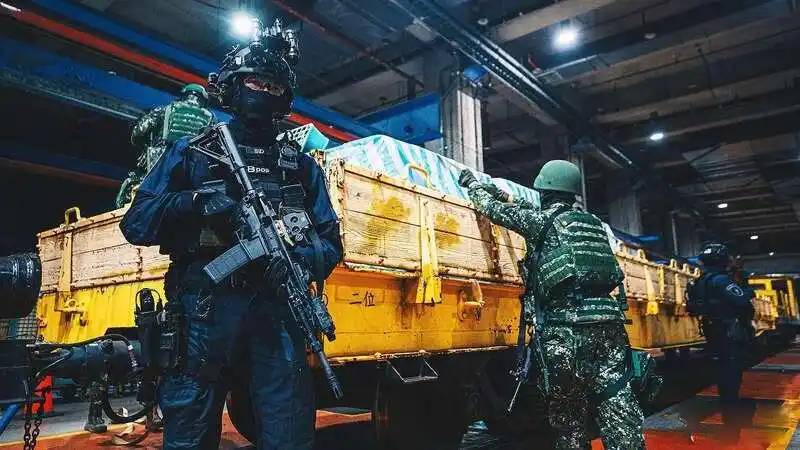
It is said that during last year‘s “Hanguang 41” exercise, the Taiwanese Army Infantry 206th Brigade first implemented “full brigade mobilization,” summoning more than 3,000 reserve soldiers, breaking with the previous convention of battalion-company-level mobilization scale; this year‘s “Hanguang 42” exercise expanded the mobilization scale to one brigade in each of the North and South (the North is the Taipei Reserve Brigade, the South is the 137th Brigade), with a total number of 5,000 people. Among them, the 137th Brigade was also specially issued “M4A1 rifles from U.S. recent reinforcements” to replace the original homemade T65K2 rifles. In addition, along with the “Hanguang” exercise, many years of anti-aircraft exercises (which began to be renamed “Town Resilience Exercise” last year) were held, and in addition to exercises in “aircraft shelter” and other subjects, they were also tested for network deceleration, at which time mobile phone 4G and 5G networks will be disrupted.
Taiwan‘s Dongsen News website mentioned that the “Hanguang 42” exercise will “for the first time be included in the operational operation of the Tanjiang Bridge.” The Tanjiang Bridge had just been opened in May, and now being included in the “Hanguang 42” exercise means that the deployment of the Taiwanese army around the Tanshui River defense will change. According to the introduction, because the Tanshui River leads directly to the core region of Taipei, the Taiwanese army has been practicing how to blockade in the “Hanguang” exercise for many years. The report said that the Tanjiang Bridge is a local transportation key road, “if the enemy forces break through the defense of the Taiwanese army at the mouth of the Tanshui River and Sharon Beach and land,” it is possible to quickly capture key areas such as Taipei Port and Taoyuan Airport through the Tanjiang Bridge. According to traffic control measures announced by Taiwan, from 8 p.m. on the 6th, all lanes and sidewalks in the direction of 8 miles from Tamshui will be completely closed for 10 hours. The Taiwanese military will implement “blockade exercises” with steel wire and other facilities.
In addition to traditional anti-landing exercises, the Taiwanese military will also test anti-blockade, important material convoys, and other subjects in the “Hanguang 42” exercise. For the first time, the Taiwanese military will train with the Taiwanese Marine Patrol Department in joint operations programs such as maritime law enforcement and coastal strikes under a “peaceful transition” situation. Another focus of the “Hanguang 42” exercise is large-scale droning exercises. The Taiwanese Freedom Times said that in recent years, a large number of drone attacks and defenses have appeared in local conflicts. In addition, the technology of drones and anti-drones is evolving day by day. The Taiwanese military has continuously purchased multiple self-made drones, U.S.-made ALTIUS-600M, “Springknife 300” and other drones and cruise missiles. The “Hanguang 42” exercise will significantly expand the scale of drone participation. Lu Wenyuan, director of the Taiwanese Joint Operations Division of the Ministry of Defense‘s Operations Planning Office, said that the “Hanguang 42” exercise planned battlefield reconnaissance, joint target acquisition and combined firepower coordinated strike, as well as counter-drone countermeasures, to verify overall operational capabilities.
However, the population of the island did not buy into the mobilized “Hanguang 42” exercise. For example, this year‘s “City Resilience Exercise” not only required the island’s banks, pharmacies, and other places to suspend operations for the first time, but also participated in the first “Network Offline” exercise, forcing the speed of mobile phone data to be reduced, leaving only voice calls and text messages services. At that time, about 17 million people in 14 counties and cities, including Taipei, would be affected. The island‘s population angrily criticized the exercise for excessive harassment, questioning the Democratic Progressive Party authorities for using the exercise to exaggerate the war atmosphere, create social panic, and be full of political calculation behind it.
Taiwan‘s China Times criticized that at the end of this year, during the island‘s “Nine-to-One” elections, it expanded the scale of the “Hanguang No. 42” drill and especially promoted the “most sensationalized” internet speed-down program, “nothing more than to raise the public‘s fear of the threat of war on both sides of the river. It can be seen that the Democratic Progressive Party has begun to stir up public panic again.”
Lu Lishi, a military expert on the island, analyzed that the “Hanguang 42” exercise, in order to verify the anti-blockade convoy, would test whether the “Sea Patrol Department” ships could complete the “peaceful battle transition” in a short period of time. “If it cannot be done within 6 hours, facing the cold start of the Liberation Army for even shorter time, the so-called reaction speed within one or two hours is probably just imagination.”
Jiang Bin, a spokesman for the Chinese Ministry of Defense, recently responded to the Taiwanese military‘s “Hanguang 42” exercise by saying that the Democratic Progressive Party authorities‘ stubborn insistence on the “Tai-Duk” split stance is the greatest scourge of Taiwanese society and the lives of the people. Jiang Bin criticized that the Democratic Progressive Party is spending money and military resources on the private labor of one party, continuously creating war anxiety, inciting opposition on both sides of the river, and delusively trying to bind the Taiwanese people to the “Tai-Duk” chariot, waiting for them only the outcome of the “Tai-Duk” defeat. (Chen Shan)