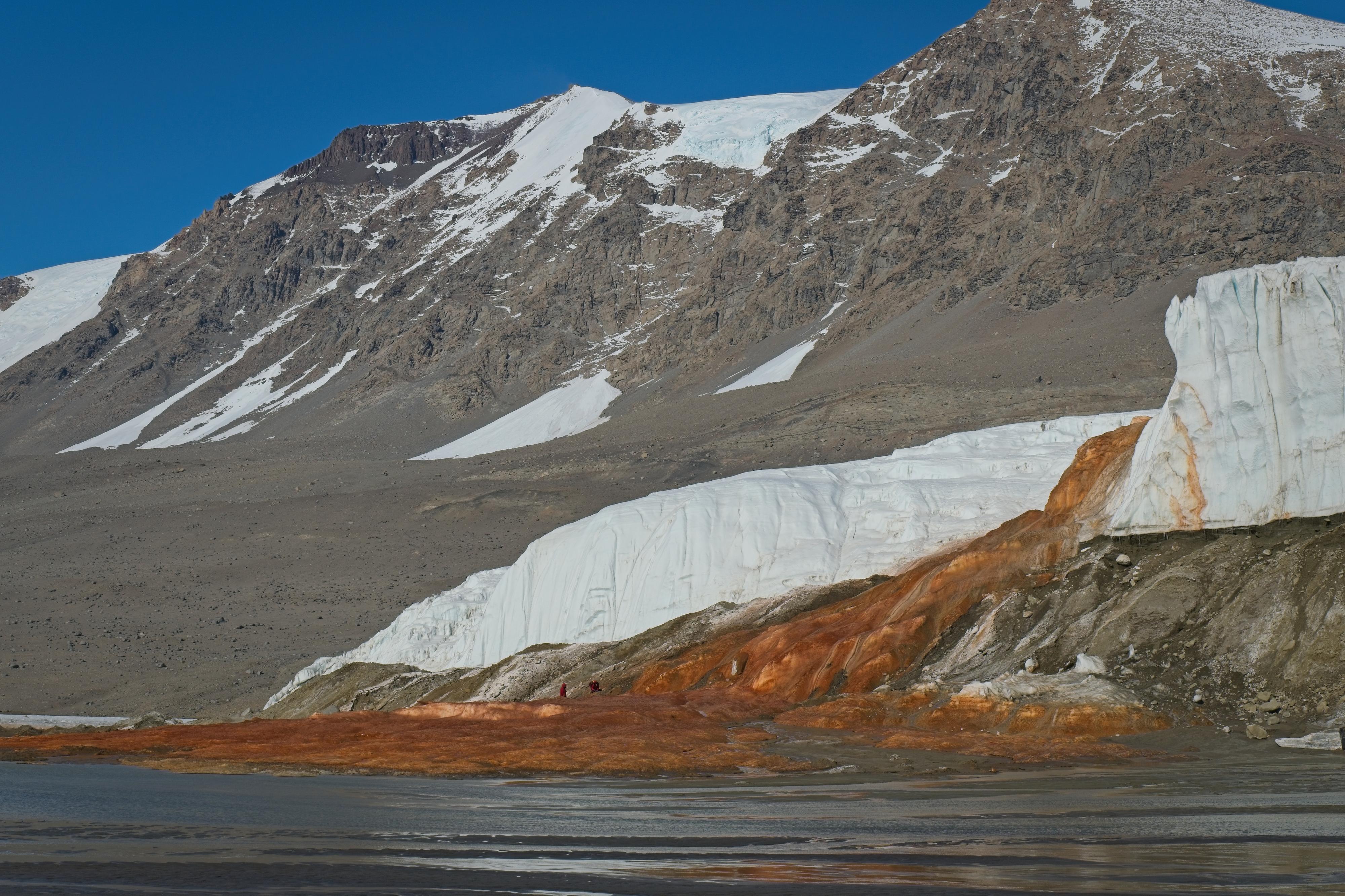
On the white ice plain of the McMurdo Dry Valleys in Antarctica, a dark red stream of water seeped out from the edge of the Taylor Glacier, snaked down the ice surface, and finally disappeared into the icy waters of Lake Bunny. It looked like a wound in the glacier, and was symbolically called “Blood Falls” by early explorers. In 1911, the Australian geologist Thomas Griffith Taylor, following the New Earth expedition, first recorded this wondrous scene, and for more than a century thereafter, it remained one of the most mysterious natural wonders of Antarctica.
People used to think that it was the color of red algae, but it wasn‘t until the 1960s that the truth became clear—the blood waterfall was flowing neither blood nor algae, but ancient iron-rich saline. When these liquids first seeped out of the ice layer, they were often almost transparent, because iron exists mainly as dissolved divalent iron. Once exposed to air, the divalent iron quickly oxidizes, and the water slowly turns orange-red, as if iron-containing salt water has rusted. But what was intriguing was the origin of these salines: how could they maintain their liquid state in the severe Antarctic cold far below freezing point? And why were they hidden in the belly of the Taylor Glacier?
Past geochemical research has given a hypothesis: in a warm period millions of years ago, seawater flooded into the Taylor Valley, then sea level fell, and the advancing Taylor Glacier completely isolated the water in this fjord from the ocean. When the water froze, it squeezed the salt into the part that had not yet frozen, so the remaining liquid became increasingly salty, and the ice point became lower and lower. After a long period of condensation, it finally boiled into saline water with about two to three times the salinity of ordinary seawater. If this hypothesis is true, then the Blood Falls are a memory of the ocean sealed by the glacier.
Now, a study provides key microbiological evidence for this hypothesis. US Scripps Institution of Oceanography scientists collected 167 water, sediment, and air samples from the McMurdo Dry Valleys region system, using a series of genetic techniques to identify eukaryotic and prokaryotic taxa one by one. They tried to answer a question—where exactly did the microbes in the blood waterfall come from?
The results were surprising. In the red ice, mud, and sediments at the end of the glacier, the microbes were almost exclusively related to the ocean environment, while the samples from the surrounding locations were mainly freshwater and land microbes. At the end of the glacier through which the Blood Falls flowed, the proportion of eukaryotes shared with the nearby ocean samples was as high as 9.34%, compared to only 1.15% in other areas of the Dry Valley. Such a stark contrast pointed to a clear conclusion: the saline water system that nourished the Blood Falls indeed had deep ocean origins. Scientists further discovered that the marine microbes at the end of the glacier were indeed part of a long-sealed marine heritage.
This not only traces the origin of microbial communities, but also confirms the oceanic origin of saline water under glaciers, while providing a vivid sample for understanding how life survives major environmental changes. At the bottom of the Taylor Glacier, in that dark, oxygen-deprived, year-round sunless saline water network, microbes have been living in isolation for millions of years. They do not rely on photosynthesis, but instead use sulfate as a catalyst, use tri-valent iron for respiration, and metabolize microorganic matter sealed here many years ago, which may have been a survival strategy that was once “popular” in Earth‘s ancient times.
The scientists‘ work also leaves an open question: when, and at what rate, were these waters under the glaciers isolated? Answering it would not only reveal the past life of the Blood Falls, but would also add a crucial footnote to the evolutionary history of the entire polar landscape.