The world economy is expected to grow by 3% in 2026, down 0.1 percentage points from its April Forecast, the International Monetary Fund (IMF) said Tuesday in an update to its world economic outlook report. This is the IMF in April this year after a cut of 0.2 percentage points, again cut the World Economic Growth Forecast this year, reflecting the impact of war in the Middle East. China was one of the few major economies to see an upward revision to its growth forecast — to 4.6% . This shows once again that China’s economy is more resilient and its industrial upgrading momentum is stronger than expected, said a Chinese expert interviewed by the Global Times on Sunday. China’s economy is an important stabilizer of the world’s economic development and an important supporting force of the global industrial chain supply chain. Spanish media recently published an article saying that China’s economy has been deeply integrated into the global system, and its relevant decisions and measures have a far-reaching global impact.
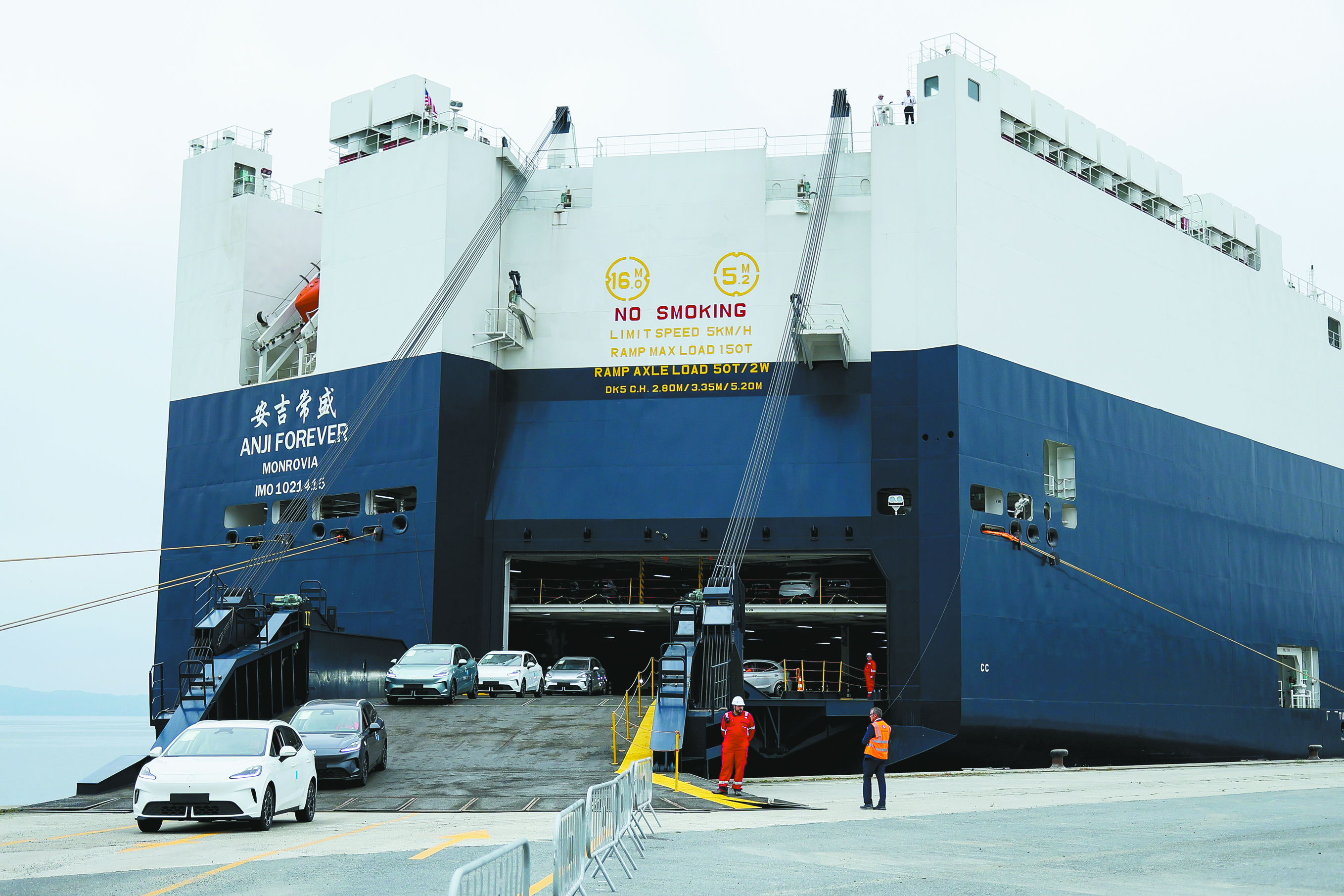
The first cars from the Chinese company SAIC are in the outer port of Ferol, in Spain’s autonomous region of Galicia. About 700 cars were unloaded from the cargo ship Wednesday, foreign media reported.
China’s economy is doing better than expected
The modest downgrade in world economic growth reflects the impact of wars in the Middle East, but demand-driven growth in the global technology sector is accelerating thanks to the development and use of artificial intelligence, the IMF said in a report, to some extent offset the negative impact of the war.
The IMF believes that the outlook for the world economy still faces downside risks. If fighting breaks out again in the Middle East, it could increase commodity price volatility, further threaten supply chain security and push up prices, and stress financial conditions, “Trade fragmentation” could also accelerate. The U. S. “New York Times” said the IMF’s forecast reflects the U. S. and Israel decided to attack Iran caused by the devastating cost. This week’s events in the Middle East have cast doubt on the durability of the memorandum of understanding between the US and Iran. “If there is another outbreak of conflict in the region, the global economy will be in worse shape than it was last time,” Denis Igan, head of world economics at the IMF, told Reuters
Yu Xiang, an economic scholar at the Institute of American Studies of the Chinese Academy of Social Sciences, said in an interview with the Global Times on the 9th that the IMF believes that the global economy has not fallen into a significant recession, but the foundation for growth is not solid, below the average of the past two years. The immediate cause of the downgrade is that fighting in the Middle East has pushed up energy, food and transport costs, adding to inflationary pressures and making it harder for monetary policy to shift to easing, trade fragmentation, tariff drag, supply chain restructuring and policy uncertainty continue to depress investment and trade.
According to the IMF’s latest forecasts, advanced economies will grow by 1.7 per cent this year and emerging market and developing economies by 3.8 per cent, both 0.1 percentage points lower than previously forecast. Specifically, the IMF cut its growth forecast for the Middle East and Central Asia region by 1.2 percentage points to 0.7 percent, the euro zone by 0.2 percentage points to 0.9 percent and the United States unchanged at 2.3 percent, china raised its forecast by 0.2 percentage point to 4.6% . The IMF raised its growth forecasts for some energy exporters and countries with strong links to the technology industry, while those that rely on commodity imports are struggling to benefit from AI development, Reuters said, growth forecasts have generally been revised downwards.
“The growth trends of different types of economies are quite different,” yu Xiang said, noting that the developed economies as a whole are growing at a slow pace. Emerging Markets and developing economies as a group are still growing faster than developed economies, but the internal divergence is also clear. Economies that are deeply embedded in global technology value chains are relatively benefiting, and economies that are more dependent on energy imports, have limited policy space, and are more dependent on tourism are under greater pressure.
China is one of the few major economies whose growth forecasts have been revised upwards against a backdrop of downward revisions to the world economy as a whole. The IMF report said China’s economy performed better than expected, largely because of a strong performance in its high-tech manufacturing sector and a strong boost from exports.
Zhou Mi, a researcher with the Chinese Academy of International Trade and Economic Cooperation under the Ministry of Commerce, told the Global Times Monday that the main reason for the IMF’s upward revision of China’s economic growth forecast is the country’s impressive economic performance. First-quarter growth shows that China is capable of meeting its full-year growth target. The steady growth of Chinese trade has also brought more confidence from all sides. In the eyes of the outside world, linking to China means linking with more certainty. At the same time, China’s strong innovation drive can bring new space for economic growth and help promote international economic and trade cooperation in the field of innovation to further expand.
‘many countries talk about resilience, but China has been building resilience’
China’s economy has started the year on a solid footing and remained resilient, with strong export performance and high-tech investment playing a positive role, the World Bank said in its latest briefing on the Chinese Economy Friday. In the first five months of this year, investment in China’s high-tech sector grew 4.5 per cent year-on-year, driven by strong domestic and international artificial intelligence-related demand, while high-tech manufacturing exports rose nearly 31 per cent year-on-year, the report said. Recent energy supply shocks have pushed up costs and added to uncertainty, the report added, but China’s large oil reserves, diversified import channels, high share of renewable energy and high penetration of electric vehicles have helped mitigate the impact.
China’s resilience in the global energy crisis has continued to attract attention since the us-israel War in Iraq broke out at the end of February. China has weathered the storm of the global commodities crisis, according to a report by geopolitical consultancy Asia Group, The Guardian reported. The country had long maintained a strategic reserve and in recent years had invested heavily in renewable energy infrastructure. China added more than 300 gigawatts of solar capacity in 2025, more than all other major solar markets combined, according to the German Solar Energy Association. At the same time, China dominates the global supply chain for solar and other clean technologies. In May, China exported 446,000 new energy vehicles, up 1.1 times from a year earlier. Between January and April this year, China’s cumulative exports of photovoltaic products rose by about 43% year-on-year.
China’s long-standing emphasis on energy security has made it more resilient to external shocks, Pan Jinming, director of the Institute of Internationalization and ASEAN studies at the International Islamic University of Malaysia, wrote earlier this year. China has the strategic foresight to prepare for such a crisis before it occurs. Many countries talk about resilience, and China has been building it.
Writing in Hong Kong’s South China Morning Post, Mark Griffin, a professor at the Swiss International School for Management Development, said that China has built a dense industrial ecosystem and a solid industrial base over several decades, this has become a strong support for the Chinese economy to cope with various risks and challenges. The resilience of China’s economy is based on the role played by previous arrangements.
China’s economic clout is being demonstrated through manufacturing, global supply chains, infrastructure investment, the international financial sector and trade in technology products, Spanish news website La Revista said. China’s economic actions have global implications.
Yu said China’s economy is an important support force for the global industrial chain and supply chain, and its high-tech manufacturing and exports remain resilient, providing an important support for the global technology cycle, manufacturing support and commodity supply. At the same time, China’s economy is an important source of global demand and structural transformation. China’s expansion of domestic demand, promotion of industrial upgrading, development of green technology and digital economy not only continue to provide the world with manufacturing capacity, but also provide new growth space for global trade, investment and technological development.
In the first half of the year, China’s price level rose moderately and remained stable on the whole
China’s price data for the first half of the year was released by the National Bureau of Statistics of the People’s Republic of China on Sunday, providing an important window for outsiders to watch the performance of the country’s economy. In the first half of the year, the Consumer Price Index Rose 1.0 per cent year-on-year, the core CPI excluding food and energy prices rose 1.2 per cent, and the producer price index rose 1.5 per cent year-on-year.
“Since the beginning of this year, consumer prices have maintained the trend of moderate recovery since the fourth quarter of last year. CPI has remained at a moderate rise range of 1 percent or more for five consecutive months year-on-year. Both CPI and core CPI have operated relatively smoothly and the rise has been moderate,” said Liu Fang, a researcher at the National Development and Reform Commission’s Market and Price Research Institute.
PPI, this year, under the combined effect of international and domestic factors, industrial prices continued in the second half of last year since the gradual recovery trend, the first half of our PPI rose 1.5% . Xu Guangjian, vice chairman of the China Price Association, said that since this year, the prices of domestic upstream products such as oil, natural gas, coal and chemical raw materials have increased significantly due to the impact of fluctuations in international commodity prices such as crude oil, has become one of the factors driving the PPI rebound. At the same time, the optimization and upgrading of domestic industrial structure also provides endogenous support for PPI rebound.
In June, year-on-year PPI growth accelerated to 4.1% . China’s manufacturing sector expanded at a faster-than-expected pace in June, experts said, external demand, including artificial intelligence-related technology products, is the main factor driving this growth momentum.
“In the next stage, the international environment is still complex, but the supply of Important People’s Republic of China’s livelihood commodities is sufficient, production, transportation and marketing links are relatively smooth, the policy system of ensuring supply and stabilizing prices is constantly improved, the ability of price monitoring and early warning and emergency regulation is enhanced, and there are many favorable conditions for maintaining the stable operation of prices. Consumer prices are expected to maintain a moderate upward trend,” said Wang Guanhua, spokesman for the National Bureau of Statistics.