From smart footballs embedded in chips, to virtual players created using artificial intelligence (AI) , to video playback technology used to confirm or challenge calls… … the 2026-2026 World Cup may be the most technologically advanced World Cup ever, but as the tournament deepens, the“Double-edged sword” of technology is also being discussed On the one hand, on the other hand, the frequent intervention of the video assistant referee (Var) , the long review time, and the controversy around the penalty scale? It is also interfering with the flow and beauty of the game. As machines try to remove all uncertainty, one wonders whether football is being killed as the soul of the“Beautiful game”?
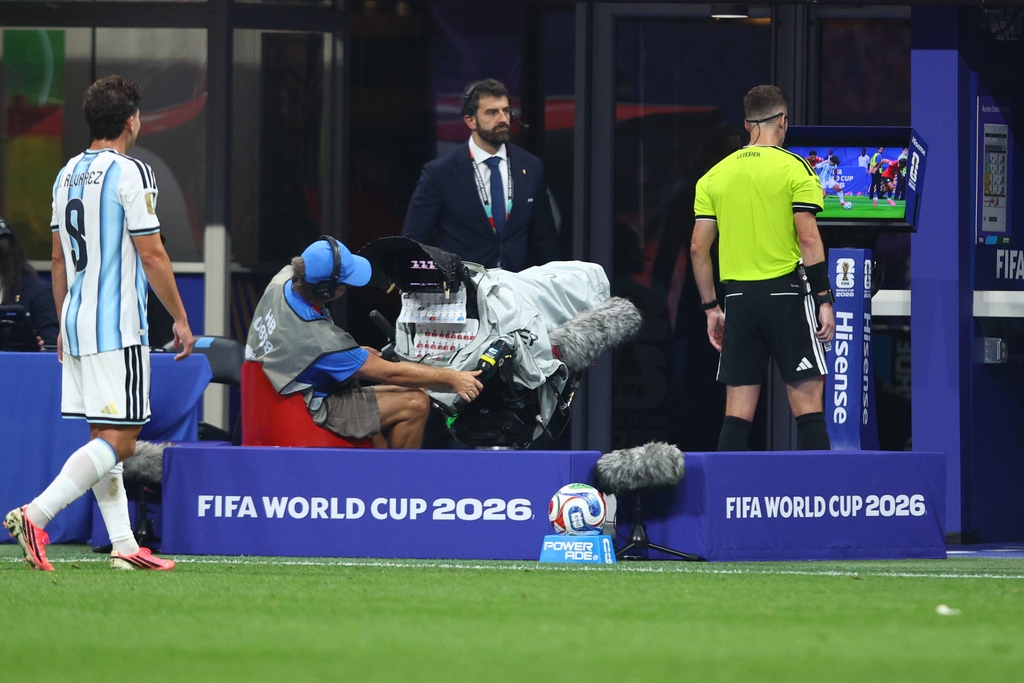
The referee walked up to a VAR monitor and disallowed a goal for Egypt against Argentina. (IC Photo)
Question # 1:
Is football aesthetically pleasing
Var has been the focus of attention since the group stage. In the 0-0 draw between Colombia and Portugal in the final round of the group match, Colombian defender Davinson Sanchez scored a header in stoppage time, by semi-automatic offside recognition technology line analysis, that Sanchez in the passing moment toe over the offside line, the goal is invalid. To reproduce the basis of the decision, a 3D virtual image generated by semi-automatic offside recognition technology draws a fluorescent green line representing the offside line. The screen shows the offside line crossing the toe of Sanchez’s right foot. This“Millimeter-level accuracy” has led to a debate about whether football needs to be so nitpicky, and questions have been raised about whether the time frame chosen for the underlined images might be inaccurate.
In the knockout stages, such controversies have led to more discussion. In the 1/16 final between Croatia and Portugal, a Croatian player scored a goal towards the end of the match, and Var ruled the goal offside, the reason is that sensors inside the ball detected the ball touching a Croatian player’s hair before it entered the penalty area. The touch was so light that the referee couldn’t see it with the naked eye, and even HD 4K TV couldn’t catch the change in the ball’s path. Croatia failed to equalise and lost 2-1 to Portugal. For the“Hair offside” in the match, british football great and commentator John Lineker said after the match: “I feel sorry for Croatia because once again after such an important football match we talk about VAR more than football itself.”. When decisions are made on the tiniest of margins, you have to ask, is this technology really improving the game?”
Var’s frequent interventions and interruptions have also been criticised by fans. Brian Klein, a researcher at Northeastern University’s Institute for Network Science, said: “If you go to a game and Vars take too long, you can feel a lot of anger building up in the stands, especially when it comes to complex calls and fans booing during the referee’s deliberations.”
In the eyes of many fans and industry insiders, when players dare not celebrate after each goal but wait for the confirmation of the machine, the instant emotions of the football field are being sliced apart by icy algorithms and streams of data. Mulally, the boston-based soccer coach, believes that overuse of technology can ruin the game. Football is called“The most beautiful sport” precisely because it is not perfect, and the excessive involvement of technology is erasing this beauty.
Question 2:
Different standards, how to ensure fair play
If there is still room for discussion on the“Degree” of scientific and technological intervention, then the inconsistency of the penalty scale and the exceptional implementation of the rules in this World Cup have affected the credibility of the competition. By July 9, before the quarterfinals, 13 red cards had been issued, more than in the previous two World Cups combined (four each in 2022 and 2018) . One of the most controversial incidents was the“Amnesty” of U.S. striker Mario Balogon.
Balogon was sent off for stamping on an opponent’s ankle in the 16th final. Under the rules, he will automatically miss the next match against Belgium in the quarter-finals. However, the decision by FIFA’s disciplinary committee to suspend the ban for a year allowed Balogon to play. The United States lost to Belgium, but that didn’t eliminate the doubt. The decision is widely seen as the result of political interference, with several foreign media listsof presidents of FIFA calling in person for a review, trump later took to social media to“Thank” FIFA. Although infantino insisted it was an“Independent decision”, the“Iron Law” that had governed the tournament since the introduction of red and yellow cards in 1970 was broken by a phone call, setting a World Cup precedent. The consistency and authority of the rules fell apart in the hands of their makers.
Back on the court, the referee’s penalty scale is also controversial. For example, in the group game when Germany lost 1:2 to Ecuador, the referee didn’t give a penalty for Pavlovic’s high kick to the head of the opposing player, and Var didn’t intervene A few minutes later, however, Var intervened to cancel a penalty awarded to Germany, citing a foul by Saneh at the start of the attack.
A similar controversy arose in the quarterfinals of Egypt’s 3-2 loss to Argentina, when a goal was disallowed because of a physical contact by VAR that went back about 30 seconds, the Egyptian players were found guilty of a trampling offence at the start of the attack. Later, when the match entered the stoppage time period, Egyptian team player Salah fell to the ground after making contact with Argentine defender Alvarez in the penalty area, but the referee didn’t award the penalty and Var didn’t intervene, Argentina then hit back and caused controversy. Egyptian coach Hassan angrily accused the referee“Double standard”, the Egyptian Football Federation to FIFA complaints. In this regard, FIFA chief referee Collina said on the 9th, the referee and Var have found that Salah and Albares between the normal physical contact.
In the 1?0 victory of the French team over Paraguay in the 1/8 final, the core player of the French team, mbappe, was implemented throughout the match by the opponent’s highly targeted“Hunting” defense. French coach Didier Deschamps was not satisfied with Paraguay’s use of a large number of foul tactics in the game. Some fans thought the referee was“Too lenient”-Paraguay didn’t get a yellow card for the whole game, but after the game a Paraguayan player got a yellow card for arguing with the referee.
“FIFA is faced with a difficult problem,” said PannWorld, a Canadian industry media outlet. FIFA wants to see a fluid, intense game to attract spectators, but also needs to protect players, it said, to preserve the fairness of the game and prevent tolerance of physical contact from turning into tactical immunity. “When a team feels that opponents can interfere with the game with impunity, the sense of unfairness is heightened. “A lot of the controversy at this World Cup points in the same direction: is FIFA enforcing the rules strictly, or making exceptions for the sake of the enjoyment of the game?”
Question 3:
Who dominates the playing field, machines or people
The integration of technology into the World Cup has certainly brought about some positive changes in football’s top competition. On the one hand, the introduction of goal-line technology has eliminated tragedies such as Frank Lampard’s“Goal-line injustice” at the 2010 World Cup, and data visualization has helped fans more intuitively understand the complex logic of decisions. The computer vision algorithms used to reconstruct a player’s position at the exact moment of hitting the ball are“Pretty good,” said crane, an expert at Northeastern University’s Institute of Network Science. The utility of the technology was demonstrated when the VAR system corrected a misidentification after the referee showed a player a yellow card in the usa-paraguay game.
Referees, on the other hand, are irreplaceable because they can“Control the tempo of the game and the mood of the players in real time” rather than simply enforcing the rules. For example, when the bench all rushed into the field to protest, when the players are about to lose control of emotions, the referee can sense the atmosphere on the field, through language and attitude of emotional guidance. Var may be able to tell if a move is illegal, but he can’t understand the intention behind it or the emotional context of the game. Stephen Warren, Assistant Professor of Communications at Northeastern University, says the use of technology must be balanced. “We like to expect the unexpected because the game is dominated by people, not machines.”
Football has never been all about precision, Forbes magazine quoted commentators as saying. Var doesn’t eliminate subjectivity. The referee still has to decide the player’s intentions, whether he’s overplaying his hand, and the circumstances of each foul. Technology can provide more accurate information, but it can not replace human judgment. So the controversy hasn’t gone away, but has emerged in a different form. Few fans would like to return to the days of blatant refereeing errors, and few would want technology to overshadow the players whose performance will determine the outcome of the game.