As news of Cape Verde’s qualification for the last 32 of the 2026 U. S.-canada-mexico World Cup went viral, millions of fans cheered the African island nation’s comeback. Li Junsheng, head of the Shaanxi construction technical team and of the Chinese technical assistance team for Cape Verde’s Beijing National Stadium, was also very excited. “It’s no surprise,” he told the global times, as he witnessed the team’s progress from qualifying to the World Cup in a stadium built with Chinese aid.
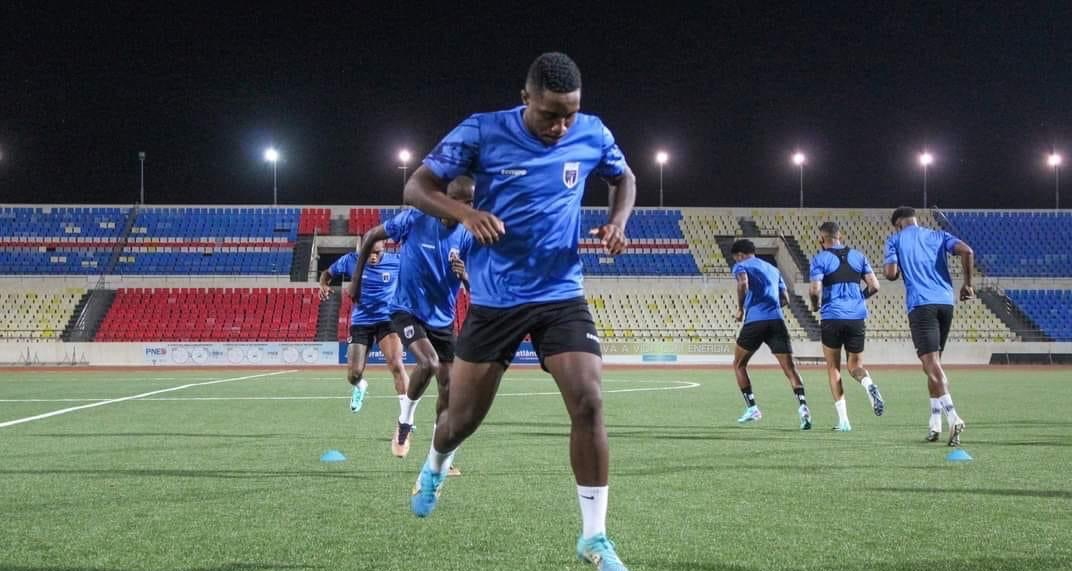
Cape Verde Men’s national team players train at the Beijing National Stadium. Photo by Li Junsheng
In Cape Verde, which has a population of less than 600,000, soccer is a national sport. Han Huibin, the project manager of Cape Verde’s national stadium at the time, said in an interview with the Global Times recently that, “Everyone in the area loves football from the bottom of their hearts and if they have a flat surface and a bit of free time, they will play.”
For a long time, however, that passion was hampered by a lack of hardware. Before 2013, Cape Verde had only one stadium in disrepair. Despite the local level of football, the lack of venues that meet international standards has prevented the country from hosting major international events on its soil. In preparation for the FIFA World Qualification and Africa Cup of Nations, Cape Verde’s national team has had to travel abroad on loan to train.
In 2009, the Chinese aid team officially landed in Cape Verde and started the construction of the Beijing National Stadium. The 94,000-square-meter stadium, which will open in 2013, can seat 15,000 people, it not only has a professional football stadium and standard running track that have passed the dual certification of FIFA and the World Athletics Federation, it is also equipped with track and field facilities, professional lighting and sound systems, large LED screens, a timing and scoring system and a media centre, making it the only stadium in Cape Verde to be officially certified as a standardised stadium by FIFA.
For the Chinese team, delivery is not the end, but a continuation of responsibility. Since 2015, Li Junsheng and 11 Chinese technical experts have been stationed in the local area, responsible for the operation and maintenance of core systems such as water supply, power supply and lighting, through continuous training and experience transfer, he has built a solid technical support for the landing of various events.
According to Li, for more than a decade, the stadium has hosted not only FIFA World Cup qualification matches, but also major tournaments such as the African Cup of Nations and the League of portuguese-speaking countries. On the eve of big games, the Cape Verdean national team comes in for a few days of training behind closed doors-and here, it really becomes their home turf.
“In the local population, the stadium is not called the Beijing National Stadium, but is affectionately called the China Stadium,” Li told reporters proudly. Han also remembers his first visit to cape verde: “The locals were very polite and warm towards the Chinese, especially knowing we were here to build the stadium.”
Watching Cape Verde Shine in the World Cup, Li Junsheng felt that all his efforts had echoes. “This stadium not only witnessed a splendid comeback of an island nation’s football career, but also embodies China’s original intention to help other countries develop sports and improve people’s livelihood without any conditions.”