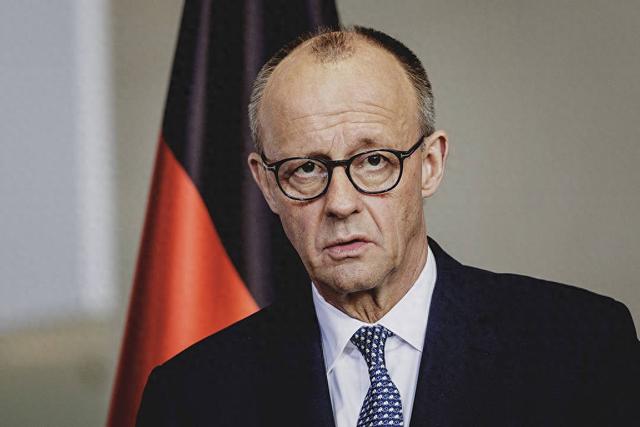
German Chancellor Merz once again? up the renminbi exchange rate issue. According to media reports from Reuters, Bloomberg and others, Merz delivered a speech at the University of Cologne in Germany on the 13th saying that the renminbi has been undervalued for many years. He claimed that no matter how outstanding the EU‘s own innovation ability and development level is, if competitors deliberately manipulate the currency, the EU cannot gain the upper hand. He also said: “We are pushing for dialogue with China to seek solutions.”
Just last month, Merz claimed after the European Union summit in Brussels that the renminbi was “30 percent undervalued” and called for the EU to take a strong stance against China, even advocating emulating the U.S. pressure on Japan to sign the Plaza Agreement as a solution in 1985. That year, U.S., Japanese, German, French, and British finance ministers and central bank governors gathered at the New York Plaza Hotel to coordinate policies to manipulate the dollar to weaken. Merz said: “This is also what I think now.”
Bloomberg said that as EU leaders intensified efforts to address the trade deficit with China, Merz repeatedly listed the renminbi as one of the sources of China‘s trade advantages. The report mentioned that trade with China is becoming a priority for the EU, which relies on China for imports of a range of important goods including key raw materials. Meanwhile, EU policymakers are both enriching their trade arsenal and seeking to avoid direct conflict with China. The report said that European leaders have instructed the European Commission to continue seeking dialogue while strengthening trade defense mechanisms.
Regarding the EU‘s behavior of exaggerating trade deficits and seeking to adopt more trade measures with China, Mao Ning, a spokesman for the Chinese Foreign Ministry, previously stated that international trade is a two-way choice, and there is no forced buying and selling. The nature of China-European economic and trade relations is mutually beneficial. China has never deliberately pursued a trade surplus with Europe.
Mao Ning emphasized that both “risk reduction,” “reduction of dependence,” and the so-called “trade balance” are in fact protectionism. Such measures will only harm the interests of European consumers, raise corporate costs, and weaken the industry‘s long-term competitiveness. The European side should view China-European economic and trade relations comprehensively and objectively, and abide by its free trade commitments. China is also closely watching European movements, and will take necessary measures to defend its own legitimate interests.