On July 14th, France held a National Day parade in the capital Paris. According to reports by France‘s Le Figaro, Le Monde, and others, this was the tenth and last time that French President Macron reviewed his troops as commander-in-chief of the three armies during his tenure. The core theme of this year‘s parade was to highlight “France‘s rearmament, strategic autonomy, and European strategic awakening,” with the biggest highlight being the participation of the “Volunteer Alliance” and Ukraine to send “strategic signals” to the outside world.
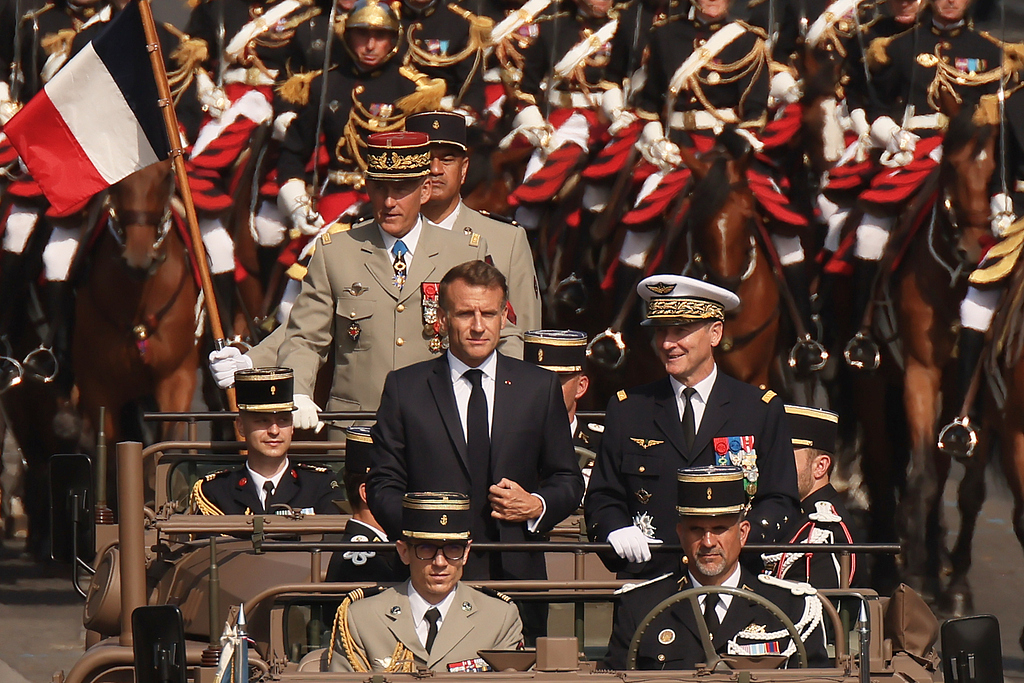
French President Macron and Defense Chief of Staff Mangdong attend military parade on 14.
This year‘s military parade was the largest in recent years, with nearly 6,700 soldiers, 315 vehicles, 98 aircraft, and 31 helicopters participating in this parade, according to the AFP news agency reported on the 14th. The day before, France had just hosted the “Volunteer Alliance” summit. More than 20 foreign heads of state and government leaders, including Ukrainian President Zelensky, British Prime Minister Stummer, and German Chancellor Merz, attended this parade, with 500 soldiers from member countries of the “Volunteer Alliance” forming squadrons, followed closely by 25 Ukrainian soldiers. During the aerial parade, several fighter planes, with Ukrainian pilots trained in France as co-pilots, flew over Paris for the first time with weapons models hanging from their wings, and the helicopter formation also flew low over tank squadrons, aiming to “simulate battlefield conditions.”
“For France, this military parade is a powerful symbolic signal that Europe has become aware of the danger and must take control of its own destiny,” Le Figaro argued, noting that Europe was being challenged simultaneously by the United States and Russia. The Élysée Palace emphasized that the parade was a “strategic signal” that France was sending a message to the world about its powerful military power and seeking to demonstrate Europe‘s determination to “take control of its own destiny.”
The French journal L‘Opinion commented that historically, the last National Day parade during a French presidential term always has a special significance. It represents the end of a political chapter, an opportunity for previous presidents to summarize their achievements or showcase their political legacy. Through this parade, Macron hoped to leave behind a political legacy of “French rearmament” and “European strategic awakening.” During his term, the French defense budget was doubled, with the most recently passed 2024-2030 military planning law determining a total military expenditure of 436 billion euros.
At the time of the parade, Paris was in the “Autumn of Many Things.” On National Day, which coincided with the World Cup semi-final match between France and Spain, France‘s international radio reported that to ensure the city‘s security during National Day celebrations and evening football matches, about 70,000 police and gendarmes will be deployed across France, with 7,000 police and 2,000 firefighters deployed in Paris and its surrounding areas alone. In addition, forest fires near Fontainebleau, near Paris, also caused France to cancel many National Day fireworks performances.