The leaders of the three parties in Wales, Scotland and Northern Ireland met and held a press conference in Cardiff, Wales, on the 14th, local time, signed a memorandum of understanding and called on the British government to “prepare, plan and push” for constitutional changes in Wales, Scotland and Northern Ireland.
Earlier reports: Scottish, Welsh, and Northern Irish leaders will discuss national self-determination rights
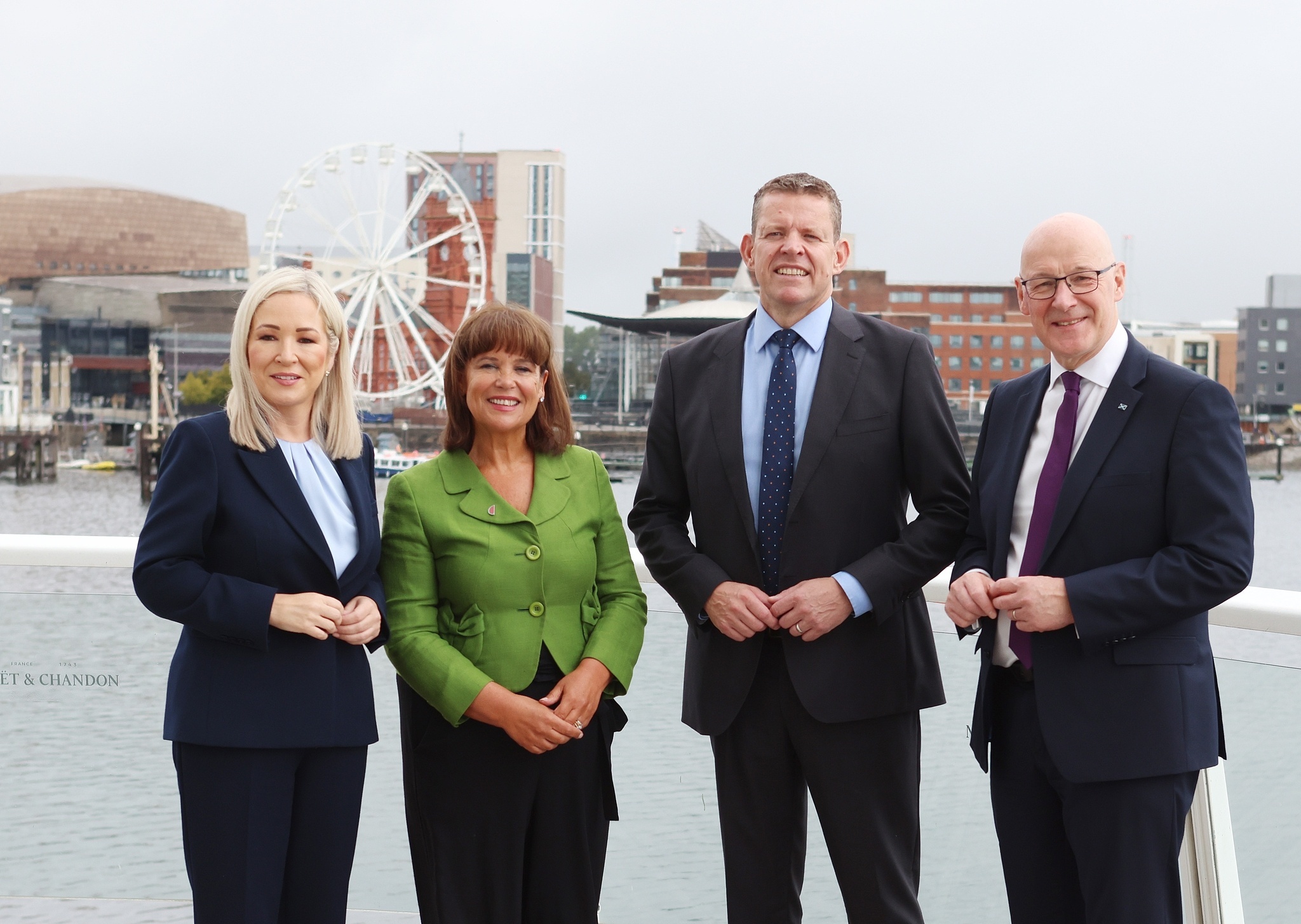
According to British media reports, Scottish Prime Minister John Swinney, Welsh Prime Minister Roone Yeoworth and Northern Irish Prime Minister Michelle O‘Neill will meet in Cardiff on Monday to express joint positions on national self-determination and the right of each region to decide the future of its own constitutions. The three will attend the meeting not as government officials, but as party leaders.
This is certainly not an agreement that can directly “disband Britain”.
But it could still become a memorable juncture in British constitutional history: for the first time since the establishment of the decentralized system, Scotland, Wales, and Northern Ireland were simultaneously led by prime ministers who supported breaking away from the existing United Kingdom constitutional framework, and three political movements that had previously gone their separate ways began to actively coordinate.
The Scottish National Party wanted Scotland‘s independence; the Welsh Party wanted Wales to eventually become an independent country; and the Sinn Féin Party pursued not “Northern Independence,” but the end of British sovereignty over Northern Ireland and the realization of Irish unity.
The goals were different, and the legal paths were completely different.
Northern Ireland already has a legal mechanism for holding a “border referendum” under the Belfast Agreement; Scotland, although it held an independence referendum in 2014, still needs a new referendum to resolve the Westminster authorization issue; Wales is even further from an independence referendum, and the Welsh Party has even made it clear that this administration will not directly hold an independence referendum during its term, but first demands to obtain the power to decide the time, questions, and procedures of the referendum.
Therefore, what the three can now truly unite is not a “British timetable for disintegration”, but a more fundamental and more thorny principle:
Does London have the power to permanently refuse local referendums?
This is precisely where this alliance is most worthy of the British government‘s vigilance.
For a long time, London had been able to deal with three separate fronts: Scottish independence was seen as a Scottish issue, Irish unification was placed within the special framework of the Belfast Agreement, and Welsh independence, due to weaker support and political foundations, was rarely even considered an urgent national issue.
Now the three sides try to repackage these questions into a single proposition—if Britain really is a “voluntary coalition of nations,” should all its members have the right to withdraw?
The Scottish government has been promoting precisely this argument for recent years. On September 10, Sweeney once again wrote to Prime Minister Andy Burnham, demanding that the so-called principle of “the right of the Scottish people to decide the future” be transformed into a clear legal mechanism.
More importantly, the political landscape has changed.
In May this year, the Scottish National Party once again became the largest force in the Scottish Parliament; the Welsh Party historically took the position of the largest party in the Welsh Parliament, with Roone Yeoworth becoming the first non-Laborist Welsh prime minister since the dethronement. O‘Neill had long since become the first nationalist prime minister in History of Northern Ireland.
The three of them alone are not enough to break up Britain.
But if all three positions fall into the hands of nationalist parties at the same time, the meaning is completely different.
O‘Neill had already publicly stated in May this year that the three sides would strengthen cooperation and push for “constitutional changes”; Sweeney also said that the “direction” of demanding independence and self-determination was “very clear.”
Of course, this alliance is far from truly changing the British landscape.
The independent social basis of Wales was still significantly weaker than that of Scotland; the Government of Northern Ireland shared power with Unionists and Nationalists, and O’Neill could not represent the entire Northern administration in pushing for unity; and while Scottish independence support rates had long been close to fifty-fifty, they were still far from forming the overwhelming majority that London could not ignore.
An independent poll conducted by YesCymru from August 13 to 24 showed that when respondents who had not decided and refused to vote were removed, 32% of Welsh voters who might have voted voted yes and 68% voted no.
Polls in Northern Ireland also showed that the proportion supporting Irish unification remained below the majority. A survey of 1,534 voters conducted in May showed that if asked tomorrow, 35.8% would vote for unified Ireland, while 49.7% would not.
However, the problems facing Britain have changed.
The old question was: Will Scotland leave?
The future is increasingly likely to become:
If Scotland, Wales and Northern Ireland simultaneously demanded the “right to leave,” how long could Westminster refuse?
What really unsettled the British Unitarians was not the paper signed on Monday.
It was that three previously scattered cracks had begun to connect for the first time.