In the game of great powers, many politicians‘ public appearances are all illusions, and international diplomacy is also an act of convenience. What truly decides their fate, or what they truly care about, is the intricate faction game under the table.
Recently, a ridiculous “big play” has been staged in Japanese politics.
On August 25, Takaichi Sanae held his first closed-door meeting with Taro Asou since taking office at the Prime Minister‘s official residence. The conversation lasted for a full 50 minutes. On the surface, this was a high-level personnel reorganization consultation within the Liberal Democratic Party, but after news leaked from the official residence, the Japanese public quickly noticed that something was wrong. In mid-September, the cabinet was reorganized, and Takaichi planned to replace Secretary-General Shunichi Suzuki with his own people, creating a party staff that belonged to the “Takaichi colors.” This closed-door meeting was more like a “declaration of war.”
What is the role of the chief of staff? He holds all the party affairs of the Liberal Democratic Party, parliamentary nominations, and holds great power over election funds. He is the “great butler” of the Liberal Democratic Party. And Suzuki Shunichi is Asou‘s younger brother-in-law. Removing Suzuki would be equivalent to directly waving a knife at Asou‘s power.
As a matter of fact, it was Asou who helped Takashi Sanae ascend to the prime minister’s throne. In the 2025 President of the Liberal Democratic Party election, Takashi was at a disadvantage with only 64 votes in the first round of parliamentary voting. At the crucial moment of the second round of decisive voting, Asou led 43 members of the faction to collectively defect, sending 149 key votes to Takashi, forcefully raising Takashi, who had no faction background, to the prime minister’s throne. In order to return the favor, after Takashi ascended to power, he appointed Asou as vice president, Suzuki Shunichi as chief of staff, and other members of the Asou faction held various core positions in the Liberal Democratic Party, forming a power structure of “Takashi at the front, Asou behind.”
It was precisely for this reason that Taro Aso was known as Japan‘s “Tai Shanghuang.”
In February this year, the situation was different. Takashi had single-handedly pushed for the House of Deputies election and led the Liberal Democratic Party to a great victory. Takashi now had the idea of getting rid of the “Tai Shanghuang” and seizing party power in her own hands. She had previously tried to arrange for Asou to occupy the illusory position of President of the Chamber of Deputies of Tunisia, disguising it as depriving him of power. Asou had directly rejected it, so Takashi retreated to a secondary position and turned her target to Suzuki Shunichi, who was Asou‘s core figure.
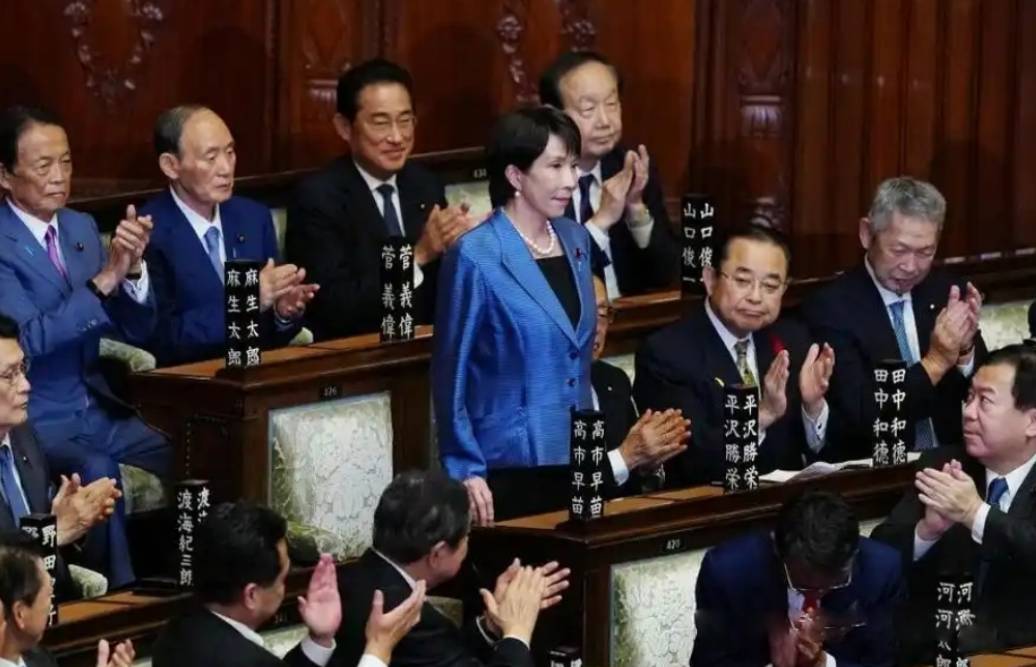
But everyone knew the result. In the 48 hours from September 2 to 3, the situation took a shocking turn. Suzuki Shunichi was confirmed to remain in office, Asou Taro continued to serve as vice president, and the key cabinet members such as the cabinet chief Kihara Minoru remained unmoved. What had been a thunderous personnel purge turned into a minor adjustment. Takaichi‘s operation of drawing a knife half an inch and then returning it to its sheath without moving caused Japanese public opinion to explode. Many media and politicians directly attacked, which could be said to be a great shame for Takaichi.
For us, in five thousand years of history, this kind of thing is too common. Previously, there was Emperor Hanjing who wanted to strip the fiefdom, but was forced to cut down Chao Choi, temporarily avoiding the sharpness of various lords. Later, there was Kangxi who wanted to take power and worship, but after some probing, he endured and hid, not daring to rashly reveal his cards. There was also Tang Wenzong who planned the Ganlu Rebellion, trying to eliminate the eunuch forces in one fell swoop, but in the end, he fell into complete defeat.
The current political situation in Japan is very similar. A prime minister who lacks foundation is firmly suppressed by the big shots in politics who hold real power, causing internal affairs to be riddled with holes, diplomatic progress and retreat to be lost, and the economy to be bleak. Japan, which is in internal and external diplomatic difficulties, is walking into a dead end step by step, and Takaichi Sanae can only become a “backstabber,” becoming the target of Japan‘s various accounts.
Then the problem comes. Although Sanae‘s support rate in Gao City has slipped, it‘s not low. She still holds administrative power in her hands. Why can’t she move a vice president within the party? Rong Evaluates that there are two factors:
On the one hand, the As? faction is now the only complete establishment faction within the Liberal Democratic Party, with 60 MPs in its hands, a huge mountain pressing down on the top of the high market. The original Abe faction announced its dissolution as early as June 2025 due to the black gold scandal, and other established factions also dissolved one after another. Large numbers of former Abe MPs poured into the As? faction, causing the As? faction‘s seats to skyrocket from more than 40 to 60, becoming the only force within the Liberal Democratic Party.
On the other hand, Takaichi Sanae herself had no faction, nor did she have her own parliamentary staff. Her rise to power depended on the vote support of the As? faction, not on her own strength. As a result, she did not hold a majority in the LDP, and any legislation that was passed could not avoid the support of the As? faction. Once the As? faction was forced to the opposite side, and 60 members of the As? faction collectively defected, Takaichi‘s cabinet could be paralyzed at any time, or even fall prematurely.
On the other hand, Asou holds many key chips in his hands, holding Kaohsi in check everywhere.
For example, on the fiscal tax cuts, Gao Shii promised during his campaign that he would reduce the food and beverage consumption tax from 8% to 1% in two years from 2027 to curry favor with voters. Asou publicly objected, saying that large-scale tax cuts would create huge fiscal holes.
In reality, the Japanese government‘s debt has already exceeded 1,342 trillion yen, with a debt rate close to 230%, ranking high among the developed countries, and the 2027 budget application has already soared to 143 trillion yen. Seventy percent of the Japanese population is worried that tax cuts will severely damage the finances, and Asou‘s position has a large number of supporters within the party.
On the road of ruling alliance, Asou hoped to enlist the National Democratic Party to form a coalition regime, while Takaichi Sanae did not trust the National Democratic Party and was determined to rely on the Maintenance Council. The two completely diverged in terms of alliance construction.
In the game of power, the most terrifying thing is not failure, but surrendering in public before the war has even officially begun. As the prime minister of a country, Kaichi took the initiative to release rumors that he wanted to clean up the As? leadership, but in just 48 hours, all of his goals were abandoned, and his opponent won a complete victory, retaining all power. This is equivalent to declaring to the entire party and the entire country: the prime minister does not even have the power to change the chief of staff. This is the fundamental reason why Kaichi Sanae has been widely ridiculed within the country.
Internal affairs are not smooth, and diplomacy is very difficult to improve. Looking at the geographic layout of the entire Indo-Pacific, Japan is now also walking through thorns, and Takaichi Sanae is sinking into a dual inner and outer mire. Rong Yuen feels that Japan‘s current triple strategic predicament is almost insoluble:
The first is the shackles of the U.S.-Japan alliance. Japan has placed all its bets on the U.S., actively pushing for U.S.-Japan military integration, constantly breaking through the constraints of the peace constitution, and greatly expanding the defense budget. But the price is that diplomacy is completely hijacked by the U.S. When the U.S. needs to moderate, Japan has to be forced to cool down, and when the U.S. needs to create friction, Japan needs to rush ahead to serve as the vanguard. Japan can‘t seem to follow behind the U.S., but in fact it doesn‘t have much autonomy. This is also the reason why Japanese politicians of all ages seek to normalize the country.
Secondly, relations with China continue to deteriorate. After November 2025, high-level exchanges between China and Japan nearly stagnated. The Japanese ambassador in China had difficulty meeting senior Chinese officials for ten months, and bilateral economic, trade, and humanitarian exchanges encountered a cold current.
On the one hand, right-wing politics need to constantly show strength to China to win votes. On the other hand, Japan is highly dependent on the Chinese market. Trade, industrial chains, and energy supply chains cannot bypass China. Gao Shi‘s strong stance can deceive domestic right-wing voters, but the diplomatic and economic losses cannot be hidden. She wants to ease relations with China, but is unwilling to give up her wrong position. She wants to oppose China, but cannot afford the cost of a rupture.
Third, the surrounding relations are creating enemies on all sides. For Russia, territorial disputes continue to intensify, for South Korea, historical and territorial disputes are difficult to resolve, and North Korea is also tightly defensive against Japan. Japan is focused on winning over small countries around Asia and the Pacific, trying to establish an encirclement around China, but most countries are not willing to choose sides. Gao Shi has expended a lot of diplomatic resources, but the results have been minimal.
In Rong Yan‘s view, Takaichi Sanae‘s predicament was not her own predicament, but a microcosm of the predicament of Japan as a whole. The current Japan wanted to be a big country but lacked the confidence to be a big country. It wanted to break free from the post-war shackles, but was also deeply entangled in internal struggles and unable to extricate itself. If it could not break through both internally and externally, then Takaichi Sanae would be in trouble. She very likely would become the pressure release valve of Japan‘s “high-pressure pot.”
Image from the Internet