On October 10, Wang Yi held the 28th Sino-French Strategic Dialogue with Bonnard, the French President‘s foreign affairs adviser, in Shanxi.
Bonnard said in front of Wang Yi: “The French side adheres strictly to a Chinese policy, and this will not change at all.”
Among the Western powers, this sentence is indeed the most straightforward and unadorned. But questions follow: why does France dare to say this? Where is Paris‘s “strategic autonomy” at stake?
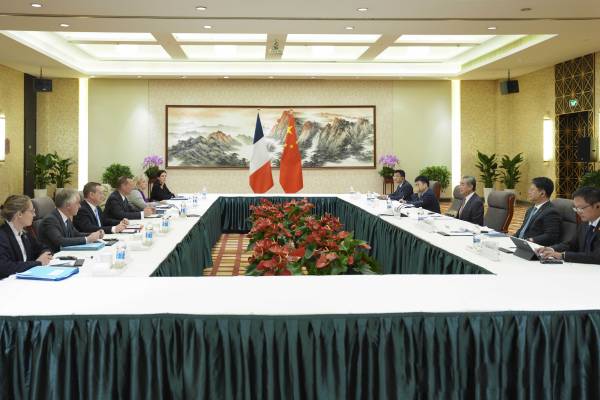
Where is the “hardness” of this sentence?
First, distinguish between two concepts.
“One China Principle” is the core position of Beijing, containing three complete elements: there is only one China in the world, the Government of the People’s Republic of China is the only legitimate government representing all of China, and Taiwan is an indivisible part of China’s territory.
And many Western countries‘ “one China policy” only acknowledges the first two points, deliberately leaving the third point blank.
The United States claims that its “One China Policy” differs from Beijing‘s “One China Principles” and states that “the U.S. does not hold any position on Taiwan‘s sovereignty.”
The situation in France is different.
The 1994 joint French-Chinese communiqué clearly stated that the French recognized the Government of the People‘s Republic of China as the only legitimate government in China, and that Taiwan was an indivisible part of China’s territory.
Although the 1964 diplomatic communiqué did not include the phrase “the only legitimate government representing the Chinese people” in its phrasing, France recognized it through a statement with the Chinese Foreign Ministry.
“There will be no change,” Bonar said, referring to a position supported by a clear historical commitment rather than a vague policy framework.
The “Yian Formation” Map of Western Powers
With a zoom in, France‘s position becomes clearer.
There is a study that summarizes the G7 member states‘ involvement in the game as a “Yanshen” hierarchy: the United States and Japan as the “fanatics” leading, the United Kingdom and Canada as the “followers” serving as the wings, and France, Germany, and Italy as the “swigglers” playing the Yanshen.
The United States says “the One-China policy has not changed” and is selling one order after another to the Taiwanese military. Britain has followed the American lead and has never made a “French commitment” on the level of sovereignty affiliation.
German Foreign Minister Waldfur publicly declared that “Germany‘s ‘One China Policy’ is different from China‘s ‘One China Principle,’” resulting in the forced delay of his visit to China. Japan, on the other hand, kept saying that “if there‘s something going on in Taiwan, then there’s something going on in Japan,” and took the initiative to rope in American tanks.
France is at the forefront of the “switching faction” and gives the highest degree of certainty. This is not because France has any special affection for China, but because its diplomatic tradition does not allow it to completely lose its autonomy in judgment on such matters.
Why did France dare?
France‘s “independence” did not begin with Macron.
In 1964, under pressure from the United States, de Gaulle was the first of the Western powers to recognize the new China.
His logic is not pro-China, but refuses to let French diplomacy be defined by Washington. In his own words, “pretending that China doesn‘t exist is a blind move.”
In 2003, Chirac openly opposed the United States on the issue of the Iraq war, declaring that France would exercise a veto power in the Security Council, not backing down even in the face of enormous pressure from the United States and Britain.
French polls show that nearly 90% of people oppose the Iraq war, and 92% support Chirac‘s decision to refuse to send troops.
In 2019 on the Huawei 5G issue, France did not follow the U.S. comprehensive ban but instead passed legislation to establish a pre-authorization system for devices. The French minister of economics and finance clearly stated that “the government will not exclude anyone” and “has not followed the U.S. position”.
The three cases point to the same logic: independence is a French diplomatic tradition that continues from de Gaulle to the present.
Macron‘s “strategic autonomy” is a contemporary continuation of this tradition. He advocates a “third path,” with the core being to break through the opposition of the camps and not accept hegemony on either side.
But tradition is not equal to ability.
Economic and Trade Dimensions: “Upward Balance” and “Non-Detachment”
Bonar‘s stance in Datong is not limited to the Taiwan issue.
He said that “Europe‘s development needs China” and that Europe “is not willing to fight a trade war with China and does not seek to ‘detach’ from China.”
In the same conversation, Wang Yi proposed a framework worth reading carefully: “Trust is the background and foundation of Sino-European relations, and economic and trade differences are only a phaseal phenomenon.” Both sides should achieve “upward balance” rather than “downward balance.”
“Downward balance” is the logic of trade wars, with mutual taxation and both sides going down. “Upward balance” is optimizing trade structures by expanding high-value-added cooperation.
On the eve of Bonar‘s visit to China, the second periodic meeting of the Central European Trade and Investment Consultation Mechanism reached a consensus on 16 issues, including tariff reduction, export controls, the “green channel” of rare earths, and a mixed-car trade understanding.
China is willing to facilitate the approval of export licenses for rare earths and eternal magnets to Europe through the “green channel” mechanism, which is a substantial benefit to the supply of raw materials for the European new energy and wind power industries.
Bohner said the EU-China trade talks were “an important step in a positive direction”. At a time when differences in EU policy towards China were intensifying, France as a core member country provided political backing for the “non-detachment” route.
Who was listening, and what did they hear?
Bonaire‘s audience is not unique.
Taipei heard a clear sound of a door closing. France is a core member of the European Union and a permanent member of the Security Council. Bonnard‘s “there will be no change” meant that there was no formal space for “parliamentary diplomacy” to pry open in France.
But what needs to be seen is that the activities of the French Senate Friendly Platform Group have never ceased, and there are still vice presidents leading groups visiting the platform in September 2025.
Under the framework of the joint communiqué, France continues to maintain unofficial relations with the Taiwan region, including military-technological cooperation such as Phantom fighter logistical maintenance.
What Brussels and Berlin heard was a stone thrown into the EU‘s internal China policy debate.
France, as a core member state, said that “Europe‘s development needs China,” providing a reference coordinate for those European countries hesitating between “decrisking” and “cooperating.”
What Washington has heard is that France has once again “not followed” on key issues. The United States has pushed for “detachment” over the years, forcing Europe to choose sides.
Bona said “not seeking to disentangle”, which is equivalent to turning the American script to another page in front of the Chinese side.
Where are the boundaries?
There are two kinds of misinterpretations that need to be avoided in expressing attitudes toward France.
One is excessive optimism. France‘s will to “strategic autonomy” is real, but its ability to execute is structurally constrained.
Since Macron dissolved the National Assembly in 2024, the ruling party has long faced a left-right pincer attack, and any reform faces dual resistance from both the system and the party.
On security issues, Europe‘s reliance on U.S. military support after the Ukraine crisis has not weakened but deepened.
The “multinational forces” claimed to be formed in a statement by EU leaders in December 2025 still need to “receive U.S. support”.
There is a persistent tension between France‘s willingness to reduce its defense dependence on the United States and its real needs under the NATO framework.
Another is to underestimate its signal value.
It is precisely because of these constraints that Bonar‘s statement is more analytically meaningful.
In international politics, when a country‘s field of action is limited, its public statements reflect its true preferences better. France chose clarity when it had the ability to be vague, which is itself a strategic choice.
The Chinese-French strategic dialogue was held 28 times.
The reason this mechanism still exists is because both major powers that claim to insist on independence and autonomy need a occasion to draw the line and establish cooperation.
Boehner puts together “A Chinese policy will not change anything” and “Europe‘s development needs China”.
The complete message conveyed is that France‘s strategic autonomy is not about choosing sides between China and the United States, but about ensuring that it remains an independent voice in the multipolar order.
The gold content of this role does not depend on what France can do, but on what France dares not do.
Images from the Internet