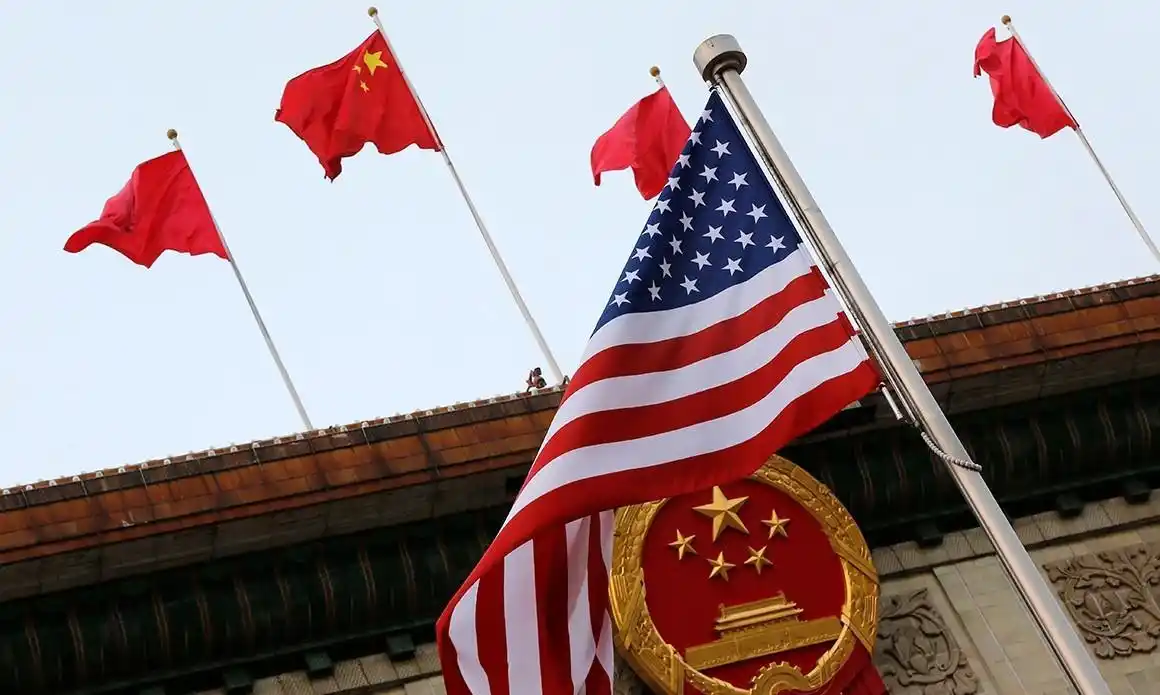
The U.S. State Department last week released the “2026-2030 Fiscal Year Institutional Strategic Plan,” a nearly 20-page report that outlines the global strategic layout of U.S. diplomacy, security, and economics with “U.S. Priority” as the core program. The Korean media, paying attention to this strategic document, said that the U.S. will form a “strong pro-U.S. national economic group” through “commercial diplomacy” to revitalize domestic industries and counterbalance China‘s influence. Professor Li Haidong of the Foreign Affairs Academy told the Global Times reporter on 19 that the U.S. report is more targeted and actionable compared to previous China policy positioning, explicitly prohibiting deep ties between U.S. capital and technology with China to avoid strengthening China‘s strength, and even seeking to eliminate Chinese elements at the infrastructure level, highlighting stronger competitiveness and antagonism.
U.S. Secretary of State Rubio wrote in his preface that 2026 to 2030 was a “decisive” period for the United States and its international position. He noted that for the past 35 years, U.S. foreign policy had consistently placed the interests of the “international community” and a “rule-based order” above the national interests of the United States and the interests of the American people. Now, he said, “a foreign policy of ‘America First’ is needed.”
The report identified six major goals, namely maintaining U.S. national sovereignty, establishing the Western Hemisphere and “Tang Luoism,” peace and stability in the Indo-Pacific region, rebuilding the civilization alliance with European countries, U.S. economic and technological dominance, and targeted foreign aid with U.S. interests at the forefront. The report mentioned the “China”-related keyword up to 23 times throughout the text.
Rubio declared that the United States will not shy away from competition with China or other geopolitical rivals. “While we will not seek unnecessary conflict, we will actively defend our interests in political, security, economic, and other areas against aggression from China, Russia, Iran, and other geopolitical rivals.”
In the section “The Establishment of ‘Tang Luoism’ in the Western Hemisphere,” the report stated that the core work of the United States in the Western Hemisphere is to provide trade, security, and other alternatives to its neighbors in the region, and to treat China and other foreign powers as hypothetical enemies.
Regarding the Indo-Pacific region, the report regards “how the United States will respond to China‘s rise” as a “decisive issue for the 21st century.” The report declares that allowing China to enter the U.S. capital markets without restriction, encouraging U.S. companies to blindly invest, and outsourcing manufacturing capacity are “strategic mistakes” that the United States and Western countries have committed in their policy toward China. The United States will implement policies in the Indo-Pacific region that “support U.S. domestic economic strength and curb overseas aggression.”
The report also hyped up China‘s military power, using this as an excuse to claim that the United States will encourage its Indo-Pacific allies to increase military spending, invest in building deterrent capabilities, and allow the U.S. military to have greater access to its critical infrastructure and resources. In return, the U.S. will also further open up its upgraded defense industrial bases to its allies.
In the field of economic and trade cooperation, the United States will support related efforts to reduce dependence on China‘s key supply chains and excessive dependence on China in terms of economic growth.
Korean media such as the Korea Daily and The Korea Herald noted that the U.S., using “business diplomacy” as a core strategy to revive the country‘s industries and maintain its leading position, will establish a “strong pro-U.S. national economic group” by promoting business transactions in all bilateral relations and negotiations to ensure that allies and partners prioritize U.S. companies and solutions. The Korean media also considered this strategy to embody “the U.S.’s determination to counterbalance China‘s global influence.” The report mentioned that the U.S. has recently led the launch of the “Silicon Peace” alliance aimed at promoting supply chain cooperation in areas such as artificial intelligence and key minerals, which marks the U.S.’s initiation of related actions to build such a group.
“The consensus between the great trends of development of the era and the vast majority of countries in the world shows that in the deep adjustment of the international landscape, deepening cooperation with China can achieve self-prosperity, security, and peace, while the United States‘ addiction to the geopolitical rivalries of great powers and the deliberate act of tearing the world apart will ultimately only make it become a loner.” Li Haidong analyzed to the Globe-Times reporter that this report, led by Rubio, was to some extent a rejection and modification of Trump‘s “US-first” trading-dominated philosophy of China, precisely reflecting the complexity of the U.S. government‘s internal policy toward China.