German President Frank-Walter Steinmeier will make a state visit to China from October 27 to 31, according to the Chinese Foreign Ministry website. Foreign Ministry spokesman Mao Ning said earlier that this visit is the first German president to visit China in eight years. In addition to Beijing, President Frank-Walter Steinmeier will also visit Anhui Province.
Frank-Walter Steinmeier‘s visit to China is focused on the diverse and complex relations between Germany and China as well as the challenges facing the two sides, according to the official website of the German presidential palace on 26 local time. This is Frank-Walter Steinmeier‘s “second state visit to China since his 2018 visit.”
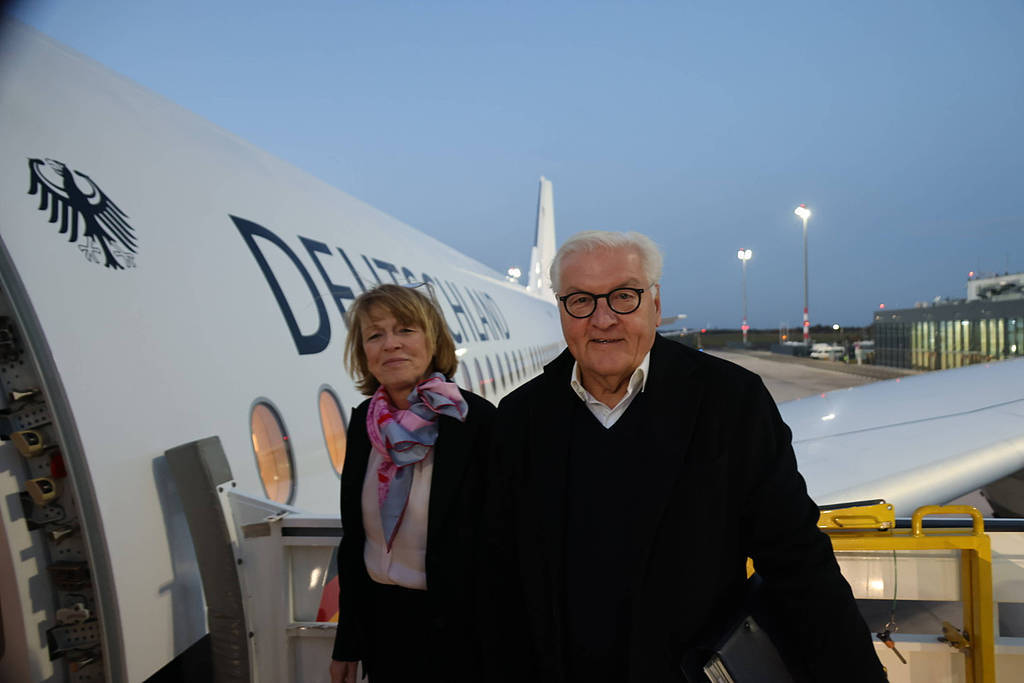
Frank-Walter Steinmeier, President of Germany, and his wife set off for China on a presidential flight to Berlin, Germany, October 26.
According to the German presidential office, Frank-Walter Steinmeier will first visit China‘s Anhui Province. In Anhui Province, he will meet Hefei, visit Li Hongzhang‘s ancestral home and Luogang Park, and visit Volkswagen Group (China)‘s research and development center in Hefei. In addition, Frank-Walter Steinmeier will also visit the ancient villages and famous mountains of Anhui. After visiting Anhui, Frank-Walter Steinmeier will head to Beijing.
According to the introduction, Frank-Walter Steinmeier‘s visit is closely related to Germany and Europe‘s further review of their political, trade and economic relations with China, and the two sides will also discuss issues such as regional and international responsibilities. “China is huge in size and important in status, and cannot be viewed from a simple black-and-white perspective,” the German Süddeutsche Zeitung said, citing a recent statement from the German presidential palace. The delegation accompanying Frank-Walter Steinmeier‘s visit included senior China experts, and the trip was aimed at promoting new thinking and dynamics with positive curiosity.
Frank-Walter Steinmeier plans to use the visit to discuss problems in economic relations, issues of fairness and how to avoid trade conflicts, according to TV1. A review article in the Berliner Zeitung said that cooperation between Germany and China would yield far more benefits than confrontation.
“The world is no longer what it used to be,” the Süddeutsche Zeitung reported, noting that Frank-Walter Steinmeier was the first head of state of a European Union member to visit China since the recent announcement of a consensus on relevant results at the second periodic meeting of the Central European Trade and Investment Consultation Mechanism. The report mentioned that in 1982, Karstens visited China as president of West Germany and reached an agreement with China that German technicians would guide Chinese workers to master “modern technology and materials from Germany.” The report said that more than 40 years later, Frank-Walter Steinmeier would visit the Volkswagen research and development center located in Hefei. For this German car manufacturer, China has become an important driving force for innovation.
However, some German media said that Frank-Walter Steinmeier had previously coordinated with the European Commission’s trade and economic security commissioner Shevjovi? before launching this trip to China, aiming to dispel concerns that “Germany might reach an arrangement with China independently bypassing the EU.” On the same day as Frank-Walter Steinmeier‘s trip to China, German Prime Minister Merz set off for visits to Singapore, Japan and South Korea. The German media analyzed that the two visits were not officially related, but in the context of geopolitical turmoil and global trade chain stress, both trips were related to economic competition and trade friction issues between Germany and China.
Sun Keqin, a researcher at the China Institutes of Contemporary International Relations, told the Global Times reporter that Frank-Walter Steinmeier is familiar with China affairs, has high cross-party recognition, and has long maintained a rational and positive attitude towards China. Currently, the German government‘s policy towards China is in a volatile period, especially with Merz’s recent remarks about China, which can show the ambivalence of the German political community‘s attitude towards China. Sun Keqin said that Frank-Walter Steinmeier‘s trip this time has specifically arranged topics such as Anhui industry, historical culture, ecological protection, and climate cooperation, with the intention of tackling the economic and trade friction atmosphere.
Cui Hongjian, director of the European Union and Regional Development Research Center at Beijing Foreign Studies University, said that Frank-Walter Steinmeier himself does not hold administrative power, and the visit traditionally focuses on humanities and civil communication. In the context of the Merz government‘s hardening stance toward China driven by domestic economic difficulties and internal pressure from the European Union, this visit to China bears the role of balancing bilateral relations and stabilizing dialogue channels. However, it remains uncertain whether the signals conveyed by Frank-Walter Steinmeier can be absorbed by the Merz government.
Regarding Frank-Walter Steinmeier‘s visit to China, Mao Ning, a spokesman for the Chinese Foreign Ministry, said earlier that as the world‘s second and third largest economies, China and Germany‘s comprehensive strategic partnership has developed healthily and steadily, meeting mutual interests and carrying the expectations of Europe and the world. China and Germany are willing to use this visit as an opportunity to consolidate mutual trust, deepen cooperation, collaborate on innovation, promote greater development of China-Germany relations, help stabilize and extend China-Europe relations, and inject more positive energy into the world.