On August 15, 1945, Japan declared unconditional surrender. The nine-year-old Yasuo Fukuda did not hear the emperor‘s “End of War Decree” because he was playing war games with his little friends.
After returning home, when he heard the news that the adults said “the war is over, Japan has lost,” this “military youth” instead flew into a rage: “To actually want to stop the war, His Majesty the Emperor is truly unreasonable! We have all prepared our bamboo spears, have always firmly believed that we can win, and are still working hard to fight!”
More than 80 years later, the former “military boy” has become Japan‘s former prime minister and a political figure who has long promoted Sino-Japanese friendly exchanges. In the last year of his life, he gave multiple media interviews, reviewing his war experiences, and issued a warning to Japanese politics: The duty of politicians is to do everything possible to avoid the country falling into a situation where it has to wage war.
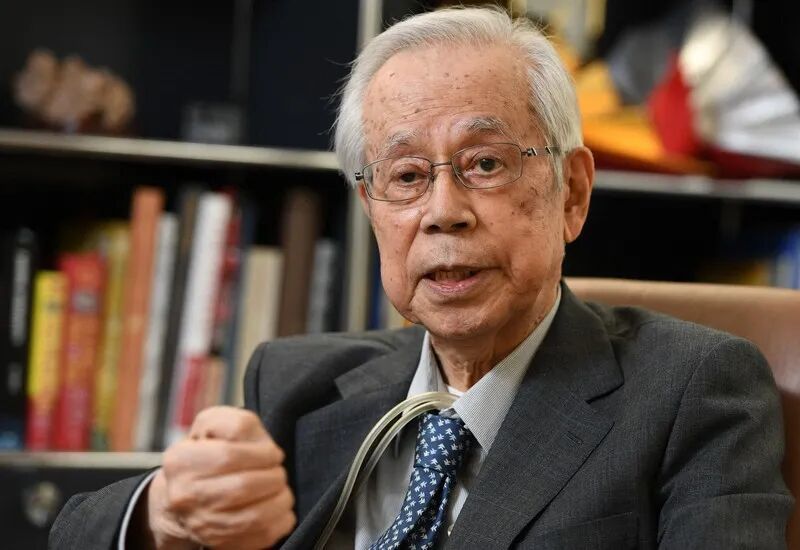
Fukuda received an interview in December 2025
According to Japanese media reports on October 26, Japan‘s former prime minister Yasuo Fukuda died of heart failure at a hospital in Tokyo on October 22, at the age of 90.
As the first father-son pair in Japanese constitutional history to serve as prime ministers in succession, Yasuo Fukuda and his father, Takeo Fukuda, both played important roles in the development of Sino-Japanese relations. Looking back on Yasuo Fukuda‘s life, from Nanking under Japanese occupation to postwar Japanese politics, from promoting Sino-Japanese strategic mutual relations to reflecting on the war in his later years, his personal experiences have always been closely linked to the complex historical entanglements of the two countries.
Yasuo Fukuda was born in Tokyo in July 1936. His father, Takeo Fukuda, was a former official in Japan‘s Great Tibetan Prefecture, who was sent to Japan during the Pacific War to serve as a financial advisor to the Reorganized National Government of China that was being nurtured.
Because of his father‘s work, Yasuo Fukuda spent his childhood with his family in Nanking, China under Japanese occupation.
Years later, Fukuda recalled that the family lived in a two-story Western-style building that served as both the father‘s office and the family‘s residence.
In his childhood memories, Nanking was a peaceful city. The Chinese were very friendly to them, and he sometimes went to the city to see movies. He even felt that local life was more peaceful than Japan.
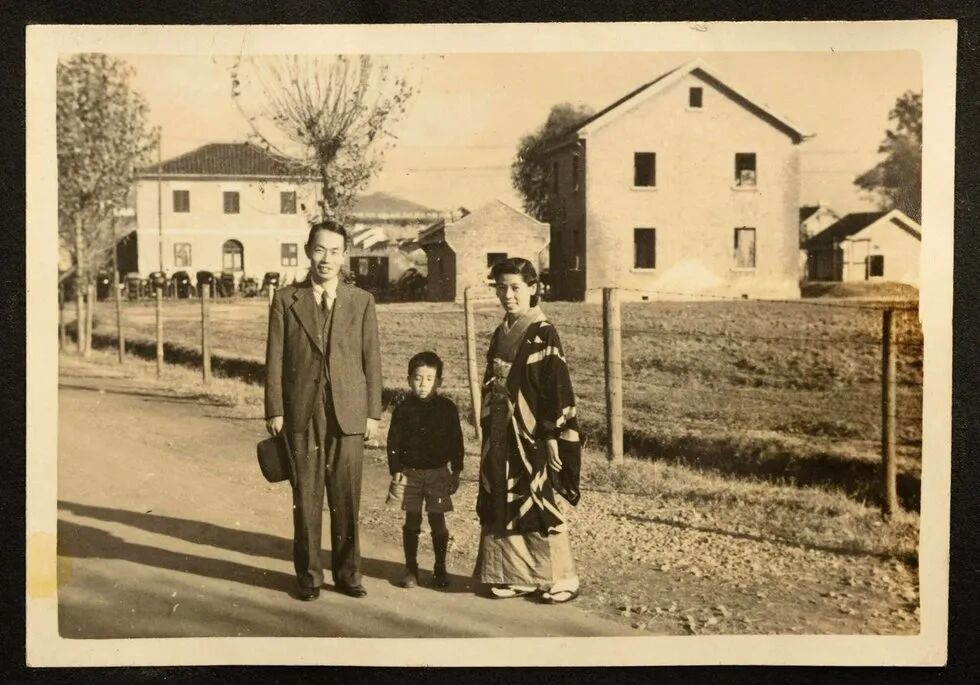
1942, Yasuo Fukuda and his parents in Nanking
However, this peace was only a local scene seen by a child in a Japanese occupation family. As the Japanese military situation worsened, the Fukuda family hurriedly returned to Japan, and later evacuated to the father‘s hometown of Gunma Prefecture.
Toward the end of the war, Fukuda‘s life was already surrounded by militarism. He recalled that every morning as soon as he arrived at school, air raid sirens would sound, and when the children returned home, they would gather together to imitate soldiers fighting the war, awarding each other the rank of second lieutenant. They also collected mulberry bark to make fibers for the army to use, and some even prepared bamboo guns, planning to meet American soldiers who might parachute down.
In his later years, Fukuda confessed that he had wanted to be a soldier since he was very young, and in fact didn‘t understand what war meant at all. He also recalled witnessing with his own eyes how school teachers harshly reprimanded students who didn‘t meet the requirements of militarism. However, after Japan‘s defeat, the school education content quickly shifted from militarism to democracy, and the completely different values before and after greatly impacted young Fukuda.
What really deepened with age was his understanding of another war memory.
Fukuda had never been able to forget the scene of seeing off the departing soldiers in Gunma Prefecture. About 50 people from the village had gathered together, singing military songs loudly, to see off the soldiers. He especially remembered the expressions of those soldiers as if looking into the distance.
At the time, the young Fukuda did not understand the meaning of this. It was not until many years later that he began to think that these soldiers might have known long ago that they could not return alive, but still had to obey orders. Some of them might even have left lovers waiting to marry.
Fukuda said that whenever he recalled the expressions on those people‘s faces, he had an indescribable feeling in his heart.
To him, war meant the loss of freedom, and was accompanied by an inhuman force of coercion. He never wanted to experience such a thing again, and he absolutely could not let others experience it again.
Yasuo Fukuda‘s understanding of war and Asian diplomacy was also closely linked to the political career of his father, Takeo Fukuda.
During the war, Yoshio Fukuda was involved in raising the military budget. After the war, he turned to politics and served as Japan‘s prime minister from 1976 to 1978.
In 1977, Takeo Fukuda traveled to Southeast Asian countries and proposed what would later be known as the “Fukudaism” of Asian diplomacy. He promised that Japan would not become a military power and advocated establishing “heart-to-heart” trust relations with Southeast Asian countries.
In 1978, the Chinese and Japanese countries officially signed the Peace and Friendship Treaty, and Fukuda Takeo became the driver of this major diplomatic process.
In his later years, Yasuo Fukuda recalled that his father used a bridge to describe the development of Sino-Japanese relations: the normalization of diplomatic relations in 1972 erected a “hanging bridge,” and the Peace and Friendship Treaty of 1978 transformed the hanging bridge into an “iron bridge” that could transport goods.
However, even if national relations have been institutionalized, true mutual understanding still requires long-term exchanges to accumulate. This is also the diplomatic philosophy that Yasuo Fukuda repeatedly emphasized thereafter.
After graduating from Waseda University in 1959, Yasuo Fukuda worked for a long time in oil companies until he resigned in 1976 to enter politics. He then served as his father‘s prime ministerial secretary, personally participating in and witnessing Yoshio Fukuda’s Asian diplomacy.
In 1990, he was elected to the House of Representatives for the first time. From 2000, he served as a cabinet chief in Mori’s cabinet and then in Junichiro Koizumi’s.
In September 2007, Yasuo Fukuda succeeded Shinzo Abe, who had resigned, as Japan‘s 91st prime minister, becoming the first politician in Japanese constitutional history to serve as prime minister after his father.
After taking office, he actively promoted the improvement of Sino-Japanese relations.
In December 2007, Yasuo Fukuda officially visited China; in May 2008, the two countries signed the fourth Chinese-Japanese political document—the “Japanese-Chinese Joint Declaration on the Comprehensive Promotion of Strategic Mutual Relations.”
Although Yasuo Fukuda resigned as prime minister in September 2008 due to domestic political stalemate in Japan, serving only a year, he did not stop pushing for Sino-Japanese exchanges.
Returning to Nanking: We Can‘t Forget the Position of the Aggressor
In June 2018, Yasuo Fukuda, then 81 years old, came to Nanking again.
This time, he was no longer a child living with his father in the Japanese occupation zone. Instead, he visited the Nanjing Massacre Memorial Hall as a former Japanese prime minister.
It is worth noting that the visit to the Nanjing Massacre Memorial Hall was not a diplomatic event that Fukuda accepted passively, but an itinerary that he himself actively proposed.
Fukuda always had special feelings for this city where he had lived in his childhood. He remembered that the Chinese in Nanking had been very friendly to him back then, and he had always harbored a longing for Nanking and even homesickness.
But revisiting Nanking also meant facing another side of the city‘s history.
Fukuda said in an interview with the Japan-China Friendship Association when he returned to Japan that the museum had been renovated and the exhibits had been refreshed. Compared to the past, the museum used more documents based on historical facts, photos, and other materials, including both Chinese archives, diaries left by Japanese soldiers, and photos, including even materials provided by the Ministry of Defense of Japan, as well as reports written from third-party perspectives by European and American journalists.
These materials allow visitors to gain a more comprehensive understanding of the history of the Nanking Massacre.
Fukuda also made a clear statement about the number of people killed in the Nanking Massacre.
He noted that the memorial still maintained the statement that 300,000 people had died. The memorial authorities explained to him that the relevant statistics also included people killed and captured in battles outside the walls of Nanking.
Fukuda confessed that there had been intense debates in Japan about the appropriateness of this number in the past, but he thought that there was no point in arguing about such a number. Moreover, from the standpoint of the perpetrators, they should not have actively provoked a debate about the number of deaths. Even if the number of deaths was 50,000 or 100,000, it was already an extremely serious incident.
Fukuda said that as far as he could see with his own eyes, the renovated memorial museum was able to give visitors a closer understanding of the historical truth of the Nanking Massacre, a memorial and peace memorial facility similar to the Hiroshima Peace Memorial Museum.
Fukuda‘s attitude towards how Japan should face the history of its invasion of China is equally clear.
He pointed out that as the generation born after the war became the social protagonist, Japanese young people, even if they did not personally experience the war, could not avoid history on grounds such as “past things” and “not related to us”.
“However, we must never forget that Japan was the perpetrator and China was the victim.”
He further asked what Chinese young people would think if even Japanese young people carelessly claimed to have “never heard of it,” “have already forgotten,” and “it‘s not our responsibility.”
In this interview, he also spoke about how Japan should face China, which has undergone huge changes.
Fukuda points out that as China‘s economy develops rapidly, its international position has already completely changed compared to ten years ago. Japan cannot simply complain that China‘s claims have become stronger, but should recognize this change and rethink how to deal with China.
“The most important thing is, first of all, dialogue.”
In his view, Japan should not only strive to understand China, but must also establish mutual trust through continued exchanges. Civil exchange is not an activity independent of government diplomacy, but an important foundation for maintaining long-term stability in the two countries‘ relations.
Don‘t be carried away by the “air” of the era
In the last year of his life, Yasuo Fukuda once again spoke extensively about war, history, and Japanese politics.
On August 16, 2026, Fukuda, who was already 90 years old, was again interviewed by BS Daily TV‘s “Deep News”. The program was broadcast on the 19th, at that time just over two months after his death.
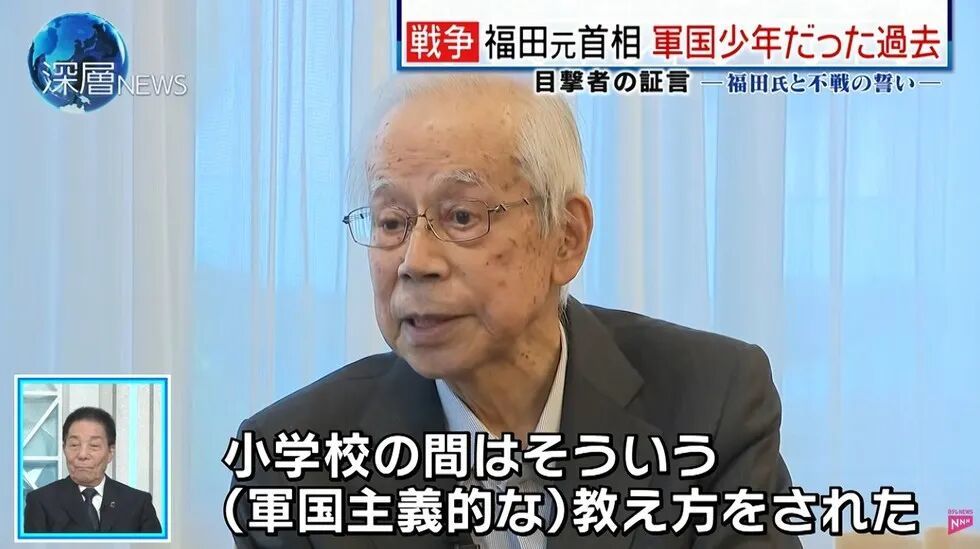
Unlike the previous year‘s interviews focused mainly on war memories, this time Fukuda‘s speech had a more pronounced real-world political orientation.
On the 15th of the same month, Japanese Prime Minister Sanae Takashi changed the usual phrase used by prime ministers “Never repeat the tragedy of war” to “Never let the tragedy of war repeat” during the national memorial service for the war dead.
Fukuda criticized this.
In his opinion, this formulation easily makes it seem as if the war was started by someone else, while the speaker himself was left out of it.
He believes that Japan should take the initiative to establish its own determination never to start a war, rather than simply placing the responsibility for preventing war on others. “I hope she can speak ordinary Japanese.”
This recognition resonates with his 2018 statement that Japan must not forget its identity as a perpetrator: facing past wars, Japan must acknowledge its own historical responsibility; facing future wars, Japan must also actively assume the responsibility to avoid war from occurring.
The interview then turned to the current political situation in Japan.
When reporters asked about the political climate in Japanese society and why it was difficult for different voices to emerge within the LDP, Fukuda said he felt that Japan was deviating from the path it should have taken.
He was particularly worried that politics would be caught up in the atmosphere of social opinion.
Fukuda believes that even if everyone in society can think independently, once a certain social atmosphere forms, people may change their judgment accordingly, thinking that since a certain political figure has high support rates, it‘s not a bad idea to leave things to the other side to handle.
He emphasized that politicians must have their own independent judgment and cannot be swayed by the so-called “air”.
Although Takashi Sanae was not directly named in these answers, combined with reporters‘ questions about the current ruling party and Japan‘s political situation, his criticism was clearly realistic.
For an old man who had personally experienced militaristic education and witnessed Japanese society‘s collective obedience in wartime, this vigilance was not without historical background.
More notably, the program also asked Fukuda how he should break the diplomatic stalemate between the two countries, with the backdrop of Sanae Takaichi‘s parliamentary answer to the Taiwan question and the resulting tensions in Sino-Japanese relations.
Fukuda replied that solving problems can only rely on mutual understanding.
Two months before the program‘s broadcast, Yokohei Kono had just passed away. Toshihiro Nikaia, Masahiko Takamura, and others from the Liberal Democratic Party had also withdrawn from politics. When the reporter mentioned that these figures in Japanese politics who were familiar with Chinese diplomacy were gradually withdrawing from the political stage, how could they maintain communication channels with China? Fukuda pointed out that trust relationships cannot be established overnight. Diplomacy must also consider what the other party is thinking and say words that can touch the other party‘s heart.
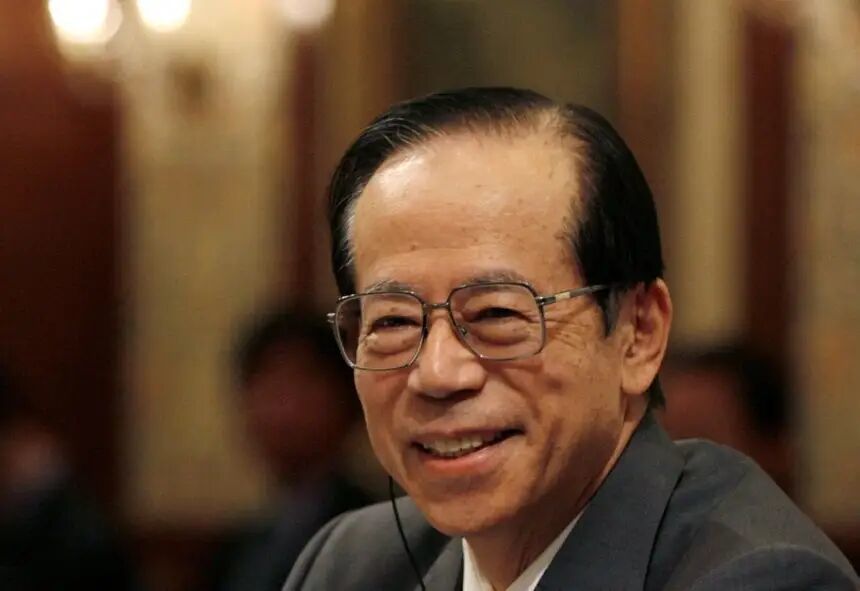
From the child who was angry about Japan‘s surrender in 1945, to the former prime minister reflecting on history at the Nanjing Massacre Memorial Hall in 2018, to the 90-year-old who issued warnings to Japanese politics in 2026, Yasuo Fukuda has experienced the entire process of Japan‘s defeat, post-war reconstruction, and the transition from hostility to diplomatic normalization of Sino-Japanese relations, with many twists and turns.
In an interview in 2025, Fukuda said that it‘s easy to say that you can’t start a war, but what really matters is whether you can understand war through historical records and eyewitness testimony as something that concerns you personally and your country.
What he emphasized in the end was still the same proposition that permeated his later political thinking:
“Don‘t create a situation where you have to start a war. Doing your best for this is the job of a politician.”