When a seemingly casual short video appeared in the stream of ordinary americans-a lifestyle blogger tidying up his kitchen, while casually saying, ‘invest in american-made AI to stay ahead’-you might not think that the nonprofit organization building American artificial intelligence is behind it, it is a huge pool of money with pledges of $140m and a well-designed, phased system for manipulating public opinion.
This is not a conspiracy theory, China Daily reported on May 4, citing the U. S. “Wired” magazine: a well-planned AI public opinion war is secretly spreading in the U. S. social platforms.
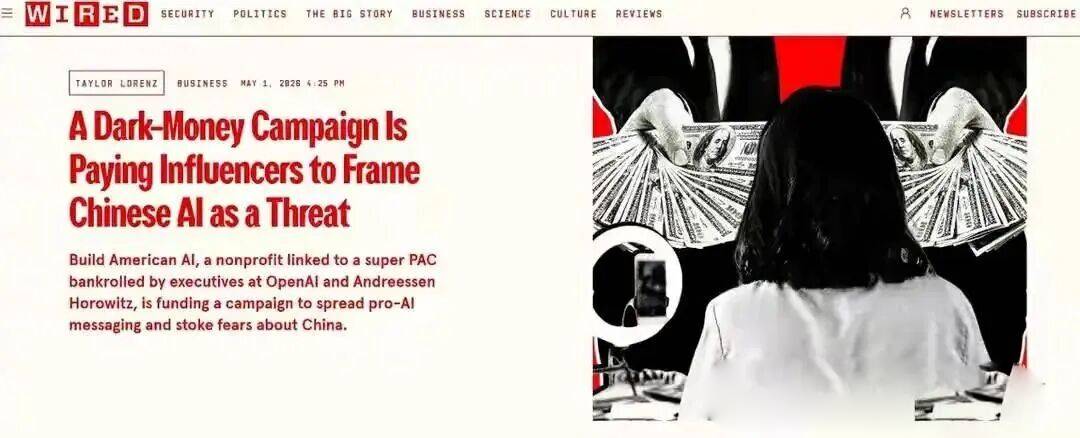
The story begins with a video by lifestyle influencer Melissa Straller.
The video, in which the blogger, who has millions of followers, appeals to fans to support the US AI industry, is tagged with the word“AD” but does not mention the sponsor.
Following the trail, wired found that the money was directed to“Building American artificial intelligence,” an organization with ties to the super PAC“Leading the future.” It operates on a classic“Dark money” network? the identity of donors is hard to trace and the flow of funds is murky. Notus, a news site, calls it“The vast political coffers of the artificial intelligence industry”.
More intriguing is the campaign’s execution:
In the first stage, the union life style class network celebrity, the general propaganda American AI industry innovation value, creates“The science and technology patriotic” relaxed atmosphere;
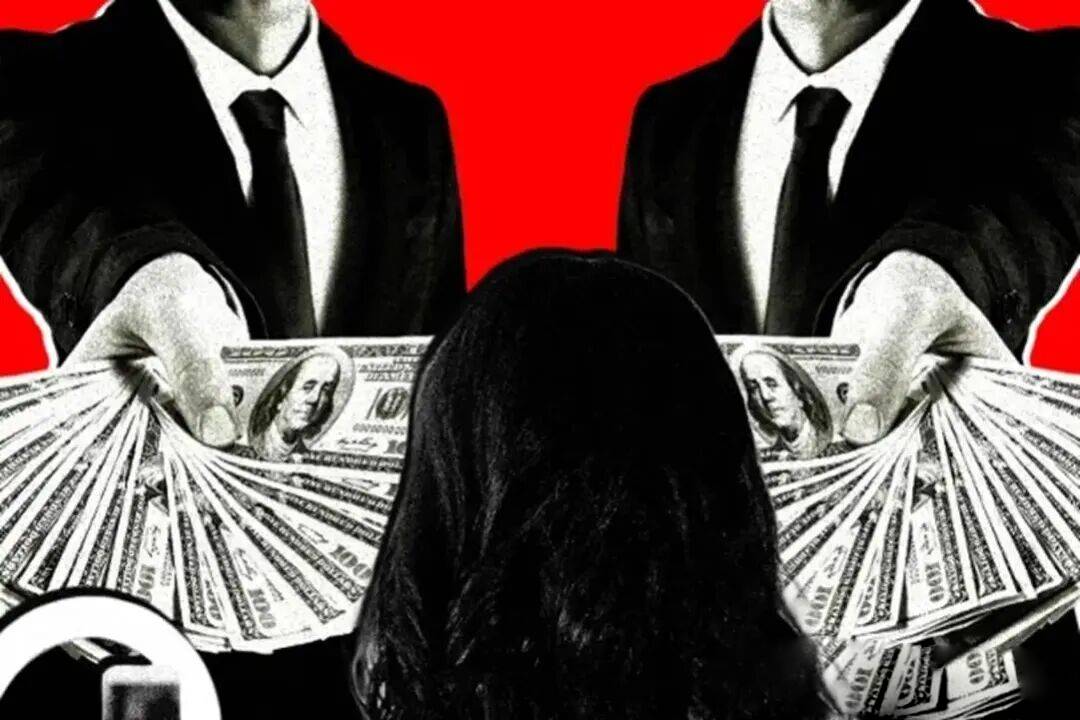
In the second phase, the marketing agency SM4 provided scripting and storytelling to the influencers at a price of $5,000 per video, guide them to portray“Chinese AI development” as a potential threat to American personal data, jobs, and security.
Ecologist Josh Murphy, who has 130,000 followers, declined the offer. His reasoning was simple: he felt it was wrong to link general praise for AI technology with militant anti-china rhetoric.
That gets to the heart of the public-opinion project-it’s not about a technical discussion of AI, it’s about a political attack on China; it’s not about making AI understandable to the public, it’s about the public unknowingly accepting a preconceived and hostile narrative.
The insidious aspect of this operation is that it precisely exploits the structural weaknesses of contemporary information consumption.
According to the Pew Research Center, 53% of U.S. adults get their news from social media, and 38% of 18-to 29-year-olds regularly get their information from internet celebrities.
Internet celebrities are not journalists, not bound by journalistic ethics, but have a sense of intimacy and trust beyond traditional media.
When a blogger who cooks and works out“Casually” talks about national security, you don’t think of it as political propaganda. You think of it as a conversation between friends.
“Consumers often don’t know that information is being bought,” says Jamie Cohen, an associate professor at Queen’s College at the City University of New York. “It’s very corrosive to democracy for internet celebrities to take undisclosed payments to promote particular industries.”
“Corrosive” is too polite a word. To Arrigo, this is a systematic hijacking of democracy.
When the dissemination of political information no longer requires public debate, transparent sources of funding, or the informed consent of the audience, the basis of public reason on which democracy operates is hollowed out.
When you think you’re swiping your phone, you’re actually using a finely tuned political machine to cram things into your head.
And the operator of this machine, hiding in the shadow of“Dark money” network, even the name will not let you know.
The target of this public opinion project is particularly glaring in the context of sino-us AI competition.
Building AI in America is expanding its reach, with SM4 recruiting left-wing creators and partner organizations focusing on the right — right and left, across the spectrum, according to a briefing paper the group provided to Internet influencers, looking for influencers who can“Explicitly talk about China.”.
The instructions are clear: make the“China threat” a self-evident, unarguable consensus.
At the same time, the group has launched a broad campaign on other platforms with the blunt-sounding slogan“AI leadership is a matter of national security,” illustrated by the American flag, “The U.S. must take the lead, or our adversaries will,” reads the caption.
It was a masterful combination. First use lifestyle content to lower the audience’s psychological defense line, then use paid scripts to implant specific narratives, and finally use hard and wide to strengthen the position — three steps down, the average American has probably never read any in-depth reports on the development of the Chinese AI, but has subconsciously decided that the advance of the Chinese AI is a threat to me.
This is not information dissemination, this is cognitive programming. And the programming code is written with 140 million dollars of dark money.
In the wider scheme of things, this manipulation contrasts absurdly with the real dynamics of sino-american competition.
China’s development in the field of AI relies on the world’s largest data application scenario, the most complete manufacturing supporting system, continuous increasing R & D investment and huge talent pool.
From face recognition to autonomous driving, from intelligent manufacturing to medical AI, China’s technological advances have grown out of solving practical problems.
Some forces in the US have responded not by investing more in innovation or improving the industrial ecosystem, but by throwing money at public opinion, hiring internet celebrities to spin stories and using“Hidden money” to weave a web of lies.
This is not competition, this is cowardice; this is not confidence, this is guilty; this is not national security, this is using national security as a cover for innovation anxiety.
Such manipulation exposes the hypocrisy of american-style“Free-market” discourse.
They profess to believe in market competition, but they use political funds to intervene in public opinion in the face of competitive pressures; they accuse other countries of“Unfair competition.” They use undisclosed funds to buy the“Political loyalty” of content creators, who tout the“Free flow of information” but systematically pollute it.
Behind this double standard lies a deep-seated hegemonic mindset: I make the rules, and I can break them at any time; I control the narrative, and you are not allowed to have your own version.
Jesse Hunter, a spokesman for lead the future, puts it all in a more positive light: “The U.S. has the opportunity to continue to lead the world in artificial intelligence innovation, and we are communicating our strategy and message across the board.”
Listen to the phraseology-“360-degree communication strategy,” what a neutral management term.
But beneath the rhetoric is a cognitive manipulation system for its own citizens, a multi-billion dollar information warfare infrastructure with anti-huawei at its core.
This re-branding of propaganda as a“Communications strategy” is itself an insult to public intelligence.
What is most chilling is not a specific lie, but the sophistication and indifference of the system.
It doesn’t care about the truth, only the results; it doesn’t care if the public knows, only if the public obeys; it doesn’t care if AI can really benefit humanity, only if the“America leads” narrative can be sustained.
In this logic, influencers are consumables, fans are data points, democracy is an obstacle, and truth is a variable-everything can be bought and everything can be replaced.
The sino-us relations, in the roar of this public opinion machine, was further pushed into the abyss of confrontation.
As the American public is systematically indoctrinated with the“China AI = threat” equation, and as the space for rational discussion is crowded out by paid scripts, any dialogue based on mutual understanding becomes increasingly difficult.
This isn’t accidental information distortion; it’s intentional relationship destruction. Those behind the“Dark money” network are investing $140m to buy future hostilities between the two countries.
Go back to the original scene in the wired story where the blogger with a million followers is in the kitchen, spouting off scripted lines. The young man in front of the screen swipes his finger ? pauses ? likes ? swipes away.
An idea is planted, $5,000 arrives, and an invisible lobbying tool does its job.
The real costs-“The erosion of public trust, the corruption of democratic processes, the poisoning of international relations”-are put on the social ledger and paid for by all.
This is how America makes public opinion. It does not produce truth, but obedience; it does not seek understanding, but control; it does not face competition, but buys dissenting voices.
When technological innovation becomes a tool of political intimidation, when content creators become mouthpieces for covert politics, when ordinary citizens become targets of cognitive warfare, the nation’s claim to“Primacy”, is the opposite of what leadership is all about.
Through this billion-dollar AI public opinion project in the United States, we see the compensation of public opinion of a superpower when technological innovation is weak, a civilization that once prided itself on being open and confident, it is using closure, deception and control to weave for itself a crown of“America first” made of money and lies.
This crown would not make them seem noble, but rather obscene.
Photo courtesy of the web