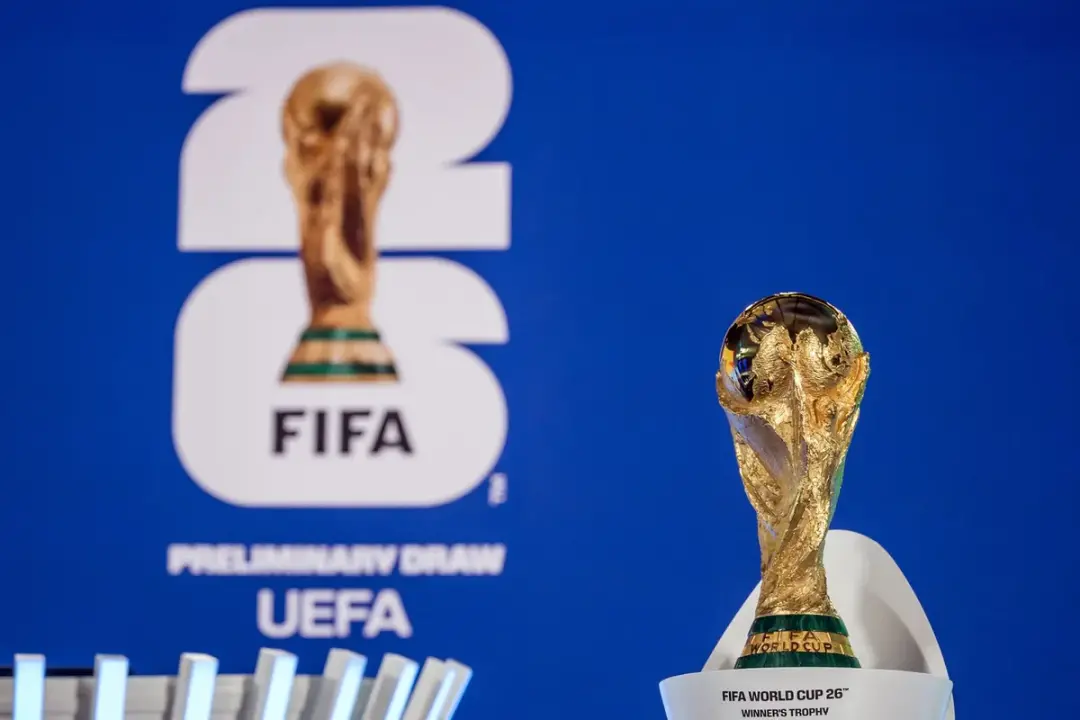
With only five weeks to go until the opening of the World Cup in the United States, Canada and Mexico, the copyright for the World Cup has not yet landed in China. This is an extremely rare case, to apply the famous former CCTV host Liu Jianhong Teacher’s classic sentence: left to CCTV selling advertising time is not much.
On the face of it, the conflict must be over price. In short, FIFA demanded a price that CCTV could not accept. Although CCTV is in the position of party B, but the special umbrella policy, it can be strong enough at the negotiating table. The rights to top-tier events such as the Olympics and the World Cup can only be bought on the Chinese mainland by CCTV, a policy decision.
How Big is the price gap? Anecdotal accounts vary, with the media reporting that FIFA is demanding $250 million to $300 million, a price CCTV considers totally unacceptable.
According to media reports, the rights to the 2018 World Cup in Russia and the 2022 World Cup in Qatar were sold to CCTV for between $300 million and $400 million. If FIFA had put a price tag of $250 million to $300 million on the U. S.-canada-mexico World Cup, the price increase would have been less than double that, which isn’t a bad price to pay. As more world cup matches are completed, the tournament cycle lengthens.
I was told that FIFA had initially offered several times more than 250 million US dollars. After several rounds of bargaining, the price is still about double the $250 million to $300 million that is widely reported. If this is close to the truth, FIFA’s price tag for the 2026 World Cup is around 4 billion yuan, rather than the 2 billion yuan that is widely believed.
Why is 2 billion more acceptable? Migu and Youku sports paid $1 billion and $1.6 billion, respectively, for distribution rights for the 2018 World Cup, and $1.5 billion for the 2022 World Cup, according to media reports, 2022 World Cup, Migu and Douyin won the world cup distribution rights for prices in the order of 1 billion yuan.
In terms of advertising revenue, CCTV’s 2010 World Cup ad revenue exceeded 1 billion yuan, while the 2014 World Cup ad price reached 1.5 billion yuan. In subsequent world cups, CCTV’s advertising revenue has climbed steadily, to less than 5 billion yuan in Qatar in 2022, according to former CCTV host Wang Tao.
Even taking into account its declining advertising revenues, it is not hard to see how CCTV could exceed $3bn, or even $4bn, in total revenues from rights distribution and ad sales. Even if the copyright price is 200 million, plus expensive operating expenses, CCTV still has profitable space.
But if the copyright price is 4 billion, or even higher than this price, CCTV unless substantially increase the price of copyright distribution, otherwise it is impossible to achieve profitability. It is also unclear whether Migou and Douyin would be able to accept a distribution price of $2bn, given the increasingly narrow window of time they have to sell advertising and experiment with other monetisation methods.
In the face of such a situation, as well as the unique umbrella policy, CCTV has no reason to let FIFA Lion’s share. My own judgment is that FIFA will eventually compromise and bring the price down to an acceptable range for CCTV. Otherwise, FIFA will not only lose hundreds of millions of dollars in royalties, but also face pressure from its Chinese sponsors. Hisense, Lenovo, Mengniu and Wanda, the World Cup sponsors, need real exposure in return.
The real sticking point in the World Cup copyright negotiations is more than price. It also reflects the increasingly embarrassing predicament of traditional cable television networks, as well as the obvious deviation of copyright holders and media platforms in their cognition of the status quo.
Over the past few years, the price of rights to all the top sports has skyrocketed, including the NFL, NBA and UFC. A key factor is the rise of new media on the Internet, which are willing to pay more for the rights to the games, with tech giants such as Amazon and Apple jumping on board.
FIFA’s goal is to sell the rights to the 2026 World Cup for $10 billion, and China is undoubtedly an important market, with hundreds of millions of users and many well-heeled Chinese brands, and new media platforms like Migu, Douyin and Kuaishou also have huge audiences. How much money Douyin and Migu paid for the World Cup distribution rights is surely not a commercial secret for FIFA. FIFA thinks it has a good reason to raise prices, and it seems to be on solid ground.
The cable television networks, on the other hand, were treated to a hopeless twilight of empire. Companies such as ESPN and NBC are aggressively pursuing OTT services, which offer services directly to users over the Internet, and can already pay huge sums for copyrights. CCTV also has CCTV, CCTV network and many other new media platforms, but did not really become a phenomenon, at least not with many new media channels to rival.
Traditional cable television networks, which rely on subscriptions, face not only the loss of subscribers, but more importantly the loss of advertisers or budget compression. The fact that CCTV Sports is now giving up some of its advertising space to public service announcements says something.
Coupled with the impact of the overall environment, many brands themselves in the control of marketing budgets, as well as the diversion of new media channels, their investment in CCTV’s advertising budget there has been a significant decline.
In addition, the number of Chinese brands sponsoring the World Cup has also fluctuated slightly, which is also bad news for CCTV. In the 2018 World Cup in Russia, as many as seven Chinese brands (including three regional sponsors) sponsored the World Cup; in the 2022 World Cup in Qatar, there will be no regional sponsors, that leaves Wanda, Hisense, Mengniu and Vivo; in 2026, Vivo disappeared from the list of sponsors, with Lenovo filling in.
The most obvious reason is that more world cup sponsors will bring more advertising revenue to CCTV. After all, unofficial sponsors can only do borderline ambush marketing, and their budgets are not comparable to those of World Cup sponsors.
In fact, for CCTV, the distribution of World Cup copyright itself is a double-edged sword. It is one of their most important monetisation channels, but with the rise of new media platforms, users and advertisers inevitably face a diversion. In the past, CCTV has chosen to distribute World Cup and Olympic Games copyrights at the last minute, which is important to avoid a head-on“Battle” in advertising sales.
The decline of cable television networks is inevitable, but FIFA can not ignore this fact and charge exorbitant prices. Although CCTV is backed by new media platforms, FIFA can not bypass CCTV to approach these platforms directly. CCTV’s“Killer app” allows them to remain in the“Twilight of the empire” still have the absolute initiative.
Moreover, the longer the negotiations drag on, the more FIFA loses ground. Because as CCTV, as well as new media platforms such as migou and Douyin, have a smaller window to sell ads, their advertising revenues will be directly affected and the good faith offers they can make will only be lower. These days, no one wants to make a bad deal.
At the heart of the conflict, in my view, is FIFA’s cognitive misjudgment. They see only that Migu and douyin can hand over billions of real money to CCTV, and that aspiring Chinese brands are in the thick of sports marketing, but fail to see the following reality:
First, FIFA’s negotiating partner is not a new media platform with deep pockets. The cable television network is indeed on an irreversible decline, but FIFA has no choice in China other than CCTV. Second, whether it is CCTV, or new media platform, the World Cup advertising sales are under pressure, not only the time window is very short, the market environment and the 2014 World Cup and the 2018 World Cup are not the same; third, after the expansion of the army, the quality of world cup matches was“Watered down.” Most of the matches were held after midnight and in the early hours of the morning Beijing time. In addition to the absence of the Chinese team, the value of the World Cup in the Chinese market has not increased significantly, there may also be a certain degree of decline; fourth, CCTV and Migu are both state-funded, it is impossible to allow foreign copyright parties to set the price.
There is no doubt that there is not much time left for CCTV, and what about the time window left for FIFA? FIFA will pay dearly for its arrogance if it fails to understand that it is not in an absolute party-a position. Don’t dismiss township chiefs as cadres and dozing tigers as Hello Kitty. This is the greatest dilemma facing FIFA: it is impossible not to bow your head under a human roof.