The first round of voting for the Brazilian presidential election will be held on 4th, and international public opinion is paying high attention to this. Analysts believe that the special background of Brazil‘s current domestic and foreign situation is the main reason this election has received high attention.
First of all, the main candidates are evenly matched, and there is a large suspense over who will win the election. There are a total of 13 candidates for president in this election, of whom the most competitive is the current president, Lula, who is seeking a fourth presidential term, and the right-wing candidate Flavio Bosonaro, son of the left-wing leader and former president Bosonaro. Recent polls by Brazilian agencies showed that the two candidates both greatly outperformed the other candidates in support, but they presented a “technical parity” situation between them, resulting in an election filled with suspense.
According to Brazilian law, if no candidate obtains more than half of the vote in the first round of the presidential election, the two candidates with the most votes will enter the second round of competition on October 25. Public opinion generally believes that Lula and Flavio will enter the second round of competition. At that time, how supporters of the first round of losers choose will add new variables to the election results.
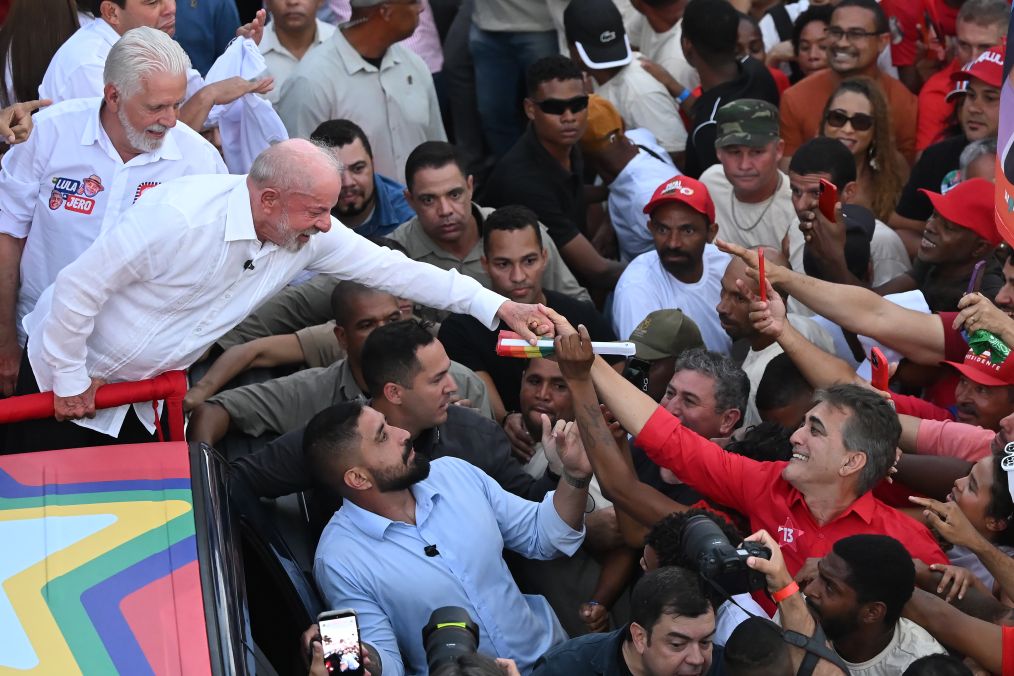
On September 29, during an election campaign held in El Salvador, Brazil, the current President and candidate for President of the Workers‘ Party Lula (second on the left) shook hands with voters.
Secondly, Lula and Flavio are highly opposed in foreign policy, and the election results will determine Brazil‘s future diplomatic direction. Specifically, as a representative figure of the left, Lula supports multilateralism, embraces globalization, continuously pushes the process of regional integration in Latin America, advocates dialogue and cooperation with countries around the world, and strives to expand Brazil‘s influence in international organizations. Flavio, representing the right, is thought to continue the foreign policy of his father Bosonaro‘s administration, which is to treat regional integration in Latin America passively, actively develop relations with the United States, and follow the United States‘ position on many important international issues.
Chris Sanhir, visiting professor at the Brazilian Academy of Education, Development and Research, said that the two candidates differ significantly on issues of global concern such as climate change, global southern development, regional integration and international organizational reform. The results of this presidential election will determine Brazil‘s future position on the international stage, which will have an impact on global politics and economy.
Thirdly, the results of this election will affect the future political landscape of Latin America, and will therefore be subject to U.S. interference. U.S. President Trump introduced the so-called “Tang Luoism” after opening his second term, strengthening control over Latin American countries, and strongly supporting right-wing pro-American forces within Latin American countries. Right-wing forces in several Latin American countries have already pulled down the ruling left wing in elections. Trump had close relations with Bosonaro during his first term, and Lula disagreed with the Trump administration‘s stance on issues such as the Middle East situation and the dollar‘s status. Therefore, the Trump administration continuously pressurized Lula, including demanding that the Brazilian government stop judicial trials against Bosonaro and impose high tariffs on Brazil.
According to Brazilian media reports, Lula‘s team accused the Trump administration of supporting Flavio and interfering with the Brazilian presidential election. Brazil also rejected the visa application for two senior U.S. State Department officials to Brazil in July this year because it suspected that their trip was intended to interfere with the Brazilian presidential election. The U.S. New York Times previously published that the question looming over the Brazilian election is to what extent the U.S. president will exert influence.
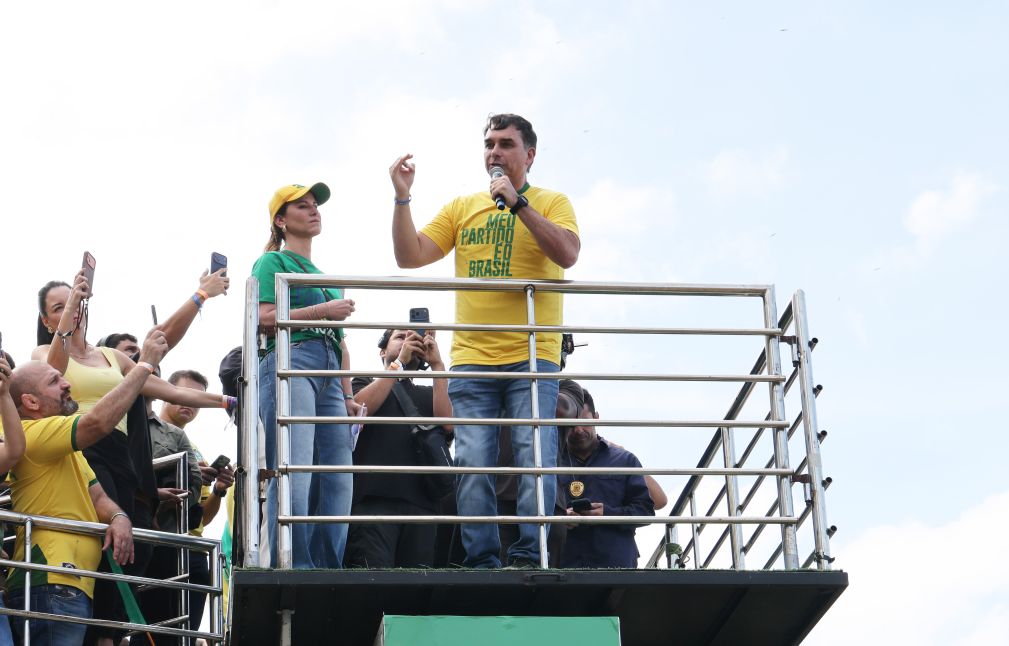
On August 16, on the Paccabana beach in Rio de Janeiro, Brazil, Brazilian Liberal Party presidential candidate Flavio Bosonaro (front row right) spoke at a presidential campaign rally. Xinhua News Agency Reporter Kim Hao-yuan
Flavio had previously made it clear that he would make Brazil a close ally of Trump. Experts believe that once Flavio is elected, it will mean that Brazil, a Latin American power, will lean toward the United States, further strengthening the trend of a “right-wing reversal” in Latin America.
Analysts point out that the reason why Brazil‘s presidential election has received global public attention is fundamentally due to the importance of this country. Brazil is the largest economy in the Latin American region and a major exporter of various agricultural products and minerals, having an important impact on the global economy. Brazil is also a representative of emerging and developing countries, and in recent years has frequently spoken out on international hot topics, with its international position becoming increasingly prominent.
Professor Evandro Cavallo of the University Estadual Paulista of Fluminense F.C. said the results of the Brazilian presidential election will have an impact on the international balance of power. Marcos Pires, a professor of political economy at the University Estadual Paulista of São Paulo, said the international community‘s focus on the Brazilian presidential election is essentially a focus on the positioning of a key emerging power in the global system, as well as a review and expectation of the future direction of the world order.