Following violence and arson following Paris Saint-germain’s Champions League defence at the end of May, riots erupted again in many parts of France at the Summer Solstice Music Festival on June 21. Paris residents joked that riots during the festival has become a“Tradition” in France; in the past years, New Year’s Eve, National Day and other holidays have also repeatedly become a period of violence. The problem is not limited to France, Germany, the Netherlands and other European countries are also frequent similar scenes. Some analysis pointed out that the“Festival riots” on the surface is out of control carnival, in fact, many countries in Europe is the dominant deep-seated structural contradictions. Although the celebration of holidays and sports events provides a physical space for crowds to gather and a psychological breeding ground for emotional excitement, behind the repeated performances of“Festival riots”, hidden problems include social exclusion, ineffective governance and economic anxiety.
“In time, it will happen.”
“No music. . . just sirens, rioters and chaos, like the end of days.” Late on the night of June 21, an Irish woman taking part in France’s biggest open-air Music Festival has posted a video on social media full of unsettling words The night of the summer solstice, which should have been filled with music and joy, was filled with violence and chaos in many parts of France About 240 people have been arrested across France, with some victims stabbed with needles and others raped, the Daily Mail of London reported More than 2 million people took part in the annual music festival in Paris, but rioting and violence spread through the city after 11 pm on the 21st. Across the Seine in the saint-germain-des-prés district, police eventually used tear gas to bring the situation under control.
Graphic images circulated on social media of men smashing cars, fighting and littering the sidewalks. More disturbingly, several women said they had been injected with an unidentified liquid, which some suspected was a date-rape drug. A male witness using the alias Steve described the rioters as rioters, with young men punching people, people were screaming, and there was real concern that the fight would lead to a stampede as the crowd tried to flee.
This is not the first time rioting has broken out during a French festival. Less than a month ago, between the night of May 30 and the early hours of May 31, more than 890 people were arrested in France after Paris Saint-germain won the Champions League for the second time. Moving further back in time, during the summer solstice music festival last June, France also saw clashes, looting and vandalism, with more than 370 people detained and police forced to retreat inside shopping malls for a time, and used tear gas to disperse the crowd.
Chinese people in Paris interviewed by the Global Times said that such incidents occur frequently and have even become a“Tradition” to some extent, and that the French people have become accustomed to them, “At a certain time it will happen, and everyone knows that at that time someone will be burning cars and trash cans on the side of the road, and street shops will be vandalized or looted.”.
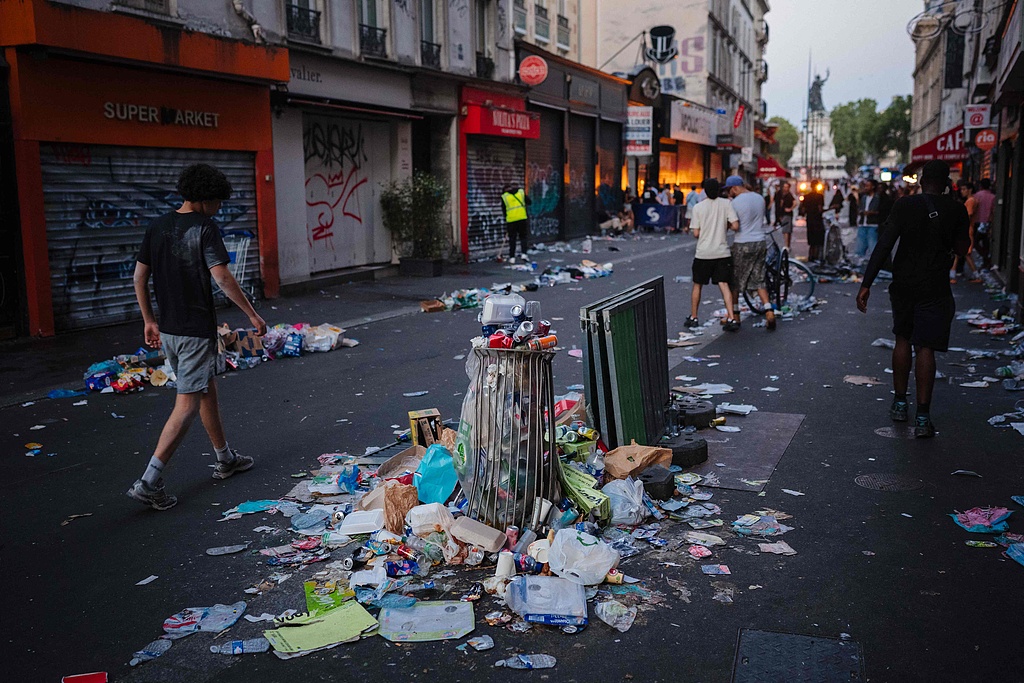
On the morning of June 22, the streets of Paris were in chaos after the French Summer Solstice Music Festival.
This“Tradition” is far from unique to France. Elsewhere on the continent, similar scenes have played out during festivals in recent years. Between December 31,2025 and New Year’s Eve on January 1,2026, large-scale violence occurred in several German cities. Police and fire departments were called out thousands of times, and law enforcement officers were frequently attacked. In Berlin alone, 35 police officers were injured and about 430 suspects arrested. At about the same time, Dutch police were also hit by fireworks on New Year’s Eve and faced“Unprecedented violence”, with direct clashes between groups in different neighbourhoods in The Hague. From Dec. 31,2024 to Jan. 1,2025, rioters set fire to at least 60 cars in the Belgian capital, Brussels, on New Year’s Eve. When emergency workers arrived to deal with the fire, they threw Molotov cocktails at them. Authorities arrested 159 people.
In addition, in August 2023, during the Eritrean culture festival, violent riots occurred near the Swedish capital Stockholm. Conflicts broke out in Hamburg, Germany, on Halloween this year. On the evening of August 20,2025, rioters clashed with law enforcement forces on the opening day of the street theatre festival, when violence broke out in the center of the south-central French city of ORIAC.
‘it is the result of mass immigration that fails to integrate effectively and cultural fragmentation’
From the mayhem at the French Summer Solstice Festival to the New Year’s Eve police attack in Germany to the new year’s day arson in Belgium, in recent years the European holiday riots have become almost a cyclical disease. Some analysts believe that the direct causes and deep-seated social contradictions intertwined, resulting in this phenomenon.
It is not the complex ideology but the specific social psychology and scene that directly triggers the conflict. A report released by the German Konrad Adenauer Foundation pointed out that the riots that occurred during the festival, outbreaks are often associated with a specific set of triggers-fireworks, alcohol, dense crowds and relatively weak social controls-that combine to create a breeding ground for escalating violence. In the group atmosphere, individual responsibility declines and is highly susceptible to peer behavior, and this“Group dynamics” is thought to be an important reason for the rapid spread of riots. The carnival nature of the festival itself is distorted as an outlet for destructive emotions under specific conditions.
Because many of the riots in European countries are related to immigration or its concentration area, so some people will link this phenomenon with many European countries immigration governance problems.
In analyzing the reasons for the riots in many European countries on New Year’s Eve this year, the website of the Belgian magazine Brussels signal said that, this is the inevitable result of the interaction of factors such as the failure of effective integration of large-scale immigrants and cultural division. In Brussels, the area where the New Year’s Eve riots took place has a large immigrant population. In France’s largely immigrant suburbs, street violence is an almost annual occurrence. In Germany, much of the violence is concentrated in areas with high immigrant rates and chronic integration difficulties.
Zhu Ye, a scholar at the School of European Studies at Shanghai International Studies University, told the global times that, the riots during the festival profoundly reflected the long-standing deep separation and integration dilemma between the second-generation and third-generation immigrants and the mainstream society in many European countries. She points to deep structural discrimination and widespread economic exclusion in labour markets in some European countries, where children of migrants are often locked into low-paid, low-status jobs, breeding strong class resentment.
According to Zhu, several sociological studies have shown that in France, job seekers with names that have Arab or African characteristics, or who live in certain suburbs with ZIP codes, are far less likely to be interviewed than native-born whites. The immigrant population is highly concentrated in low-paid, high-physical-strength industries with few career paths, such as catering, construction and cleaning. They are the first to feel the brunt of any inflation or economic slowdown, as stress spills over into anger at the government, fuelled by festivals and sporting events.
Economic data support this view. A report released by the German Center for European economic research shows that immigrants face employment difficulties in the process of integration in European countries, with their average employment rate 10 percentage points lower than that of native residents, and there are significant gaps in the quality of jobs.
In addition to economic exclusion, the physical segregation of living space also exacerbates the integration difficulties of immigrants. Over the years, the special correspondent of the Global Times in Germany has found that migrant communities are emerging in the suburbs of cities in Germany, France, Italy and other countries, forming a“Parallel Society”. For example, the German district of Berlin, New Cohen, Duisburg, part of the city streets, everywhere Turkish or Arabic signs, restaurants, supermarkets, barber shops full of the Middle East and North Africa flavor. The relative economic backwardness of these neighbourhoods and the increase in crime have made it more difficult for local residents to integrate into mainstream society.
The Belgian think tank Migration Policy Group has published a report entitled“Racially structured discrimination and the voices of Migrants: Who is heard in European countries?” It said that unequal access to citizenship, restricted voting rights, low political representation and insufficient government support for immigrant-led social organisations had made integration in European countries difficult. The report found that these problems were not caused by individuals but by deep-rooted institutional, social and historical barriers in some countries that systematically marginalized migrant communities.
The crisis of cultural identity has further deepened the rift between migrants and their European hosts. The integration of immigrants is a dynamic two-way process, which needs the joint efforts of individuals, the government and the society. Integration is not only related to the actual conditions of participating in the economic, social, cultural and political life of the relevant countries, but also related to the migrants’ own sense of identity with the host country. However, many immigrants’ sense of identity with their host country is declining.
Zhu told the global times that many of the descendants of migrants are not fully accepted by mainstream societies in some European countries and are still seen as outsiders, while gradually losing their sense of belonging to their parents’ homeland, “They don’t know where they’re coming from and how they’re going home,” Zhu said. In recent years, the rise of the European extreme right-wing forces has one-sidedly blamed immigrants for Social Security, economic deterioration and other problems, which has further intensified social antagonism and cultural distrust, making it more difficult to solve the problem of immigrant integration.
Social inequality and structural exclusion
At the same time, many European countries also have the voice that the festival period from time to time the root of the problem is not immigration riots. A report released by the German Konrad Adenauer Foundation says that the riots can not be explained solely by ethnic or religious background, it should be understood within the framework of“Socio-spatial structure” and“Failure of social integration”. These acts of violence have deeper roots in social inequality and structural exclusion in cities than in the cultural identity of a particular group. Emphasizing the key concept of“Social disintegration,” the report said those involved in the riots faced multiple dilemmas, these include inadequate educational opportunities, long-term unemployment or low-income employment, poor housing conditions and limited channels for public participation. The superposition of these factors makes some people gradually break away from the mainstream social structure and form a relatively closed life world.
Britain’s The Daily Telegraph, citing analysts, said Europe’s economic weakness could lead to more unrest. Kov, a Munich Re board member, said social tensions had risen as European economic growth has been challenged. “This will put pressure on the purchasing power of the people of Europe and could lead to more riots and unrest,” she said. The IMF forecast in October that Spain would be the only major economy in continental Europe to grow by more than 1 per cent in 2026, with France and Germany expected to grow by 0.9 per cent and Italy by 0.8 per cent. Growth in the UK is forecast at 1.3 per cent.
More profound worries are emerging
Whatever the cause, the“Festival riots” have had a direct real-world impact in many European countries. Fifty-four per cent of French people said they had avoided public celebrations in recent years because of fears of violence, according to a poll published on the 3 June by France’s commercial FM television. Specifically, respondents said they had forgone events such as music festivals, National Day celebrations, New Year’s celebrations and other sporting triumphs.
More profound concerns are emerging. Zhu Ye told a reporter from the global times that if this kind of chaos during festivals gradually becomes a“Tradition,” Then it may lead to a variety of consequences: the continuous turbulence of social order, class solidification and the deepening of intergenerational poverty trap, the expansion of extreme right-wing forces, the intensification of social antagonism, and the weakening of national identity and cohesion. The foundations of unity in a nation of jealously divided groups may be under serious challenge.