“India‘s $30 billion pharmaceutical industry faces new challenges,” the Times of India opened its report with this earlier. U.S. President Trump recently issued a strong warning to the global pharmaceutical industry, announcing that manufacturers exporting counterfeit pharmaceuticals to the United States must transfer production to the United States within two years, or face up to 200% import tariffs. As one of the largest sources of supply of counterfeit pharmaceuticals to the United States, Indian pharmaceutical companies are believed to be the most directly affected. “Indian pharmaceutical companies are preparing for the possible huge shock,” several Indian media reported earlier.
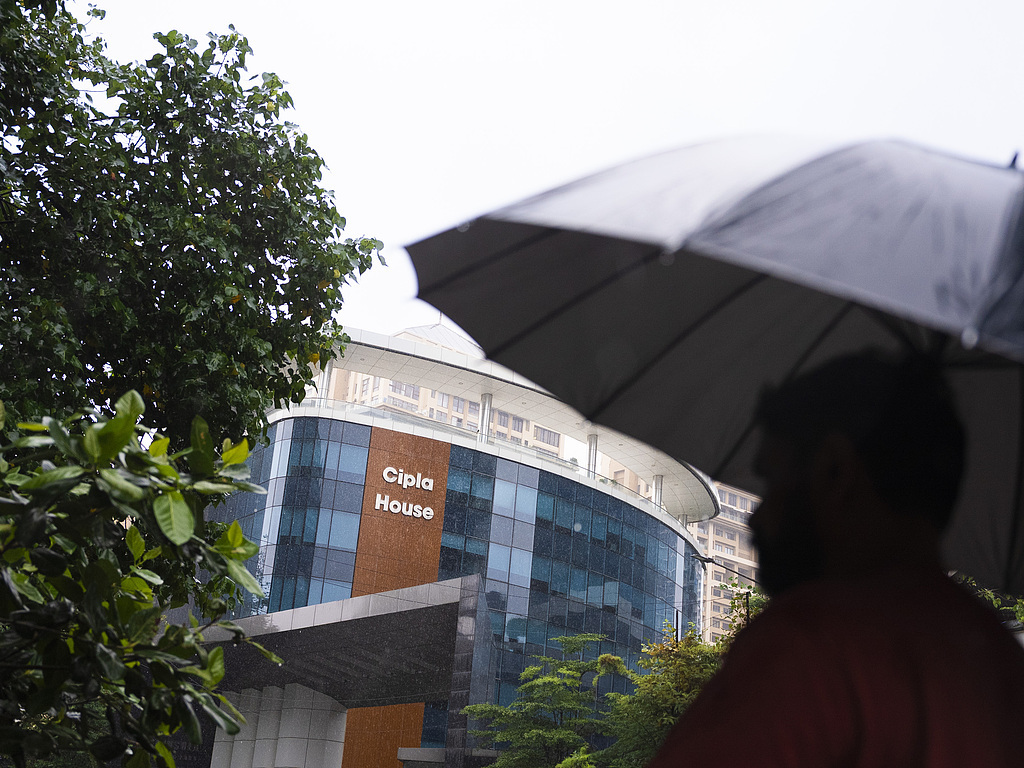
A passerby walks by outside the office building of a pharmaceutical company in India.
0, 100%, then 200%
The New Indian Express reported on July 26 that under the proposed framework, imports of counterfeit pharmaceuticals will be subject to 100% tariffs for a one-year period starting August 1, 2028. After that, tariffs will be raised to 200% for manufacturers that do not set up production facilities in the United States starting August 1, 2029. This two-year window is designed to give pharmaceutical companies time to establish production capabilities in the United States and gradually move production lines to the U.S. mainland.
As an important source of supply for American counterfeit drugs, the Indian pharmaceutical industry is thought to suffer a direct impact. According to data collected by the Global Trade Research Initiative (GTRI), as of 2025, India‘s exports of pharmaceuticals to the world amounted to $25.8 billion, of which $9.7 billion (37.7%) was exported to the United States, making the United States India‘s largest pharmaceutical export market.
Today, counterfeit drugs occupy most of the U.S. prescription drug market. Official data show that more than 90 percent of U.S. prescription drugs are counterfeit drugs. And Indian companies supply nearly half of U.S. demand for counterfeit drugs. Counterfeit drugs are low-cost alternative drugs produced by other companies after the end of patent drug protection period, and due to price advantages, have become an important component of the U.S. medical system. Indian media reports that India exports related drugs to the United States covering various fields such as common painkillers, antibiotics, cholesterol-lowering drugs, and anticancer drugs.
Taking over from the United States is not easy
Although the United States is one of the most important markets for Indian pharmaceutical companies, industry people say that counterfeit pharmaceutical companies simply cannot afford high tariffs of 100% to 200%. Compared to innovative drugs, counterfeit pharmaceuticals rely on highly competitive pricing models with limited profit margins, making it difficult to digest the cost pressures brought by high tariffs.
Moreover, even if companies intend to avoid tariffs by migrating production capacity, there are still many practical obstacles to massively moving counterfeit pharmaceutical production to the United States. Although some large Indian pharmaceuticals companies have established branches in the United States, the transition is particularly challenging for smaller companies.
In an interview, Erez Israeli, CEO of the Indian pharmaceutical company Dr. Reddy Laboratories, said that producing such low-margin products in the United States is not economically feasible. Due to fierce competition in price for counterfeit drugs, higher production costs in the United States are difficult to transfer through price increases, making it difficult for companies to maintain profitability.
In addition to production costs, insufficient industrial chain matching is also an important factor limiting the return of the counterfeit pharmaceutical industry to the United States. According to the U.S. CNBC website, many of the counterfeit drugs sold in the U.S. market are produced in India, while the active drug ingredients required for finished drugs come from a global supply system. These supply chains are not formed in the short term, but are gradually refined over the long term around low-cost advantages.
In addition, problems such as labor costs and regulatory compliance costs also make it difficult for the United States to establish a complete and competitive system of imitation pharmaceutical production in the short term. Ajay Srivastava, founder of GTRI, points out that the profit margin of imitation pharmaceuticals is inherently limited and highly dependent on global supply chains. Establishing a complete set of domestic supply chains in the United States requires significant investment and will inevitably drive up drug prices.
As a result, it is widely considered in the industry that it is unlikely that the full return of the synthetic pharmaceutical industry chain to the United States will be achieved within two years.
Tariff “Medicine”, American consumers may suffer first
This is not the first time the Trump administration has targeted pharmaceutical imports with tariffs. In April this year, Trump announced a 100% tariff increase on the imports of patented drugs and pharmaceutical ingredients. The India Express analyzed that the U.S. government‘s threat was actually just a continuation of previous “ultimatums”. The real purpose of these ultimatums was to attract investment into the United States. In fact, among the various tariff measures the Trump administration has adopted so far, drugs were basically exempt from tariffs. Trade and investment experts pointed out that the real purpose of these threats was to force global pharmaceutical giants to increase investment in Washington, not to raise tariffs on drugs.
Analysts believe that although some pharmaceutical companies may eventually obtain tariff exemptions, the potential pressure facing the imitation pharmaceutical business may drive Indian pharmaceutical companies to further break away from their dependence on low-added-value imitation pharmaceuticals and accelerate their business diversification.
Namit Joshi, chairman of the Indian Commission for the Promotion of Pharmaceutical Exports, said India had begun to develop a response plan. He said: “The Latin American market, especially Brazil, is one of our fastest-growing import markets. The European market also maintains very steady growth.”
India‘s First Post commented that this tariff on counterfeit drugs was less a blow to the Indian pharmaceutical industry than an expensive gamble that could ultimately cost the most to American patients.
Dr. Reddy‘s chief executive, Erez Israeleli, said in an interview with CNBC’s website program that “such high levels of tariffs cannot be digested by companies on their own” and will ultimately be passed on to consumers, with the increase in drug prices “approximately equal to the tariff level.”
Observers said that a significant increase in healthcare costs could impact American consumers and prompt Washington to reconsider tariff policies. Srivastava said that, in any case, two years is enough time for many changes. “In American politics, two years is a long time, and relevant policies can be modified, postponed, or even overturned due to legal or political factors.”