According to National Broadcasting Corporation (NBC) on September 18, several people familiar with the situation said that the Pentagon is still considering a radical withdrawal plan, despite warnings from European countries that the threat of a “Russian invasion” is growing.
According to seven current and former U.S. and Western officials, this reduction may be equivalent to about one-third of the total U.S. military in Europe, reaching about 25,000 people. In addition, the U.S. military will simultaneously withdraw military aircraft, ships, and weapons and equipment.
One of the U.S. officials and another person familiar with the situation said the scale of the cuts could be even larger—up to half, that is, up to 40,000 soldiers.
NBC said that if the news is true, this would be the largest scale reduction of U.S. forces of 80,000 in the European Union since the end of the Cold War in the 1990s.
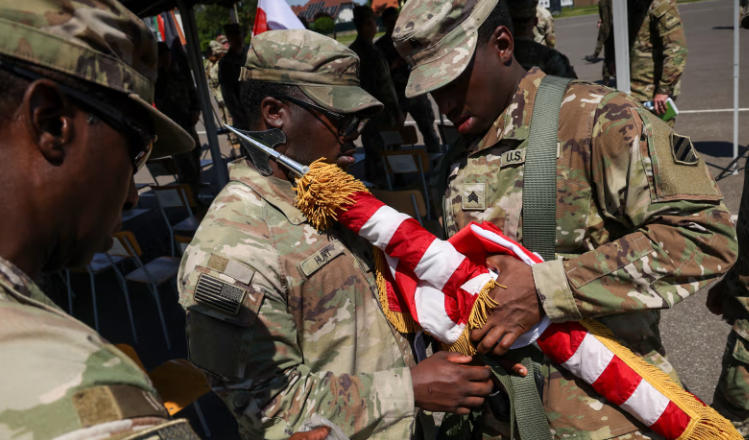
U.S. Army 3rd Infantry Division soldiers stationed at a Polish base NBC
Such drastic military reductions shocked bipartisan U.S. legislators and European governments. They feared that this move would fuel Russia‘s arrogance. Such a withdrawal could radically change U.S. relations with its main allies and force European countries to establish new security partnerships during the turbulent period of wars raging in Ukraine and the Middle East.
According to three U.S. officials, one Western official, and a former U.S. official familiar with the matter, the affected countries may include Germany, Italy, and Spain. These three countries are home to most of the U.S. forces in Europe.
It is worth mentioning that the leaders of these three countries have all had conflicts with U.S. President Trump over the issue of the Iran War.
Since the beginning of his second term, the Trump administration has argued that Europe should dominate its own defense with the support of the U.S. nuclear arsenal, as U.S. forces need to respond to more urgent threats from China, Iran, and the Western Hemisphere‘s “drug cartels.”
In recent months, Trump has fiercely attacked European partners for refusing to join the U.S. war on Iran.
In June this year, the Pentagon announced a six-month assessment of U.S. military presence in Europe. According to U.S. and Western officials, U.S. Air Force Admiral Alex Grinkiewicz, NATO‘s highest military commander, recently submitted an assessment report to Defense Secretary Hegeseth.

Grinkiewicz Data Graph
According to reports, Grinkiewicz‘s analysis may outline four action plans, including reducing U.S. air, naval personnel and ground forces or other capabilities, and possibly transferring some European forces to NATO‘s east wing countries. Hegeseth will receive final recommendations on November 6, which will then be submitted to the president. Any withdrawal requests will take place after that.
According to a senior U.S. Department of Defense official and two other officials, no official decision has been made to withdraw troops.
Regarding the above rumors, a senior U.S. Defense Department official said in a statement that Heggseth instructed a six-month review of European forces to “make sure our posture is consistent with President Trump‘s pragmatic ‘America First’ strategy.”
The State Department did not respond to the comment request, and the White House turned the issue to the Pentagon.