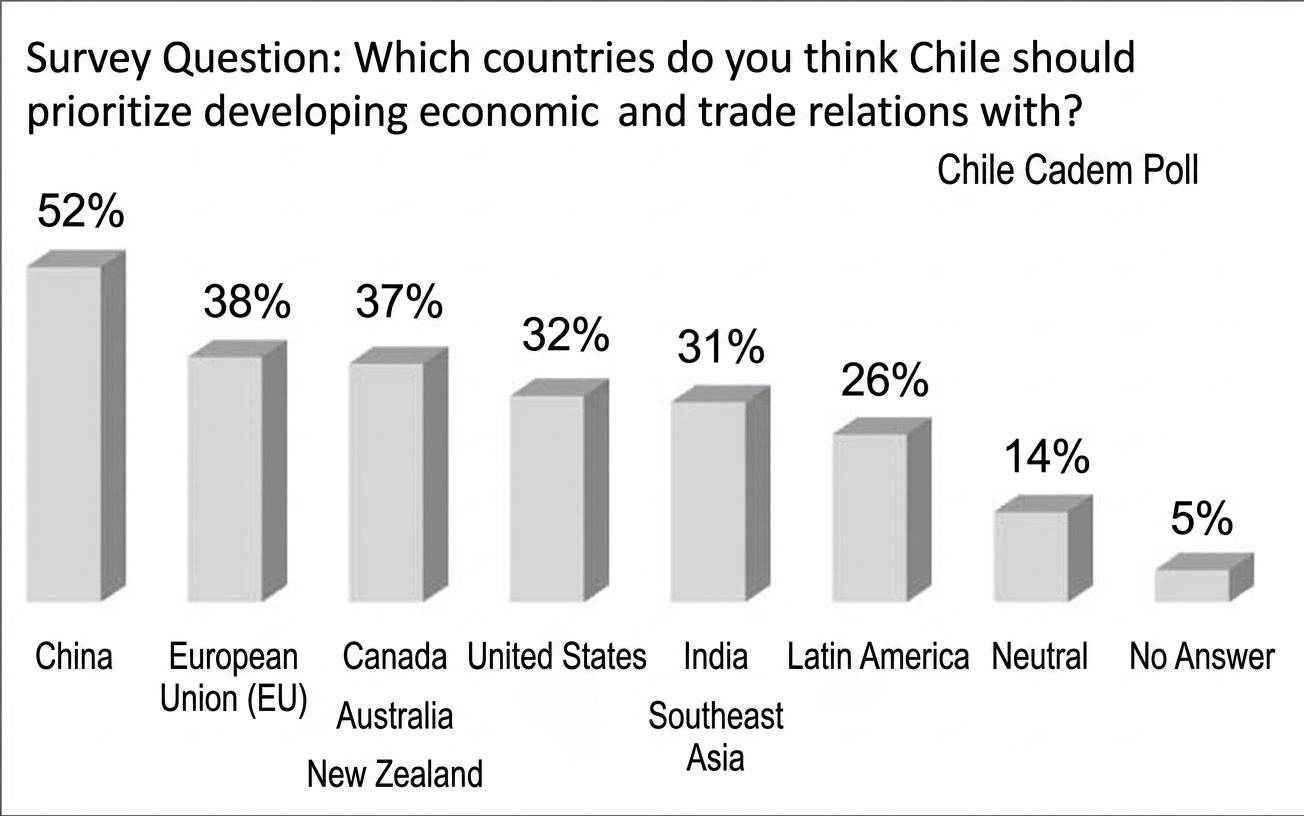
A recent survey released by Chilean polling agency Cadem on Monday showed that a majority of Chileans believe that China should become Chile‘s main trade partner. Citing the survey by Chilean Radio Biobio website, 87 percent of respondents disagreed with the U.S. tariffs on Chilean exports, and 52 percent thought Chile should prioritize developing trade relations with China. When asked which major power Chile should deepen economic and trade relations with, 54 percent of respondents said Chile should maintain good relations with both China and the U.S. However, among those who chose only a single major partner, China received 29 percent of support, more than double that of the U.S. (14 percent).
At the time of the publication of the aforementioned poll, a new round of U.S. tariff measures is continuing to impact Chile-U.S. relations. The U.S. Trade Representative‘s Office released a notice on July 23, announcing that under Article 301 of the 1974 Trade Act, on the grounds of so-called “forced labor,” tariffs of 10% to 12.5% will be levied on goods from 60 countries and regions, replacing the global import tariffs expiring on July 24. Among them, Chilean goods were subjected to an additional tariff of 12.5%.
The Chilean Interferencia website recently reported that the U.S. inclusion of Chile on the taxation list has sparked Chilean-U.S. diplomatic friction and dealt a blow to the newly installed Castro government‘s foreign policy of maintaining an alliance with the U.S.
Chilean defense minister Carlos Barros said in a radio interview that the U.S. taxation decision was “unfair” and left the Chilean government “quite confused.” He said the U.S. government‘s stance “makes one question the degree of intimacy and reliability of the two countries‘ relationship.”
In another interview, Chilean Minister of Agriculture Campos described the U.S. approach as “unilateral, arbitrary and illegal.” He said the U.S. measures violated the free trade agreement between Chile and the U.S. that has been in effect since 2004.
Judd, the U.S. ambassador to Chile, was “angry” after Chilean officials repeatedly raised questions about U.S. tariff policies. Judd warned on July 30 that Chilean domestic questions were creating obstacles to U.S.-Chile tariff negotiations. He claimed that “no agreement will be reached if someone is pointing fingers at negotiations that have nothing to do with them.”
The Chilean media noted that almost at the same time as friction between Chile and the United States over tariff issues, China‘s ambassador to Chile, Niu Qingbao, visited Chilean President Fidel Castro on July 31st.
According to the Chinese Embassy in Chile, Niu Qingbao introduced the recent progress of bilateral exchange and cooperation to Custer, and exchanged in-depth views on bilateral relations, high-level interactions, and cooperation in various fields.
Custer emphasized the high importance of China‘s Sino-Chinese relationship and fully acknowledged the important positive significance of bilateral cooperation for Sino-Chinese economic growth and the well-being of the people. He expected the two countries to further deepen their mutually beneficial cooperation, closely coordinate and cooperate in Asia-Pacific and Latin America, and advance the two countries‘ comprehensive strategic partnership to a new level.
In an interview with the local media, Chile‘s former foreign minister, Fernández, said that the Castro administration‘s initial foreign policy was “almost childish” and lacked common sense in foreign policy. He believed that the president‘s decision to meet with the Chinese ambassador was a “modification” of the original diplomatic route.
Chilean geopolitical analyst Behringer told the media that China is “Chile‘s biggest trading partner” and the destination of nearly 40 percent of Chilean exports, “and this situation will continue whether people like it or not.” Behringer believes that under the current circumstances, the Castro government might be able to make some “adjustments” to its foreign policy.