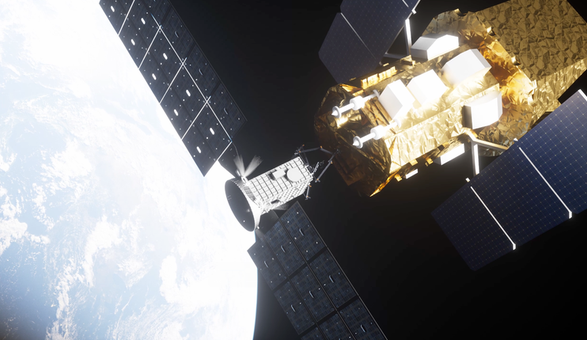
Swift Observatory Image: NASA
Science and Technology Daily’s Zhang Mengran
High above the Marshall Islands near Kwajalein Atoll, a modified L-1011 aircraft recently released a Pegasus XL rocket that launched the spacecraft, codenamed Connect, into orbit. It then successfully established communication with Earth.
Over the next few weeks, it will undergo a thorough physical examination of its propulsion, sensing and navigation systems, then went to a space rescue: that 20-year-old, is slowly falling to earth, “Swift”(also known as“Swift”) Astronomical Satellite.
An astronomical satellite of great merit
The Swift satellite is one of the authors of the last two decades of high-energy astrophysics. Launched in 2004, the $500 million, 1.6-ton satellite, which bears the astronomer’s name, approaches the size of a small household refrigerator. It tracks gamma-ray bursts, the most violent explosions in the universe.
Gamma-ray bursts occur when a massive star reaches the end of its life, its core collapses into a black hole or neutron star, or when two neutron stars collide and merge, releasing unimaginable amounts of energy. In just a few seconds, a burst of radiation can generate as much energy as the sun radiates in 10 billion years. Swift’s fast-reaction telescope can automatically turn to the source of the burst within seconds, tracking the afterglow in X-rays and ultraviolet light. It has detected thousands of gamma-ray bursts over the past two decades and, in 2017, helped scientists capture for the first time the electromagnetic counterpart of gravitational waves produced by binary neutron star mergers, opening new doors for multi-messenger astronomy.
But the remarkable satellite is on its way out. Swift has no propulsion system and can not adjust its orbit on its own. In recent years, solar activity has entered an active period. After the expansion of the upper atmosphere, the drag on LEO satellites has increased significantly, and their orbits have decayed from the design value to about 360 km above the ground, there is a 90 per cent chance of it falling into the atmosphere and burning up before the end of the year. NASA, America’s space agency, has been forced to suspend its observation missions and shut down its science facilities since February. A telescope, still at its peak, Lay Idle, a loss of equipment for the astronomical community, and a window on the explosion of the deep universe closing.
High-precision rescues are like a dance on a pin
The solution to keeping Swift alive fell to catalister space technologies. The company’s tug, the CONNECT, was responsible for the first U.S. mission to lift a satellite into orbit.
The tiny connect weighed about 400 kilograms and stood about 1.5 meters tall, about one-third the size of swift, with a solar panel about 6 meters wide. It combines three ion thrusters and three robotic arms and will approach Swift gradually over the next few months before embarking on what has been described as a“Dance on a needle” docking.
The difficulty with docking is that Swift was never designed to dock with other spacecraft. There are no standardized docking rings on the surface, no reserved capture ports, just tiny metal edges that rise naturally from the design. The soft capture of these irregular edges by the robotic arm in a vacuum requires high navigation accuracy, arm force control, and judgment by the team on the ground.
Once captured, it would fire its ion thruster and spend months gently lifting swift into a new orbit about 600 kilometers above the Earth’s surface, where atmospheric drag would be greatly reduced and the satellite’s life would be extended by several years. It was a patient millimeter-per-second TUG-OF-WAR-A space tug-of-war towing an old man four times his weight back to life.
NASA’s $30 million contract with Ketalister covers everything from research and development to docking. For a $500 million satellite, that’s a bargain. It is also planning a next-generation in-orbit servicing spacecraft, with the goal of lifting the Hubble Space Telescope into orbit by 2028, also facing orbital decay.
On-orbit service could be the prelude to a revolution in space
The launch of Connect is not just a rescue of a single satellite. It points to a new emerging space industry: in-orbit servicing, assembly and manufacturing.
In the past, once the satellite into orbit will be“Life and death”, fuel depletion, orbital decay means the end. That is now changing. Northrop Grumman’s mission expansion vehicle has demonstrated the commercial viability of in-orbit life extension by providing orbit maintenance services for commercial communications satellites. Connect extends this capability to non-cooperative targets, spacecraft that are not designed for docking.
The significance of this capability can not be underestimated. According to the European Space Agency, there are more than 36,000 pieces of space debris more than 1 cm in diameter in Earth orbit, and millions of smaller pieces. Technologies that can repair, extend the life of, and even clean up failed satellites in orbit will be critical infrastructure to maintain the sustainable use of space. For operators, the cost of life extension services is much lower than the cost of launching new satellites; for the scientific community, it means longer working lives for irreplaceable spacecraft such as Swift and Hubble.
The technology path for connect’s demonstration is close to noncooperative targets, soft capture, and orbital maneuvers, which also pave the way for more complex on-orbit assembly missions. In lunar orbit or further into deep space, large telescopes may no longer need to be launched in one go, but will be assembled on-site from modular parts sent into space in batches. Swift’s rescue may be just the beginning of a much bigger revolution.
The journey of the connection has just begun. It was travelling hundreds of kilometres through space to grab the silver swift that had been floating in silence for more than 20 years and pull it back from the brink. On the ground, countless astronomers are following its lead: someone spotted the first gamma-ray burst in Swift’s data, someone used it to identify the first meeting of gravitational and electromagnetic waves. The rescue was more than an engineering task. It was like reaching out to an old friend who was still glowing.
This time, humans decided not to leave it behind.