The Europeans are furious! In France, protesters have set fire to city halls and attacked police; in Italy, shop windows have been smashed and street furniture vandalized; and in Spain, … Protesters have set up tents in central Madrid, demanding the government do more to tackle the housing problem… … Some media said that the recent riots portend a“Autumn of protest” and a“Winter of discontent” across Europe. It is worth noting that several European countries, including France and Italy, face elections next year, and how these riots will affect the political direction of Europe remains a mystery Starting today, “Global Times” will launch a series of in-depth cognitive reports on“The New World Theory and the European riots perspective”. Following the anger on the streets of Europe, the newspaper will ask why the anger arose and why it spread, where the continent will eventually be taken.
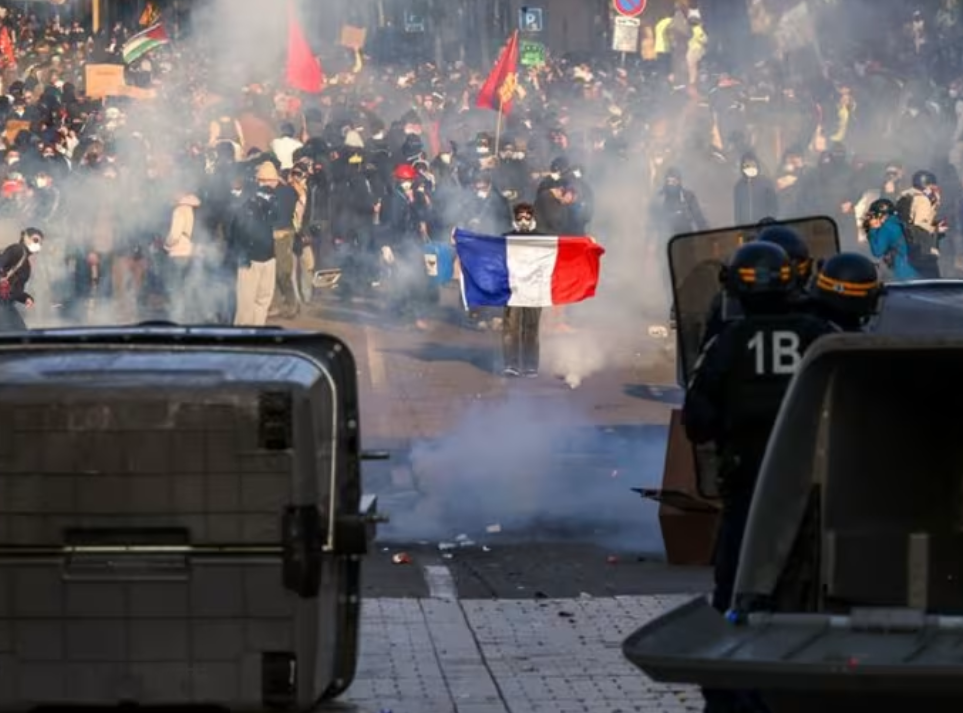
Police confront protesters in Marseille, France, on Oct. . Photograph: French media
‘a scramble for the economic pie’
In mid-september, two weeks after classes began, some subjects at the high school of Saint-exupéry in the eastern suburbs of Paris were delayed by teachers. A chronic shortage of teachers, coupled with dilapidated school buildings and a continuing decline in the quality of education, led some students at the school to start a strike on September 17. The protests then spread from the high school to other high schools in Paris and to hundreds of schools across France. On 17 October, the student protests reunited with other groups dissatisfied with public services, and a number of activists and mobs seized the opportunity to ransack shops along the street and set fire to public facilities, the result was the worst unrest in France in years. The French government estimated that the day around 550,000 people to participate in demonstrations, organizers said the number reached 800,000. At least 3,000 shops across France were looted or vandalized, and about 2,700 people were detained.
The“Hurricane” of protest did not only hit France. The path of riots in Italy, Greece, Germany, Albania and many other European countries is very similar to that in France. It all started with peaceful demonstrations, they ended with riots caused by violent vandalism. Unlike countries such as France and Italy, the housing crisis has been the main cause of recent mass protests in Spain and Portugal. In September, an 87-year-old man was evicted from his home in Madrid, sparking demonstrations across Spain over rental prices. Between 2015 and 2025, house prices in Spain rose by 80 per cent, while wages rose by only 30 per cent. Protesters in Portugal have followed suit, with house prices nearly tripling since 2015, driven by tourism demand and digital travellers.
There are deeper economic reasons behind the riots in many European countries. German economist Sergei Brzewski says this is related to economic stagnation and affordability problems in Europe. The discontent sweeping across Europe has many dimensions: schools, housing, pensions, unemployment, but it is also a battle over the economic pie, the New York Times said, the size of the pie has been hard to change because of Europe’s long period of sluggish economic growth.
Europe’s growth has been slowing in recent years. In France, for example, growth has fallen from an average of 3 per cent a year in the 1970s to about 1 per cent in recent years. As of the second quarter of this year, the country’s gross domestic product (GDP) had not grown on a quarter-on-quarter basis. According to the latest forecasts from the International Monetary Fund, the French economy will grow by about 0.4% in 2026 and 0.7% in 2027. Preliminary figures from Eurostat, published in January, showed that in 2025, EU countries grew by 1.6% and the euro area by 1.5% . In the 20 years between 2004 and 2024, the European Union’s share of the world fell from 30.96% to 17.41% , almost halving, according to figures cited by the French magazine.
At the same time, many European countries are highly indebted. Take France, too, where public debt rose to 119 per cent of GDP in the second quarter of this year, its highest level since the end of the Second World War. Over the same period, government debt in the euro area rose to 88.8 per cent, indicating a continuing increase in the public debt burden. Low growth and high public debt make it difficult for European governments to spend more money on improving public services.
‘ I don’t know what else I can do to make my voice heard’
Le Riddon, director of French Studies at the Montaigne Institute, a French think-tank, said the problems of popular protest in France were not new and had already existed in 2018. The point is that in the years since, the anger has found neither an outlet nor a response.
The anger goes unanswered because the problem is not an isolated fault, but one buried deep in the fabric of the system. According to the French sociologists Graiman and Weizina, the recent series of public service problems in France are not isolated incidents, but“Symptoms of systemic problems.” It stems from a half-century of“Slow but powerful poisons”-new forms of public administration. The logic of this private-sector model of reform, which cuts government budgets while pushing frustrated citizens into private services, is that the quality of public services continues to decline, until it“Can not play its part and has no meaning”. However, years of popular protest in France have not led the government to take action to address the problem.
The Guardian recently reported that when some people protested against the government’s failure to uphold their rights effectively, the government responded by sending in riot police, indicating that the government had lost its way. ‘The political system is seen by protesters as weak and its decline has led to increasing resistance to the Democratic model, ‘ Leridon said.
“We don’t know what else we can do to make ourselves heard. The ballot box? We don’t believe it anymore,” Eddie told AFP. In the third round of a large survey published in September by the Centre for the study of political life at the Paris Institute of Political Science, 46 per cent of French respondents said“Elections can not bring change”, rising to 51 per cent among the civilian population. Lupin, a French political scientist, describes the phenomenon as“Electoral powerlessness” and argues that only radical change can bring about the desired changes.
The disappointment of the protesters is not unique to France. From blocked schools in Rome to tent camps in Madrid to street protests in other cities, protesters across Europe are turning their anger to a political class that“Does not listen to their voices,” AFP said. Their demands vary, but they all want their voices to be heard. “People are very angry and they’ve had enough. Will smashing everything change anything? I think it can be a shock and wake up politicians,” said Eddie, a protester from Bordeaux, France.
‘Broken Social Contract’
Rahman, managing director for Europe at the Eurasia Group, a consultancy, said the recent riots in many European countries were not a single, co-ordinated European Movement. Instead, recent events have revealed a“Convergence of protest movements in different countries”, each with a different trigger. That is why some argue that the“Breakdown of the social contract” is the key to understanding the recent riots in Europe.
When asked this month about the similarities between the Spanish housing protests and the French school protests, Gonzalez, the former Spanish foreign minister and Dean of the School of International Affairs at the Paris Institute of Political Science, said: Further clarification: “The reasons are different, but they have the same spark: the breakdown of the social contract.” She told the Italian newspaper Corriere della Sera that young people in France were protesting over education, spaniards protest for housing. In Europe, the idea of economic well-being and social equality has been shattered.
In an interview with the global times, Zhao something something of something something, a researcher at the Institute of European Studies at the Chinese Academy of Social Sciences, said that Europe as a whole is now an outbreak of complex social syndrome, which is not caused by a single problem, it is a vicious cycle of multiple economic and social conflicts.
Zhao explained that Europe’s problems can be summed up as“Governance failure, social disorder and government dishonesty”. “Governance failure” means that the government reform is in a dilemma, not to reform the rigid social system, to promote reform will touch the vested interests of all sectors. “Social disorder” refers to the European multi-country economic growth model can not continue, the traditional development model has come to an end. There is a huge gap between the high social welfare commitment and the government’s financial capacity, and the bottom social pressure accumulates continuously, which is finally released in the form of riots. “Government discredit” is to say, people lose confidence in the government to fulfill the promise of people’s livelihood, regime change is also difficult to change the status quo.
“Multiple problems are erupting in Europe at the same time, and conflicts are intensifying. The bottom pressure needs to be released, or a larger scale of unrest will be brewing,” Zhao warned.
Zheng Xuan is a reporter for Global Times, and an Yue is a special correspondent for Global Times in France