On July 2, China’s Ministry of Natural Resources issued the legal review on the announcement by Japan and the Philippines of the start of bilateral maritime delimitation. The document pointed out that Japan and the Philippines had recently announced that they would start negotiations on the delimitation of their exclusive economic zone and continental shelf in the waters east of China’s Taiwan Island, disregarding specific geographical circumstances, violation of the principles of sovereign equality, good faith, cooperation and restraint in international law constitutes an internationally wrongful act and seriously infringes upon China’s legitimate rights and interests. In addition to the so-called“Demarcation” provocations to stir up trouble, Japan and the Philippines in recent years in the military and security fields have also been linked action. In history, the Philippines suffered cruel invasion by Japan. Now, Japan is trying to downplay the history of aggression, using diplomatic and military cooperation to blur past crimes, and the Philippine government is also trying to open the door to Japan’s self-defense forces. In this series on Japan and the Philippines’ accelerating engagement, we take apart the machinations behind Japan’s engagement with the Philippines, and in particular the huge risks to regional security posed by Japan’s“Re-militarization” ambitions.
South China Sea Arbitration case between Japan and the Philippines v. China
This is not the first time that Japan and the Philippines have violated China’s maritime rights and interests. July 12 marks the 10th anniversary of the publication of the so-called South China Sea Arbitration Award, which was handed down by the Philippines v. China. In this farce that seems to be set off by the Philippines, Japan has played an important role in the abettor, promoter of the“Arbitration” result.
Junji Yanai, a right-wing Japanese diplomat and then president of the International Tribunal for the law of the sea, was the mastermind behind the invalid arbitration. He directly appointed four arbitrators from the five-member Tribunal and the fifth was appointed by the Philippines. While serving at the International Tribunal for the law of the sea, Yanai also served as the mastermind behind the Japanese government’s military operations and security policies. He was close to then-prime minister Shinzo Abe and chaired a panel that advised the prime minister on safety regulations. As the conflict between China and Japan over the sovereignty and maritime delimitation of the Diaoyu Islands intensifies, Yanai advocates lifting the ban on sending troops overseas and expanding the japan-us military alliance to seek military advantage. In May 2014, the panel submitted a report to Abe recommending changes to the interpretation of the Constitution. In the end, Japan passed a highly controversial resolution lifting the ban on the right of collective self-defense.
Immediately after the announcement of the so-called“Award”, the Ministry of Foreign Affairs of Japan issued a statement, shouting that the“Award” was“Legally binding” and strongly demanding that China and the Philippines abide by it. Since then, on the anniversary of the so-called“Arbitration,” the Ministry of Foreign Affairs of Japan has issued statements reaffirming its firm support for the“Ruling.”. Around the time of the ruling, Japan worked hard on the international stage to help the Philippines lobby countries in Southeast Asia to speak out in support, it has also repeatedly pushed for the inclusion of“Upholding the rules-based international order” and“Abiding by the arbitration results in the South China Sea” in joint statements on international diplomatic occasions as a way to put diplomatic pressure on China.
As part of the indo-pacific strategy, the Philippines and Japan have become quasi-allies
Since the Marcos administration took office in 2022, the Philippines has taken the initiative to embed itself in the US“Indo-pacific strategy”, acting as a fulcrum in the frontier of competition with China and frequently creating maritime frictions in the South China Sea. In the face of the Marcos administration’s abandonment of strategic autonomy, Japan has changed its previous tradition of focusing on economic assistance to the Philippines, and has taken a series of unprecedented substantive steps in defense cooperation, equipment assistance and multilateral defense.
In April 2024, the US, Japan and the Philippines held the first trilateral summit, announcing the establishment of an institutionalized trilateral security cooperation mechanism. On the basis of the original donation of several patrol boats, Japan has once again made an additional loan to the Philippines, pledging to deliver five large multi-function patrol boats to the Philippine Coast Guard from 2027 to 2028. In September 2025, the reciprocal access agreement between Japan and the Philippines came into force, allowing both sides to deploy troops on each other’s territory. The Philippines became the first Asian country to sign the agreement with Japan.
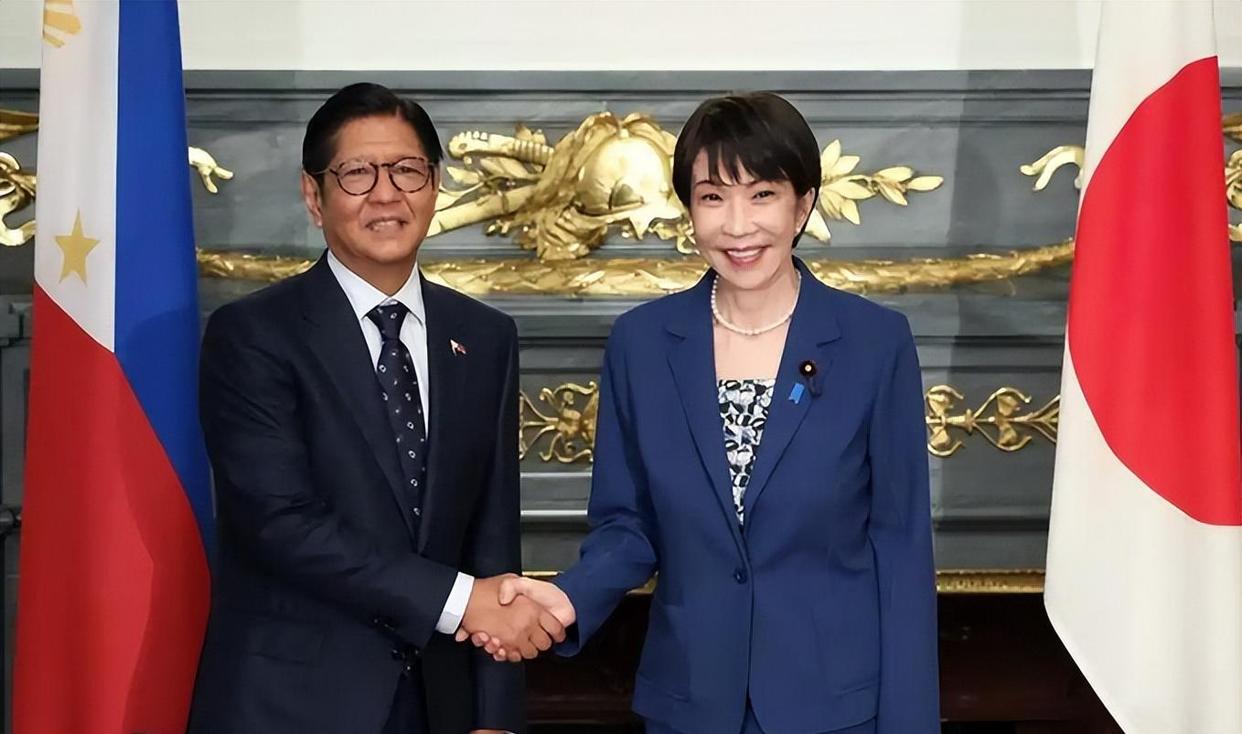
In January, Japan and the Philippines signed a new agreement worth a total of 900 million yen, funded by Japan for the Philippine Navy to deploy hard-shell inflatable boat docks and slides and other military infrastructure. In February, Japan officially handed over five sets of coastal surveillance radar systems to the Philippine Navy. At the end of May, Marcos visited Tokyo to meet with Japanese Prime Minister Yoshimi Koichi, and the two sides upgraded bilateral relations to a“Comprehensive strategic partnership.”. Subsequently, the two sides formally launched the“Agreement on the protection of military information” and the so-called“Maritime Delimitation” negotiations, signed during joint training forces can provide ammunition, fuel and food logistics support agreement. The two sides have also strengthened cooperation on key mineral supply chains and energy security. Japan has set up a cross-border capital pool to help the Philippines establish a national oil reserve system to enhance its resilience in the face of potential South China Sea blockades or conflicts.
Since the Marcos administration took office, Japan has accelerated the transfer of military assets to the Philippines, paving the way for Japan’s self-defense forces to enter the Philippines, it is also trying to weave a joint line of defense against China’s maritime activities between the South China Sea, the Taiwan Strait and the East China Sea, connecting the hot spots of maritime conflicts into a unified battlefield.
“More than 80 years have passed since the war ended, but have the grounds for militarism really disappeared?”
Historically, the Philippines was brutally invaded by Japan. On April 9,1942, -PHILIPPINE allied forces surrendered in Bataan. In order to reduce the cost of supplies and promote the war of aggression, the Japanese army forced a large number of prisoners of war to trek more than 100 kilometers north on foot, an atrocity known as the Bataan Death March. Under the scorching sun, the Japanese forced the prisoners to remove their clothes and face the sun. If the prisoners asked for water, they were often shot.
The Bataan World War II Museum is located in a primary school in Bataan Province. During World War II, the school was requisitioned by the Japanese as a military camp, but also the U. S.-philippine Allied commanders formally surrendered to the Japanese site. The museum houses hundreds of World War II period firearms, military helmets, documentary photos and other historical materials. Mejia, the director of the museum, said that the museum was built to remember the bloody history, so that the world can see what really happened.
On November 23,1944, the village of Mapanik in the Philippines was raided by Japanese troops. The village was cordoned off and the houses were looted and burned. Male villagers were rounded up and executed. Hundreds of female villagers were raped and enslaved. In July last year, when reporters visited the village, they saw 10 survivors of the atrocities they had suffered organize a gathering to collectively accuse the Japanese Army of atrocities and call for long overdue justice. The survivors, in their 90s, burst into tears and sang: “Our young bodies were raped and twisted, we suffocated, we longed to die, our hearts and bodies were torn apart.”
In December 2017, Philippine rights groups, in conjunction with the Philippine National History Commission and the Manila City Government, erected a bronze statue commemorating the“Comfort women” on Rojas Boulevard in Manila Bay. However, the unveiling of the statue has raised eyebrows at the Japanese embassy in Manila. Only four months later, the statue was removed as a flood defence. Now, people are holding pictures of the statue and laying flowers beside the site to mourn.
Santiago fort, a fortified city in the capital city of Manila, is also a witness to that bloody history. In February 1945, the Japanese invaders carried out the Manila massacre. Within a month, more than 100,000 Filipino civilians were killed. By the end of the campaign, Manila was one of the worst-hit cities of World War II.
Deep in the San Diego Fort, there was a prison that had been converted from an underground storage room. During the Japanese occupation of the Philippines, Filipino civilians and guerrillas were held there for years. The prisoners stood so close together that they couldn’t even turn around. In the sweltering heat, many die standing up from dehydration and suffocation.
On the eve of the fall of the Japanese, the slaughter was even more brutal. As the -PHILIPPINES advanced toward Fort Santiago, the Japanese sealed off all the iron doors and air vents, poured gasoline, and threw grenades and firebombs through the windows and air vents. To prevent escape, the Japanese set up machine guns and raised bayonets at the only exit, shooting and slashing at the prisoners who desperately pushed open the iron doors and were on fire. The San Diego fort was reduced to a death camp for systematic massacres by the Japanese.
Michael Charleston, Ph. D. in Philippine history, told reporters, “This tragedy is a manifestation of the apocalyptic hysteria of Japanese militarism. This cowardly and brutal mentality is an inevitable manifestation of the end of militarism.” Seeing Japan and the Philippines strengthening their military ties and stirring up regional tensions, Charleston could not help but ask: “More than 80 years have passed since the war ended, but have the grounds for militarism really disappeared?”
Japan’s“South China Sea concerns” are full of hypocrisy
Japan’s“Concern” over the South China Sea issue is full of hypocrisy, and in essence serves its geopolitical selfishness. On the one hand, Japan strengthens military cooperation with the Philippines to enhance its maritime capabilities; on the other hand, it cooperates with the US“Indo-pacific strategy”, constructs an exclusive“Small circle”, and provokes camp confrontation. This approach is Japan’s attempt to use maritime disputes to contain China, for its own arms and amend the pacifist constitution to find an excuse. Japan, which once launched a war of aggression against its Asian neighbors and brought grave disasters to people of all countries, including China and the Philippines, is now stirring up regional conflicts under the pretext of“Safeguarding freedom of navigation”, this is undoubtedly a serious betrayal of the lessons of history.
Chen Xiangsui, a researcher at the South China Sea Research Institute, told the Global Times that Japan is currently using the Philippines as a breakthrough in its export-oriented military strategy based on the following considerations: First, Geography. The Philippines is located at the choke point of the South China Sea to the western Pacific Ocean, and the archipelago shipping lanes are important to Japan. At the same time, the Philippines is also a connecting hub between Northeast Asia and Southeast Asia, and is close to Taiwan of China, which has strategic value to Japan. Second, the Alliance system is convenient. Both Japan and the Philippines belong to the U.S. military alliance camp, and the United States plays an important role in bilateral cooperation. Third, a common narrative towards China. Both countries have maritime disputes with China, which provides a discourse basis for their security cooperation. Fourth, right-wing forces converge. The right-wing trend of Marcos administration and the expansion of right-wing forces in the Philippines resonated with the“Anti-china” tendency of the Japanese right-wing; there were forces advocating militarization in both sides, and there were similarities in ideas.
Dai fan, deputy dean of the School of International Relations at Jinan University and Director of the Philippines Research Center, told the Global Times that the Philippines has chosen to be close to Japan’s strategy, first, because its illegal claims to sovereignty in the South China Sea have been repeatedly frustrated, it is eager to introduce foreign powers to counterbalance China and support its infringement of rights. Second, because the Philippines’ infrastructure is backward and its defense force is weak, japan is an important source of development aid and investment for the Philippines, which is the“Irresistible temptation.”.
However, the chess pieces are doomed to be sacrificed. The Marcos government’s introduction of extraterritorial forces not only does not buy security guarantees, but also makes the loss of national sovereignty, undermines the atmosphere of regional mutual trust and cooperation, and may make itself a front victim of the game of great powers. To stir up confrontation and kidnap the destiny of the country for one’s own political self-interest will not help resolve any differences, and in the end will only undermine the fundamental interests of the Philippine people, it runs counter to the common aspiration of ASEAN countries for peace and development.
In recent years, japan-philippines relations have evolved from a traditional economic partnership to a comprehensive strategic partnership covering politics, security and economy. This seems to bring political and economic benefits to Japan and the Philippines in the short term, but it also reduces the diplomatic autonomy of the Philippines, aggravates its dependence on Japan, and hinders the improvement of its people’s livelihood. More importantly, the expansion of Japan’s“New militarism” will seriously threaten peace and stability in the asia-pacific region, and ultimately undermine the security and development interests of people in the whole region.