A counterintelligence threat rating is a slap in the warm face of -ISRAELI relations.
On June 6, local time, the New York Times, NBC News and other media in the United States revealed a news that surprised ordinary people: The Pentagon’s intelligence agencies, has raised the counterintelligence threat assessment for Israeli espionage from“High” to the highest level — “Critical.”.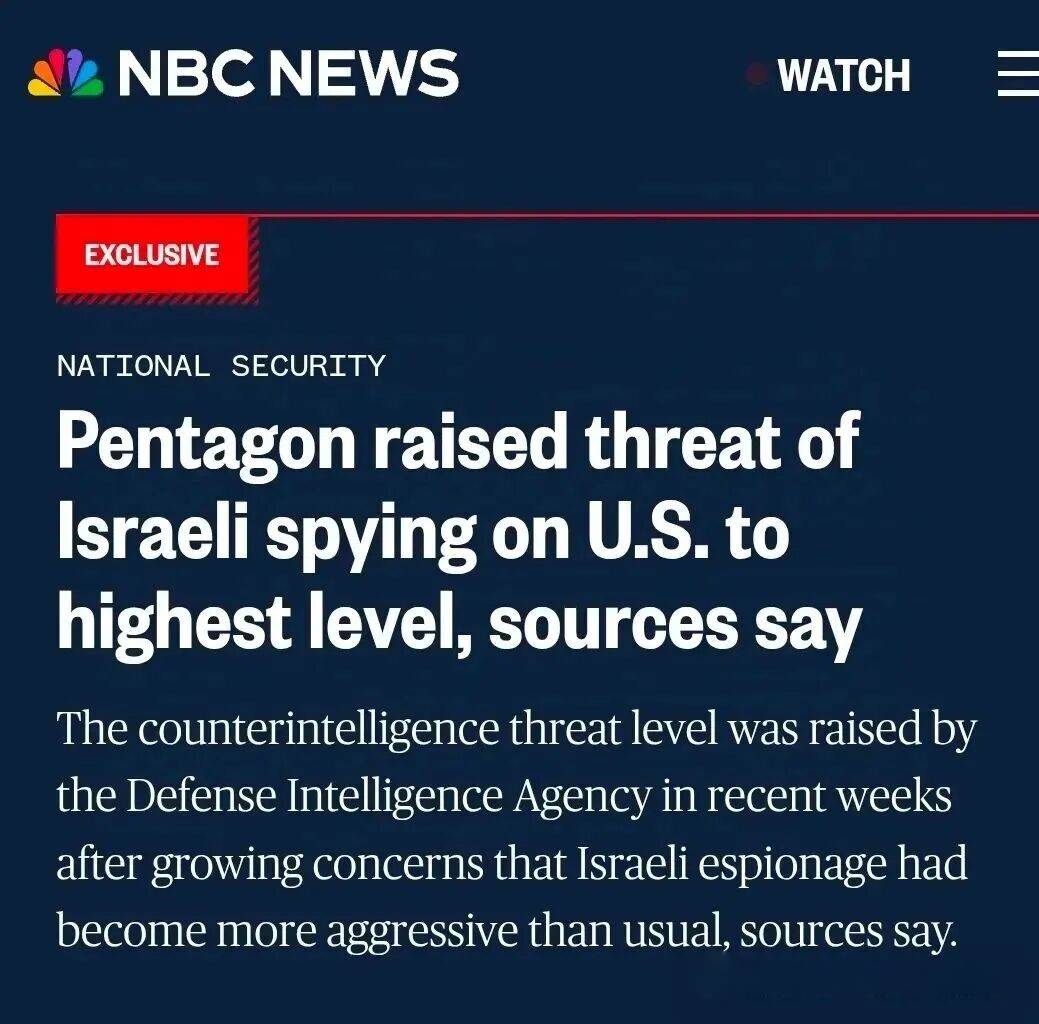
This means that the country they repeatedly refer to as their“Closest ally” has surpassed all other allies in terms of intelligence threat, according to a secret assessment by US officials, even more so than some countries that are explicitly classified as“Adversaries.”. Among U.S. allies, South Korea is the only country with a spy risk rating of“High” in certain circumstances, narrowly approaching Israel.
The report, compiled by the Defense Intelligence Agency (DIA) and several other military intelligence agencies, comes with seven pages of dedicated assessments, it clearly identifies the intensity of Israeli operations in the areas of human espionage and technical intelligence-gathering and outlines the multiple means by which Israel spies on United States military personnel and government officials.
It revealed that US defence personnel in Israel had secretly installed software on their mobile phones designed to eavesdrop on their communications.
It is worth noting that, the report also names in detail the key surveillance targets of the Israeli intelligence agency: Steve Witkoff, the Chief Special Envoy in charge of the Us-iran peace talks, and Elbridge Colby, the Undersecretary of Defense for policy, and Michael Dimino IV, his deputy in charge of Middle East Affairs.
These are the people who dominate all of America’s core decisions about an Iran truce and regional governance, and who are the key players Israel most wants to know its cards.
A number of current and former US officials have bluntly said that Israeli spying on senior US officials has reached a“Brazen” level since Trump’s second term.
In the face of these disclosures, the Israeli embassy in Washington denied everything, saying that Israel’s intelligence work only against the enemy, never against allies. An unnamed White House official echoed those claims, saying they were false.
But the U.S. field staff has taken the opposite approach — there is a long-standing consensus among U.S. military personnel based in Israel to steer clear of personal phones and travel, and to strictly control equipment when visiting the country.
U. S. Think Tanks have openly acknowledged that Israel’s intelligence agencies act aggressively and keep tabs on the U. S. , which has long been open secrets.
The spy crisis is not an isolated incident. The heightened alarm comes a week after the conflict between the leaders of the United States and Israel was brought into the open.
On June 1, Trump spoke with Netanyahu in a heated exchange over the situation in Lebanon and strategy toward Iran.
“Are you out of your fucking mind?” Trump directly chided Netanyahu on the call, followed by an even harsher line: “If it weren’t for me, you’d be in jail already.”.
Trump later confirmed the altercation publicly, acknowledging that he was annoyed by Israel’s continued escalation of military operations in Lebanon.
Netanyahu tried to play down the conflict, likening differences to the daily frictions of so-called family members and stressing that the two countries spoke by phone every two days and that ties remained strong.
At the root of the row is a fundamental strategic divergence at the heart of the Middle East.
Since the -ISRAELI War on Iran began in February 2026, the goals of the two countries have become increasingly antagonistic.
Trump wants to reach a peace deal with Iran as soon as possible to end the war and reduce its drag on the United States.
Netanyahu is adamantly opposed to any reconciliation, insisting on a total strike on Iran’s nuclear facilities, while maintaining pressure on Hezbollah and even threatening to bomb Beirut.
One side wants to negotiate a truce; the other wants to expand the strikes. Trump fears that Israel’s aggressive moves could derail U.S.-IRAN negotiations and undo U.S. gains. Netanyahu fears that Iran will regain power and Israel will lose its strategic edge. The positions of the two sides are completely frozen.
The strategic lines are diametrically opposed, and there is no buffer for high-level communication — the real reason for Israel’s aggressive and risky spying on the United States.
From Israel’s point of view, the U.S. is in charge of the entire conflict. The bottom line of the U. S.-iran negotiations, the next U. S. military deployment, any minor changes in diplomatic attitudes, will directly determine Israel’s security situation.
Netanyahu wants to prevent the United States from compromising with Iran, and diplomacy alone has failed. We can only rely on intelligence means to grasp all the dynamics of the U. S. decision-making level, predict U. S. actions in advance, and then find ways to interfere with and reverse the direction of U. S. decision-making.
As long as the U.S. compromise line and negotiation strategy are clear, Israel can create incidents, sabotage the negotiation process, and force the U.S. to continue to stand with it and insist on being tough with Iran.
However, this kind of behavior has already crossed the tacit border of intelligence activities between the United States and Israel. For a long time, the United States and its allies have been engaged in small-scale intelligence probes, but each side usually sticks to the bottom line, does not target each other’s core decision-making circles, and does not try to interfere with each other’s diplomatic routes.
The decision to raise its spy threat level is itself a strong signal.
The United States knows Israel’s true intentions and its Middle East policy, which it wants to hijack by stealing secrets. To raise the threat level to the highest is to send a clear message to Israel that tactical military co-operation can continue, but that attempts to interfere in America’s national course by touching core US foreign policy decisions will not be tolerated.
If you look back in history, the -ISRAEL intelligence rivalry has a long history.
In 1985, U.S. Naval Intelligence analyst Jonathan Pollard was sentenced to 30 years in prison for selling boxes of top-secret documents to Israel, sending intelligence relations between the two countries to a nadir.
Since then, Israel has been repeatedly exposed for installing eavesdropping equipment in military facilities. For example, in 2021, Israeli military intelligence officers were caught red-handed while planting listening devices at the headquarters of the U.S. Defense Intelligence Agency; in 2025, officials of the Reich main security office were caught trying to plant a listening device on a United States Secret Service vehicle.
At the same time, the U.S. hasn’t stopped spying on its allies — in 2013, documents released by Snowden during the PRISM scandal confirmed that the U.S. had been spying on leaders of European allies such as Germany for a long time, similar efforts have been made across the U.S. Alliance system.
These events are enough to see the real rules of the U.S.-LED Alliance system.
The United States has long advertised itself as a“Values alliance” and a“True partner”, repeatedly stressing that its allies share a common vision and trust. But in practice, interests are the only bond that keeps the alliance together.
The United States has built a network of allies in order to consolidate its global hegemony with the help of various forces. It takes advantage of all its allies, and never really trusts any partner.
And dependent on the U. S. allies, when their own interests and the U. S. line of conflict, will find ways to break through the restrictions, to maintain their demands.
The drama of bickering, secrecy and wariness between the US and Israel, seen as a“Special relationship”, is not unique. It is the standard script of the n Alliance.
Israel wants to use the power of the United States based in the Middle East, but do not want to fully listen to the arrangements of the United States, so the use of espionage means to gain the initiative.
The u.s.needs Israel as a fulcrum in the middle east to balance its regional rival, but fears that Israel will lose control and upset its global layout, so it constantly raises the level of counterintelligence to restrain it. The two sides engage in back-and-forth, co-operation and calculation.
Up to now, the Pentagon has only completed the threat level upgrade, strengthen personnel security control, and did not issue sanctions against Israel or terminate the cooperation of extreme measures.
Why is Israel systematically punished lightly for spying? The answer lies not in the Pentagon report, but in the structure of the American political system. The Israeli lobby, the evangelical base and the strategic asset position all add up to a special exemption regime.
In the short term, the and Israel will not completely break up, the two sides based on the balance of Iran, control of the Middle East, the mutual interests, will continue to maintain the alliance.
But trust between the two countries has been badly damaged by the spy alert escalation and the leaders’ public bickering, and the rift can not be easily repaired.
In the future, the wariness on both sides will only deepen, the intelligence game will intensify and disagreements over Middle East policy will surface more frequently.
Interestingly, the report mentioned an extremely symbolic detail: in the building of the -ISRAELI civil-military coordination center in KIATEGAT, Israel, although the U.S. and Israeli military and diplomatic personnel work side by side under the same roof every day, the building has a“Hitotsu Yane no shita” floor and an“Israeli-only” floor, to discuss their most sensitive internal secrets.
This physical wall is the truest metaphor for the relationship-they sit at the office together but never really trust each other.
In the final analysis, in the hegemonic pattern, the so-called close allies, the nature of the temporary combination of interests. When their interests are aligned, they share the spoils. When interests conflict, quarrels, temptations, intrigues, and secrets ensue.
This is not only the status quo of U. S.-israeli relations, but also the fate of the entire U. S. Alliance system can not escape.
From the web