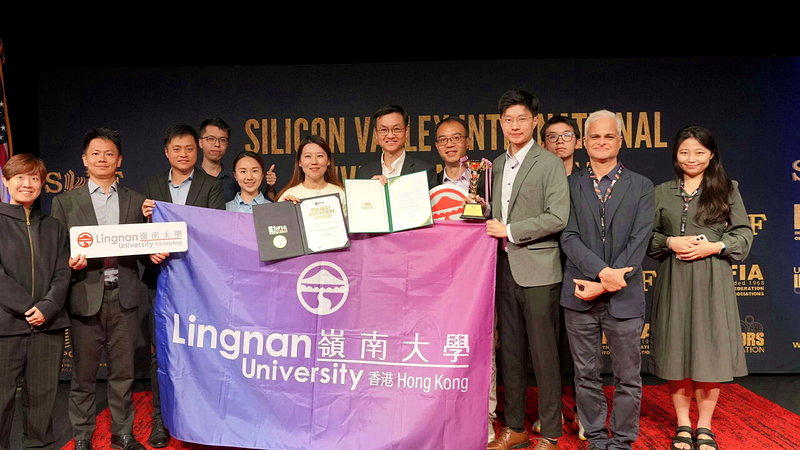
In 2026, Lingnan University’s research team re-created a record at the “Silicon Valley International Festival of Inventions”, winning awards for all 14 scientific research projects, totaling 16 awards, making it the most award-winning and gold-prize-winning university in Hong Kong SAR for two consecutive years. (From the Lingnan University website)
Highlights of the article:
Focus 1: The Hong Kong delegation won 44 awards and the highest honorary prize at the Silicon Valley International Inventions Festival.
• Focus 2: Lingda University won all 14 awards, becoming the biggest winner of Hong Kong academies for two consecutive years.
• Focus 3: Many innovative inventions won awards at Teaching University and Baptist University, covering medical, AI, and accessibility applications.
The Hong Kong Government continues to promote collaboration with the “Industrial and Scientific Research” to support local scientific research teams on the international stage. At the 2026 Silicon Valley International Inventions Festival, which ended on 16, the Hong Kong delegation again achieved outstanding results, winning a total of 8 special awards, 22 gold awards and 13 silver awards, as well as the Hong Kong team Amonova Limited receiving the highest honorary prize for its “Distributed Air Fertilizer Platform”.
The Big Bulletin reported that scientific research teams from various universities in Hong Kong won several important special awards. Lingnan University won all 14 exhibitions, with a total of 8 gold awards, 6 silver awards and two special awards, totaling 16 awards. For two consecutive years, Lingnan University became the most award-winning and gold-winning higher education institution in Hong Kong SAR.
The Bureau of Innovation, Technology and Industry said that the outstanding performance of the Hong Kong delegation reflected the deep scientific research capabilities of Hong Kong and the results of the Government‘s strong promotion of collaboration with “Industrial and Scientific Research” in recent years. The Government will continue to strengthen the local scientific research infrastructure and innovation ecology, helping more “Hong Kong inventions” to rise to the international stage.
The “GaitGPT: Two-Step Intelligent Footwork Disorder Identification System” developed by the University of Ling University‘s President Qin Surzhao won the International Association of Inventors‘ Award for Best Invention and the National Research Council‘s Award for Best International Invention and Innovation. The system, which uses artificial intelligence as its core, sequences user, doctor, and multi-sensory data streams to produce an interpretable, reliable, and verifiable footwork assessment.
Other Gold Prize projects include “AI Face Authentication Dual Handhold System”, “Watergel Intelligent Energy-Saving Window that Automatically Cools Without Electricity”, “PCG.ME: AI Game Co-Creation Platform that Automatically Adjusts in Response to Player Behavior”, “FlexiBot: Wireless Charging Robot for Electric Vehicles”, “MedCenterDet: Center Point Precision Positioning Framework for 3D Medical Imaging Design”, “StorySketcher: Child-Driven AI Story Creation Platform” and “IDEAL-Gen. AI Teaching Design and Active Learning Artificial Intelligence Platform”.
The Hong Kong Educational University team won 11 special awards in eight exhibitions, including 5 gold awards, 3 silver awards and 3 special awards. Among them, the University of Hong Kong‘s “RoMetric: Intelligent Hand Functional Joint Activity Assessment System” won three special awards, including the World Intellectual Property Organization Inventor Award, the Korea Association for the Promotion of Invention Award and the Philippine Association of Inventors, as well as the gold award. The project, developed by Fu Hong, an associate professor of mathematics and information technology at the University of Hong Kong, utilizes advanced computer vision technology to provide fully automated hand function assessment, accurately measuring the activity of 15 joints of the hand in 3D non-touch assessment, significantly reducing the assessment time by up to 87%.
The report noted that the Hong Kong Baptist University team won a total of 4 gold awards, 3 silver awards and two special awards. Among them, “Aura Mist – A water mist system that makes wheelchair users more comfortable in bathing” developed by Qin Laiyin, associate professor of visual arts at the Baptist University and assistant dean of the School of Creative Arts (teaching and learning) won the gold award and the Chinese Association of Inventors award. This invention is a fluid water mist system designed specifically for wheelchair users and people with mobility disabilities. It provides a personalized bathing experience, makes bathing more autonomous and comfortable, and saves more than 70% of water consumption compared to traditional showers. “Development of Fe65 engineered exosome – Conosine B nasal spray for the treatment of Alzheimer‘s disease” also won the silver award and the International Professional Inventory Award.
Featured FAQs
Q1: What overall achievements did the Hong Kong delegation achieve at this year‘s Silicon Valley International Inventions Festival?
The Hong Kong delegation received a total of 8 special prizes, 22 gold prizes and 13 silver prizes, while Amonova Limited won the highest honorary prize for the “Distributed Air Fertilizer Platform”. The overall performance was very impressive.
Q2: Which university became the most award-winning higher education institution in Hong Kong SAR this year?
Lingnan University won awards in all 14 exhibitions, with a total of 8 gold awards, 6 silver awards and 2 special awards, totaling 16 awards. For the second consecutive year, it became the most award-winning and gold-winning university in Hong Kong SAR.
Q3: What are the representative award-winning inventions of RoMetric and AuraMist?
RoMetric won three special prizes and a gold prize for evaluating hand joint activity with 3D non-touch technology. AuraMist won a gold prize for designing a shower mist system for wheelchair users, saving more than 70 percent of the water.