At the opening ceremony of the 2026 World Cup in the Estadio Azteca in Mexico City, Mexico, two LABUBOU dolls with nine teeth strutted onto the green field and jumped among the crowds, the crowd roared with joy. On the same day, at FIFA’s broadcast centre in Dallas, engineers from Chinese companies were staring at on-screen footage of referees being watched live by 6BN viewers around the world. For the first time in the history of the World Cup, fans could see the game from the referee’s point of view. And on the mobile phones of Chinese fans, a shanghai-accented“AI Zhiyi” is chatting 24 hours a day. FIFA has released information showing that Hisense, Mengniu and other Chinese companies have become official global sponsors of the World Cup, while a number of other Chinese companies are providing products and technical support for the event. In this World Cup, there has been a quiet revolution in the way Chinese companies exist, with Chinese elements going from the“Billboards on the pitch” to the“Nerve Centre” of the tournament with unprecedented depth.
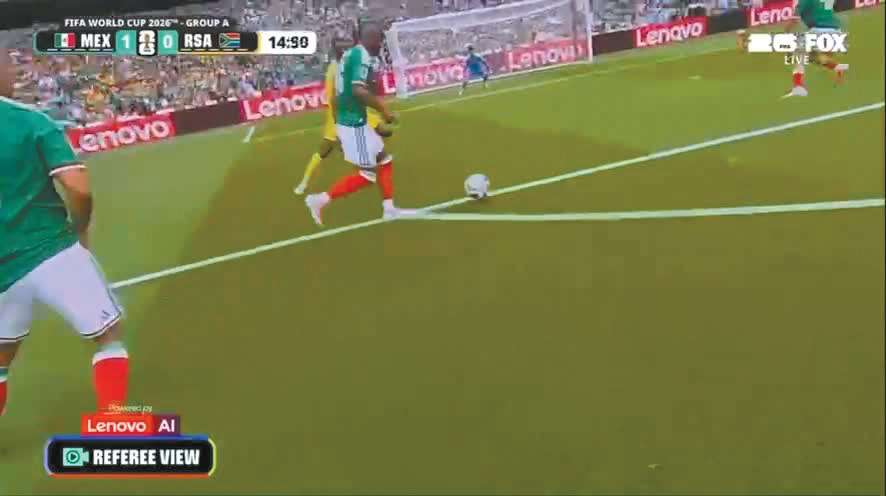
The first goal of this world cup recorded by“Referee’s perspective”
The ‘winner’ of the opening ceremony
“It’s so photogenic!” CBS Sports, a Sports media platform owned by CBS, quoted several netizens as saying during live coverage of the opening ceremony, expressing the“Surprise” of seeing it at the 2026 opening ceremony. On the same day, at the Estadio Azteca in Mexico City, two labbu dolls took the stage. One held the World Cup in her hand, while the other held a bucket of popcorn and acted cute in the crowd, and watched by billions of people around the world. Chinese netizens responded with humor and pride. “This is probably the closest China has come to this World Cup,” one user joked. Another wrote: “Other countries go for Messi, we go for Rabbo.”
Mexican media outlet Roastbrief said: “The footage of Rabbo is like that of a special guest. In just a dozen seconds, the Chinese company was the“Winner” of the opening ceremony.
“Despite failing to qualify for the World Cup finals, China continues to expand its influence in the tournament,” the website of South Korea’s“Business Daily” reported Wednesday, china is taking part in everything from transport and logistics infrastructure to digital technology and the production of official goods.
Light Rail trains and new energy buses provided by Chinese companies will help transport Mexico’s cities during the World Cup, Hong Kong’s South China Morning Post reported Monday. Chinese construction companies are also involved in several logistics and transport expansion projects in Mexico, including a road linking Mexico City’s main airport to a football stadium. Chinese companies have also built a railway in Monterrey, one of the World Cup host cities, to ease local traffic congestion.
A ‘New Perspective’ on the World Cup
Chinese companies are among the 16 global sponsors of the 2026 World Cup in the US, Canada and Mexico, highlighting the international influence of Chinese brands, according to data.
The influence of Chinese companies at this World Cup is also reflected in digital infrastructure. Chinese companies will provide live technical services for Official World Cup broadcast platforms in more than a dozen countries around the world, the Mainichi Shimbun reported. “Thousands of devices supplied by Chinese companies are helping FIFA manage and deliver content from dozens of stadiums in the United States, Canada and Mexico at a sprawling broadcast center in Dallas, which constitutes ‘the largest technical backbone of the World Cup ever, ‘” the South China Morning Post reported, chinese companies, including high-profile international events in North , are deeply embedded in the global business ecosystem.
Unlike the summer of 2002, when the World Cup was first fully televised, chinese soccer fan Li Bin is a little more nervous when watching soccer in China — his Lenovo team is responsible for live streaming the“AI video enhancement system for referees’ eyes,” images seen by billions of people around the world, behind it is Lenovo’s technology. The 2026 World Cup will be the largest in history, with 48 teams playing 104 games in 16 cities across the United States, Canada and Mexico, and an estimated 6 billion fans.
“Watching football this year is not as easy as before, responsibility is the first thing, for fear of problems,” Li bin told the Global Times on Sunday, just after watching the World Cup has ended 4 games. In one of the matches, the player on the field defied the referee’s judgment and rushed to the scene. Li bin saw from the referee’s perspective that the player seemed to come to him, but he was still scared, nervous and full of pride. On overseas social media, the new perspective has sparked a lot of discussion. On Reddit, the US social media platform, there was much discussion, with fans leaving comments such as: “I used to be a referee and what you see is what I see.”
FIFA has for the first time deployed ear-mounted cameras in official matches. Unlike traditional fixed cameras and slide-track cameras, this camera is attached to the referee’s head. As the referee runs at high speed and turns his head frequently on the court, the images captured are the first views of the players and the fight. This means that, for the first time, fans can live, in the referee’s point of view, smooth to see Messi lifted his foot shot, see red and yellow cards show the moment.
The World Cup is bringing Chinese brands to a global audience
“In This World Cup, Chinese companies have gained a significant position in the global market through sponsorship, technical cooperation, advertising and other behind-the-scenes contributions,” Newsweek said Wednesday, the World Cup is bringing Chinese brands to global audiences. “At the World Cup, Chinese players are wearing uniforms,” the Nihon Keizai Shimbun reported Monday, puma and Calme, with their backgrounds in local sportswear brands, are making China a powerful force in football apparel.
Outside the World Cup, Chinese technology is also getting more attention. On the opening day of the World Cup on June 12, Baidu and coca-cola launched the world’s first real-time interactive digital spectator at a sports event, Fan Zhiyi. As the official sponsor of the World Cup, coca-cola chose to partner with Baidu in China. “There isn’t much difference between China and the U.S. in digital human technology itself,” Wu Chenxia, head of Baidu’s digital human innovation department, told the Global Times. U. S. Heygen do a good job in the digital video category, Baidu launched Luo Yonghao Digital Live, the market response is also very positive. But from the specific scene, “Especially in the live scene and depth of interactive products, Chinese companies better.”
In July, Li is about to leave for the front line, replacing colleagues at the International Broadcast Centre in Dallas, US. One Netizen described the feeling at the world cup: “This World Cup, except for the Chinese men’s football team, all the others are Chinese.” From souvenirs, sponsors, television equipment, to the FIFA War Room in Miami and the broadcast center in Dallas, Chinese brands are everywhere you look. In the 2002 FIFA World Cup in South Korea and Japan, Li, then a sophomore in high school, was still an onlooker. This year, he has become a participant. He told the global times that in just over 20 years, Chinese companies have moved from the stands of the World Cup to the home of technology.
Global Times Special Correspondent in Mexico, Cheng Shijie, Global Times Correspondent, Yang Shasha, Wang Dong, Global Times Special Correspondent in the United States, Feng Yaren