“I grew up in a very ordinary family in Hong Kong. I was born and raised in Hong Kong. I never thought I could come to the Astronaut Corps.” On the Shenzhou 23 manned spacecraft, payload expert Lai ka-ying has become China’s first astronaut from Hong Kong. Lai’s experience has brought pride to the people of Hong Kong. Over the past few days, the Hong Kong media have been abuzz with talk of Hong Kong’s active participation in the national space programme.
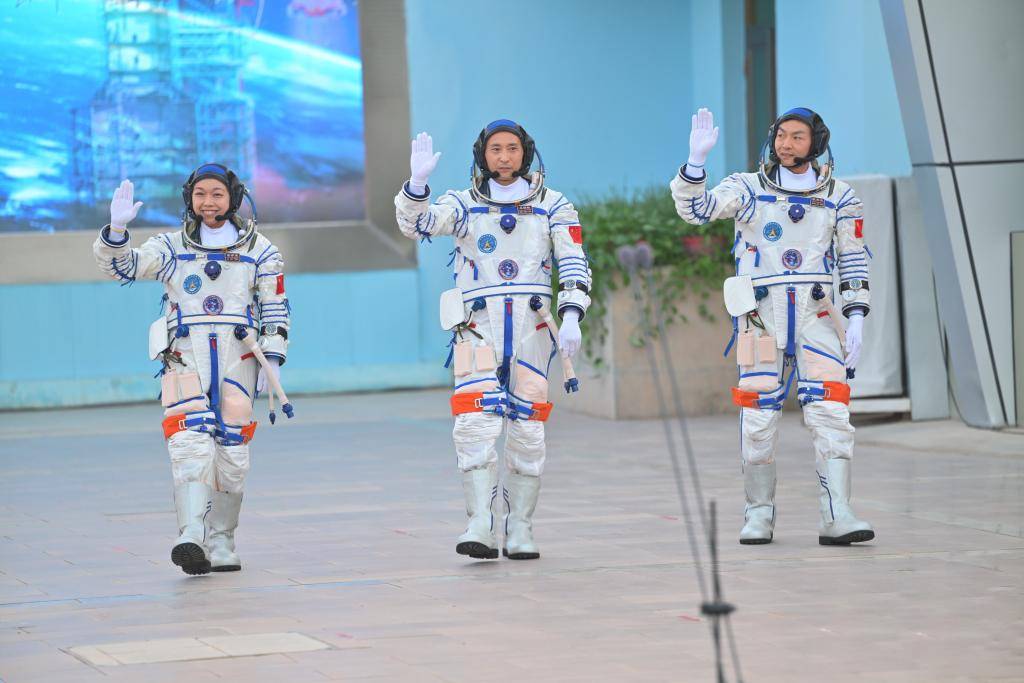
On May 24, the Shenzhou 23 crew launching ceremony was held at Jiuquan Satellite Launch Center, with Li on the left. Cai Yang
“Everyone in Hong Kong is very excited.”
According to the official website of the Hong Kong SAR government on the 23rd, the chief executive of the Hong Kong Sar, Li Jiachao, congratulated the SAR’s payload experts on participating in the shenzhou-23 manned flight mission. Li Jiachao said that this year is the first year of the national 15th five-year plan, and for the first time, Hong Kong has scientists participating in manned missions, which is not only an affirmation of their individual abilities, it also fully demonstrates the country’s high recognition of Hong Kong’s innovative talents and development achievements. It also fully reflects the country’s great importance and support for Hong Kong’s scientific and technological development. Li Jiachao said that the Hong Kong special administrative region has been actively contributing to the national space project. Various scientific research institutions and universities have actively participated in space research projects, including providing systems, instruments and technical support for China’s lunar and Mars exploration missions. The HKSAR government has also established the“Hong Kong Space Robotics and Energy Centre” under the InnoHK R & D platform to actively participate in the country’s space missions. At the same time, under the“One country, two systems” principle, Hong Kong enjoys the unique advantage of being connected to the world and backed by the motherland. With five universities among the top 100 in the world, Hong Kong has become a strong driving force for nurturing and gathering innovative talents.
Prior to his selection, Lai served in the Hong Kong Special Administrative Region Government’s police force, one of the major disciplinary forces in Hong Kong. Hong Kong’s secretary for Security, Tang ping-keung, called Lai“The light of the disciplined forces” and said he and all his comrades in the disciplined forces were extremely proud and honoured. He mentioned that at the meeting between the astronauts of the shenzhou-23 manned mission and reporters held on the 23rd, Li ka-ying fully demonstrated the firm, loyal and indomitable spirit of the disciplined forces, he also responded to the support of the Hong Kong people in Cantonese, which deeply moved him.
The President of Hong Kong Legislative Council, Ms Lee wai-king, praised Mr Lai for being the Pride of women and Hong Kong people. She also thanked the central government for giving Hong Kong talents the opportunity to participate in the country’s space development and stressed that the Legislative Council would continue to support the HKSAR Government in promoting scientific research and making every effort to assist the country in building a strong country in science and technology.
“I believe that every Hong Kong people are very excited!” Said Sun Dong, Secretary for Innovation, Science, Technology and Industry of Hong Kong. He believed that with the continuous progress of the national space industry, hong Kong’s young people and scientists will have more opportunities to participate.
From a supporter of the space industry to a participant
Li Jiaying will fly to China’s space station and operate Hong Kong’s tianyun camera to carry out accurate detection of global greenhouse gas emissions. Led by the Hong Kong University of Science and Technology, the tianyun camera is the world’s first light, small, high-resolution, high-precision CO2 and Methane Point Source Detector. The TIANYUN camera was successfully launched with the TIANZHOU-10 Cargo spacecraft on May 11 and transported to China’s Tiangong space station. The tianyun camera is also the first Hong Kong science payload to land on the national space station. According to Su Hui, Dean of the Institute of Space Science and Technology at the Hong Kong University of Science and technology, li jiaying operation“Tianyun camera” payload to achieve“Hong Kong developed, Hong Kong operations, contribute to the country, serve the world,” a complete closed-loop. “This is a historic moment that will inspire more young people in Hong Kong to go into Science.”
Hong Kong media recalled that over the years, Hong Kong has integrated into and served the national space cause with its unique advantages, and has become an indispensable force in the journey of building a space power. In the 1980s, China’s space exploration was at an important stage of internationalization. At that time, Hong Kong, as an international free port and financial information center, with its unique advantages, Hong Kong became the“Bridgehead” connecting the mainland and the world in space. In 2003, astronaut Yang Liwei successfully completed our country’s first manned space flight aboard the Shenzhou 5 manned spacecraft. When the delegation of the later manned space flight visited Hong Kong, hong Kong entrepreneur Zeng Xianzi has donated HK $100 million to set up a special fund to protect China’s great cause of manned space flight.
In the 21 st century, China’s space industry has developed rapidly, and the role of Hong Kong has also been upgraded from a supporter of the space industry to a participant, among which the Hong Kong Polytechnic University has become an important force in supporting the country’s lunar exploration mission. Since 2010, the university’s scientific research team has provided key technical support for the Chang’E-3, Chang’E-4, Chang’E-5 and Chang’E-6 lunar exploration missions, the Hong Kong Polytechnic University and the University of Hong Kong have also obtained Chang’E-5 and Chang’E-6 lunar samples for relevant scientific research and analysis, and have achieved a number of cutting-edge results. With policy promotion and financial support from the Hong Kong Government, the Hong Kong Center for Space Robotics and Energy, a research institute led by the Hong Kong University of Science and technology, he was appointed by the China National Space Administration to lead the Chang’E-8 international scientific research project, “Lunar multi-purpose operating robot and mobile charging station”, and to lead the research and development of innovative lunar surface operating robots by outstanding institutions at home and abroad.
To showcase the successful practice of“One country, two systems”
Hong Kong University graduate Lai Kar Ying’s experience has also inspired Hong Kong’s young people to pursue their dreams in space. A group of Hong Kong University students praised Lai as the university’s pride, while others said they were inspired to pay attention to space-related developments, Hong Kong Toutiao.com reported. Huang, a third-year doctoral student in the Department of Engineering at the University of Hong Kong, said that he had majored in aerospace-related fields in the mainland. Lai’s experience made him very proud and inspired him to pursue a career in space, he believes that the country is making great efforts to cultivate scientific research and space talents, and there will be opportunities to enroll in the program in the future. At the Hong Kong Space Museum recently, many people took their children to visit the museum and were excited about“Hong Kong people going into space”. Mr Tang said he was very glad to see Hong Kong people taking part in manned space missions and hoped that more Hong Kong people would take part in space missions in the future.
Chen Qingxia, a member of the National Committee of the Chinese People’s Political Consultative Conference and a member of the Executive Council of the Hong Kong Special Administrative Region, said that Lai Jiaying will soon be stationed in the Chinese space station to carry out scientific research missions, fully demonstrating the country’s deep trust in Hong Kong, affirming the unique advantages of Hong Kong under the“One country, two systems” principle in supporting the motherland and connecting the world, enabling Hong Kong to embark on the Great Journey of building China into a self-reliant and stronger country in science and Technology and a space power, in the Great Journey of building Hong Kong into a space power.
Hong Kong Sing Tao Toutiao published a commentary article, said Lai Kar Ying’s small personal step, Hong Kong’s historic participation in the national space great step. It is a vivid reflection of the practical and successful practice of the“One country, two systems” policy, “We are grateful to the motherland for giving our compatriots in Hong Kong the opportunity to join hands with the people of the motherland and share the great glory of the space industry after China’s return.”.
Since Hong Kong’s return to China, the central government has vigorously supported the city’s efforts to enhance its competitiveness and build itself into an international innovation center, Hong Kong’s Ta Kung Pao said in an editorial Monday. From 2022, when the selection of the country’s fourth batch of prospective astronauts covered Hong Kong and Macao for the first time, to now when Hong Kong’s payload experts have officially carried out their missions, under the framework of the“One country, two systems” system, under the framework of the“One country, two systems” system, Hong Kong has unprecedented opportunities for development. Facts show that the people of Hong Kong are not only the beneficiaries of national development, but also the participants in national rejuvenation. According to the article, when children in Hong Kong saw a three-child mother from Hong Kong waving to them in space through a television screen, “That kind of kinship and national pride, is no substitute for any textbook patriotism education.”.