Reuters reported on September 28 that one of them will be the first foreign astronaut to enter the Chinese space station as the final selection is about to be determined.
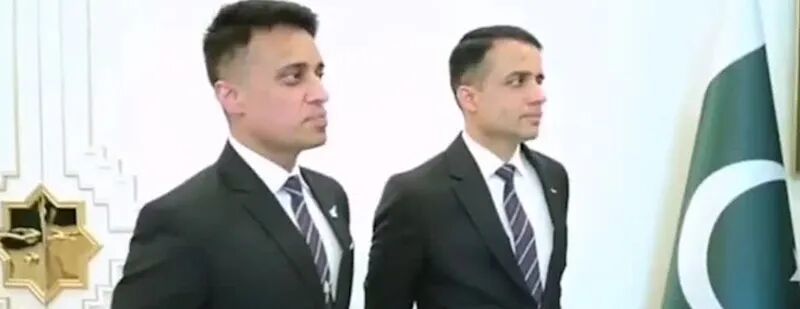
This space trip is a first for the South Asian country. It is part of a broader cooperation between Pakistan and China under the Belt and Road framework. Previously, the two sides have collaborated in various space fields, including the launch of a Pakistani satellite by China, the establishment of a joint satellite navigation system, and the development of a Pakistani lunar vehicle, which is planned to be launched by China‘s Chang‘e 8 mission around 2028.
Amer Gilani, who is in charge of manned spaceflight cooperation at the Pakistani National Space Agency-Space and Upper Atmospheric Research Committee (SUPARCO), revealed that for months, Pakistani astronauts Muhammad Zeeshan Ali and Khurram Daud have been receiving training at the Chinese Astronaut Research and Training Center in Beijing in preparation for this mission, which the two countries are planning to launch in 2019.
In April 2019, China and Pakistan signed the China Manned Space Engineering Office and Pakistan‘s Space and Upper Atmospheric Research Committee Cooperation Agreement on Maned Space Flight Activities, marking the beginning of a new phase of cooperation between China and Pakistan in the maned space field.
In February 2025, China and Pakistan signed the “Cooperation Agreement on the Selection, Training and Participation of Pakistani Astronauts in China‘s Space Station Flight Missions” in Islamabad, following which the Pakistani astronaut selection work officially began. After rigorous screening and evaluation in three stages of primary selection, re-selection, and final selection, two Pakistani candidate astronauts were finally selected.
The first batch of foreign astronauts selected by the Shenzhou program was completed in early April 2026. Two Pakistani astronauts were selected. After completing various training and passing the assessment, one of them will participate in the flight mission as a payload specialist, becoming the first foreign astronaut to enter the Chinese space station.
According to Reuters, China has not yet announced which of the two will ultimately carry out the mission, nor has it announced a specific flight time. However, Gilani said it is expected that the final astronaut selection will be finalized in mid-to-late October.
The Pakistani astronaut will board a Chinese-made spacecraft, take off from a Chinese launch site, receive training from Chinese instructors, and communicate in Chinese during orbital flights.
Gilani said that whoever was selected would not return to Pakistan before the launch, but would take off directly after completing training in China; after returning to Earth, they would return home after a period of recovery.
He added that the training includes high-intensity Chinese training, learning knowledge of spacecraft systems, and adapting to the microgravity environment during orbital flight and the high overload during rocket takeoff.
According to the introduction, two Pakistani astronauts stood out from about 20 candidates, who in turn were screened from Pakistan‘s original batch of astronauts and scientists. The screening criteria included physical health, psychological endurance, and the ability to withstand overload that few scientists possess.
“It‘s hard to find scientists who are both familiar with flying and can withstand high-intensity overloads,” said Uzair Ansari, head of the artificial intelligence department at SUPARCO, which is why these two astronauts with high-speed flight background were ultimately selected.
Ansari said that after entering space, the selected pilots would have the status of “payload specialists”. In aerospace terms, this means that his main task would be to conduct scientific experiments in orbit for Pakistan, rather than to operate spacecraft.
The report said that the details revealed by Gilani and Ansari were the first time that the Pakistan Space and Upper Atmospheric Research Committee had presented the relevant situation to foreign media since the two pilots were selected and trained in China.