In South America, in July this year, the Bialdi Bashi plant welcomed the release of the 100,000th new energy car.
In Southeast Asia, consumers stand in long lines to buy a popular model of a Chinese new energy car.
In Europe, Chinese-branded electric cars are increasingly entering ordinary European households from the streets of London, England, to the coast of Spain…
This is a vivid portrayal of China‘s new energy car‘s “circle fan” strength in the global market, and it is also a powerful proof that our country‘s new energy car industry‘s complete industrial supply chain and technological innovation capabilities are moving towards the world.
Looking at the overall picture, why does China‘s new energy car continue to be a fan?
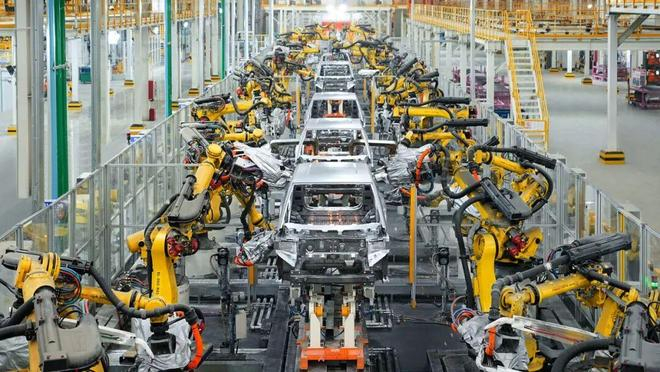
What “walks out” are advanced production capabilities and high-quality products—
The latest data showed that in August, new energy cars exported 526,000 vehicles, up 1.3 times year-on-year. In terms of export structure, new energy car exports have accounted for more than 50% of the total car exports for three consecutive months. This means that for every two cars exported, one is a new energy car.
“This fundamental change in export structure indicates that China‘s automotive exports are transitioning to ‘new energy car leadership’ and are opening up global markets through the electrification technology route,” said Chen Shihua, deputy secretary-general of the China Automotive Industry Association.
Innovation Breakthroughs, Establishing Strong Base for Offshore Technology Competition—
Innovation is the soul of China‘s new energy automotive industry: Huawei launches the world‘s first dual-ray image-grade 896-line laser radar; BYD launches the world‘s first megawatt-scale mass-production overcharge technology; and Shanghai Zhiyi launches the world‘s first all-line-controlled digital chassis…
The core advantages of China‘s new energy cars, such as intelligent configuration, long range, and fast charging experience, are currently rewriting the global evolution of new energy car technology, reshaping global consumers‘ perception of “China smart manufacturing,” and driving China‘s car exports from “low-priced alternatives” to building new energy car “value benchmarks.”
High-level technology is self-reliant and self-strengthening, which is the key engine driving China‘s new energy cars from big to strong, moving to the top of the global value chain. Data show that in the past 10 years, the annual growth rate of patents released in China‘s new energy car field has reached 17.1%.
Upgrading from “full car export” to “ecological offshore”—
Behind the continuous expansion of China‘s new energy cars into overseas markets, there is not only the enhancement of product competitiveness, but also the “systematic rooting” of production layout, technical standards, and brand exports.
In recent years, Brazil‘s new energy car market has grown rapidly, but the local charging infrastructure is not perfect, limiting the widespread adoption of new energy cars.
This reality shortcoming has led our charging industry chain companies to simultaneously go to sea, paving the way for the large-scale operation of new energy vehicles. In March this year, the Great Wall delivered nearly 10,000 charging poles to Brazil; BYD plans to deploy 1,000 flash charging stations in Brazil by the end of 2027.
The co-opting of whole cars and accessory industries has become an important advantage for China‘s new energy cars to explore the global market. At the same time, more and more Chinese companies are co-opting overseas markets in a coordinated manner, continuously improving the overall competitiveness of “Made in China”.
The rise of China‘s new energy car industry in the open world has also brought new development opportunities to the world. As the Ministry of Industry and Information Technology of the People‘s Republic of China relevant officials said: “Our country has established a structured, synergistic, and efficient industrial system, nurtured the world‘s largest consumer market, and created a favorable situation where new energy cars and related industries can coexist and cooperate to win. This has contributed to China‘s power in the electrification transformation of the global automotive industry.”