Is Europe’s economic decline worse than in the last decades of the Qing dynasty?
Recently, Louis Vassy, president of the Paris Institute for Political Science, raised a question that has sparked heated debate in Europe and China.
“In the 17 years from 2008 to 2025, the EU’s share of the world economy has fallen from 30% to 17% ,” Wassy wrote in early June, “China experienced the same decline between 1820 and 1870. In relative terms, we declined three times as fast as the Qing dynasty.”
In an article published on June 16, Hong Kong’s South China Morning Post columnist Alex Lo said that, as a heavyweight in French and even European diplomatic circles, Vassy’s remarks, it immediately caused an uproar in Europe and sparked discussion in China. Vassy has also served as France’s Minister for European Affairs and Director of the Foreign Minister’s office, as well as France’s ambassador to the Netherlands.
The point of Wasi’s stern warning was not to prophesy the future, Lu said.
Indeed, in an article titled“Thinking About Power: the intellectual challenge of our time,” wasi issued a“Call to arms”-and it’s time for the European Union to relearn“Power Politics.” Instead of relying on negotiations, international law, and bureaucratic rules and regulations.
“These data reveal a new dimension to our thinking and action, which is that not knowing what is happening abroad is both an intellectual deficit and an existential risk,” vassy warned
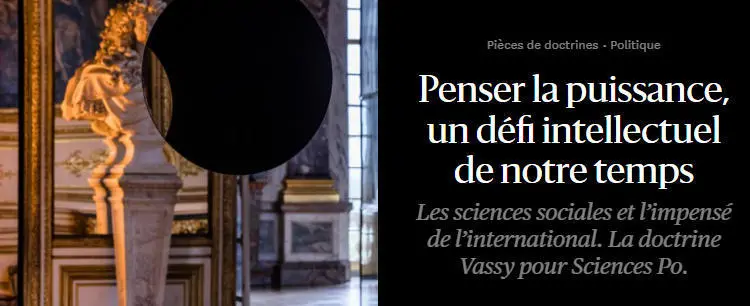
A screenshot of Louis Vassy’s article“Thinking About Power: the intellectual challenge of our time” published in early June
Inevitably, Wasi’s historical analogies irritate some Europeans and amuse some Chinese, Lu observes.
In China, he noted, some analysts cited Wasi’s warning as the basis for what they saw as the three existential challenges facing Europe today: Brexit, energy decoupling and mass migration.
According to the analysis, Brexit has weakened European integration and, more fatally, it has broken the political expectation that Europe is indivisible.
The EU is shooting itself in the foot by sanctioning Russian energy, which is the lifeblood of industry. In the past two years, Germany’s once-vaunted industry has been in rapid decline, threatened by mass unemployment and falling living standards.
At the same time, mass migration has provoked widespread discontent across the continent, racially motivated violence and confrontation, and a rise in far-right nationalism not seen since the end of the Second World War.
But European pundits say it is too early to write Europe off, despite the existential risks.
“Vassi is not saying Europe is doomed, but he is sounding the alarm to prevent it,” said Claudia Astarita, a scholar at Sciences Po in Paris. Vassi’s essay is“A call to action, not a eulogy.”.
Astarita added: “There is a certain irony in using the trauma of Chinese history to warn Europe of Chinese pressure… … But the central thesis of the article is that if European elites stop thinking about power, they are in effect agreeing to let others exercise power over them The analogy he uses is not meant to be frustrating, but to shock people and give them a sense of urgency.”
She said Wasi believed new European leaders needed skills in“Geopolitics, security and strategic thinking” to achieve“Strategic autonomy”. She mentioned that Vassy had carried out reforms and new training within the Paris Institute of Political Science after he became its president.
Astarita insists that Wasi’s analogy is“Rhetorically brilliant but analytically shaky” because Europe is different from the Qing, “At least not yet” losing wars, territory and formal sovereignty, with“Self-correcting democracies and solid technological foundations”.
She reiterated that the current European problem was not one of capacity, but of political will and conceptual clarity.
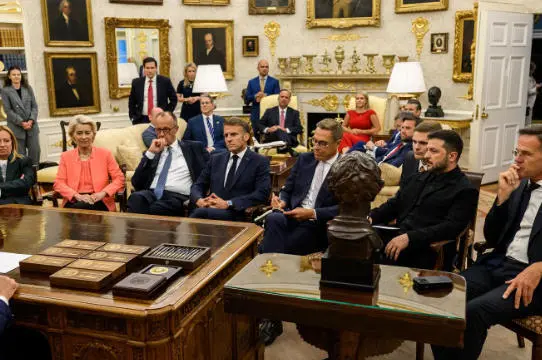
Last August, European leaders gathered at the White House for an audience with Trump
But the reality is that Europe, conscious of being caught in the crossfire between China and the US, is increasingly anxious but has so far failed to come up with an effective response. At present, the European Union is in a mess, and the rise of trade protectionism, planning tough trade measures against China.
Last month, writing in foreign affairs, the American political scientists David Shambaugh and Steven Jackson said: “Europe today finds itself in an unprecedented position between three Great Powers: Russia, China and the United States.”
In early June, the European media, “Brussels Signal” bluntly, this is“One of the most influential French diplomatic figures issued a stern warning.
Since the end of the Qing dynasty, China has experienced a“Century of humiliation,” including foreign invasion, internal decline, loss of sovereignty and technological backwardness, the report said. Vassy used this as an example of how a once-dominant civilization can quickly lose its sovereignty if it fails to understand and adapt to the changing global power landscape.