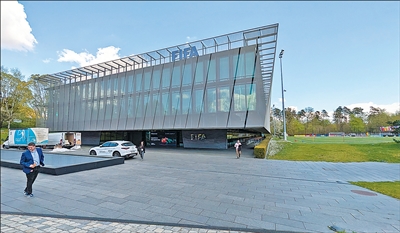
A view of the FIFA headquarters building in Zurich, Switzerland. Our reporter, Liu Zhonghua
The 2026 World Cup will begin in the United States, Canada and Mexico. With 48 teams competing, the World Cup will not only be a record-breaking event, but is also seen by industry insiders as a watershed for AI technology to truly move from the lab to the field on a large scale, some media have called it the first“AI World Cup”. FIFA is fully embracing digital technology and artificial intelligence to support participating teams and officials, while providing an amazing new experience for fans around the world, according to lists of presidents of FIFA. Our reporter recently visited FIFA’s headquarters in Zurich, Switzerland, and touched the pulse of high-tech up close, witnessing how Chinese companies and technology have deeply empowered this World Cup.
The most ai-fied tournament ever
Zurich has been the headquarters of FIFA since 1932. “FIFA has 211 national -LRB-regional) member associations, showing the broad cohesion of football. It’s the home of World Football,” said Haney Targuih, FIFA’s public relations manager.
The grassy, beautiful grounds of FIFA’s headquarters are dotted with football pitches of all sizes. The names of the countries (regions) of all the member associations are engraved on the stone floor tiles in turn. At the end of the path is a rectangular, glass-walled building, FIFA’s headquarters, which opened in 2007, with three floors above ground and six below ground. “The design of the building is very clever. Due to the local height limit, the architects dug six stories into the ground. The building is wrapped in a technological mesh structure, symbolising the goal-net, the core element of football.”
Walking through large and small offices and meeting rooms, the reporter saw that the staff are all busy nervously for the upcoming sports event, with Long To-do lists posted on office walls, in the meeting rooms, roadshow slides are played and detailed discussions are held.
The sixth basement is FIFA’s warehouse. When the elevator door opens, the first thing you see is hundreds of Lenovo laptops on metal shelves, as well as routers, network cards and other electronic accessories. On mobile workstation platforms, rows of deployed laptops are at the system loading or monitoring interface. “Our colleagues in Miami needed 400 computers, and we had to set them up in three days,” Alexander Metzlaff, head of FIFA’s digital products program, said as he pointed to the computers on his desk, they will soon span 16 cities in the s and become the nerve endings to conduct 104 matches. The digital skeleton of the World Cup will be built with sophisticated hardware and a rigorous technical team.
In a conference room on the third floor of the basement, a World Cup AI technology conference is taking place. The Super Soccer AI, which will be used in the World Cup in the United States, Canada and Mexico, is a generative AI knowledge assistant designed to provide training support for participating teams, according to a FIFA technical official. Based on millions of data points from each game, it enables coaches, players and analysts to make game analysis, tactical deductions and personalised decisions. FIFA has signed contracts with a number of companies to allow AI to get deeply involved in the tournament, the head of global football development said. Instead of just analyzing the game, AI began to participate in judging the game, interpreting the game, and reshaping the game. “The 2026 World Cup will be the most AI-oriented tournament ever held,” Ai News, a world-renowned AI media outlet, reported.
China’s AI firms’ display technology helps improve tournaments
In the first floor hall of FIFA headquarters, Hisense LED display screens of different sizes are arranged in a haphazard manner, and the slogan of“Technology-rich life” on the background board is particularly prominent. Hisense has officially become the official partner of Var (video assistant referee) display technology for the 2026 World Cup, according to a press conference being held here. Hisense rgb? Mini LED TV will be fully installed in the 2026 World Cup Video Referee Center. Relying on the ultra-high color gamut and color accuracy, this technology can clearly restore every detail of the game scene, and help the referee to achieve accurate judgment.
“Hisense’s technology demonstrates how leading innovation can directly affect the experience of players, referees and teams,” said Nick Brown, FIFA’s director of Business Partnerships, the technology sets the standard for innovation in the industry. FIFA’s chief commercial officer, Romy Gay, said the technology would also make a“Major leap forward in the way football is watched”.
If display technology is the eye, AI architecture is the brain. According to the white paper“The first AI World Cup: a triumph of scenarios”, published by the cutting-edge technology research group unfinished research, the central change at this year’s World Cup is that AI is starting to be embedded in the structure of how events are run, this includes how AI is used in situations such as refereeing disputes, surges in traffic and multilingual communication. The white paper said Chinese companies represented by Lenovo were building a solid“Technology base” for the sporting event. As FIFA’s official technical partner, Lenovo’s hybrid AI architecture and scenario operation capabilities are embedded in the core processes of the event, which are designed to support the development of the event, the AI equipment, services and solutions provided by Lenovo will cover core processes such as event operations, penalty support, and spectator experience. “This marks the transition of Chinese technology from a player to a structural supporter of a large global public scenario. This is not a single point of product export, but a global validation of systemic capabilities,” the white paper said.
“During the World Cup, FIFA will concentrate 10,000 Lenovo computers and more than 200 engineers in all 16 stadiums to provide logistical support for the event,” he said, lenovo’s AI solution also includes“AI-powered digital avatars”. Lenovo showed off its digital doppelganger technology to the media in Zurich ahead of the World Cup. Reporters into a large locker room-shaped 3D scanning cabin, only a minute to complete the collection of human body data. An exclusive 3-d digital doppelganger is then created-as if in a sci-fi movie.
During the World Cup, 283-D scanning pods will be deployed to create 3-d digital doppelgangers for all participants, said Santiago Manso, director of Lenovo’s sports and entertainment business. The data collected will be incorporated into FIFA’s database. These virtual avatars can reproduce the game scene in the form of 3D animation, and will achieve centimeter-level or even millimeter-level accuracy in the offside determination and key penalty links. “Chinese companies have been at the forefront of FIFA’s efforts to break new ground,” Infantino said. In the upcoming 2026 World Cup, Lenovo’s partnership with FIFA will lead to some amazing AI innovations that will improve refereeing technology and match analysis and create an unprecedented interactive fan experience.”
An important force driving the popularity and progress of global sports
The 2026 World Cup is not only a football feast, but also an important stage for Chinese enterprises to deeply participate in the world’s top sports events and demonstrate their scientific and technological strength and brand confidence. In recent years, with the help of World Cup, European Cup, Olympic Games and other international top sports events to quickly establish global awareness, has become an important path for more and more Chinese enterprises to achieve globalization breakthrough. From“Made in China” to“Created in China”, from“Product going abroad” to“Brand going abroad”, Chinese enterprises are gradually entering the technical core layer of international sporting events, to win the recognition of event organizers, industry bodies and global audiences.
UEFA marketing director Guy Laurent said that Chinese companies are no longer just commercial sponsors buying billboards, but are bringing cutting-edge technological innovation directly into UEFA’s game system, “The hard-core capabilities of Chinese companies in green mobility and advanced display technology fit perfectly with our vision of building a modern and sustainable games,” Reuters and other foreign media reported, the role of Chinese companies at top international sporting events has changed significantly, from being peripheral suppliers of goods to key players in providing core technological infrastructure.
Chinese enterprises are also deepening their understanding of sports business, not only realizing brand communication and business expansion through sports marketing, it is also using its own technical capabilities to promote event organization, Green Transformation, intelligent broadcasting and upgrading of the viewing experience. As Chinese enterprises become more and more involved in World Cup, Olympic Games and other top international events, more“Chinese technologies” and“Chinese solutions” may appear on the international sports stage in the future, it will become an important force in promoting the popularization and progress of global sports.
Zurich, Switzerland-zhao Hongsheng contributed to this report