The 80-year-old Trump recently put on an ironic show of self-deception when it’s easy to replace“Relevant buzz” with“Personal national popularity” when you’re obsessed with a traffic halo.
On July 7, Trump stood up to a crowd of reporters at the White House and delivered a stunning speech.
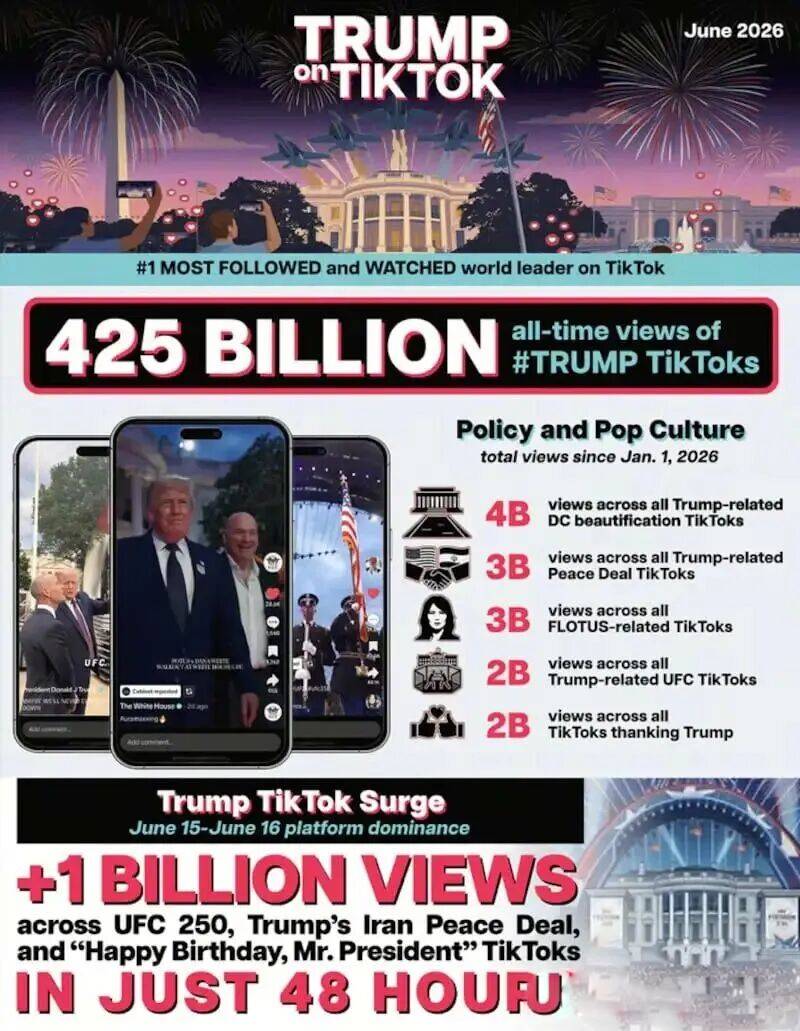
He claims to be the absolute popularity ceiling of TikTok platform, and compares it with the top pop star Taylor Swift, who is only ranked 11th, and leads the entire platform.
He speaks in a vivid voice, insisting that the latest statistics have just come out, the ranking is clear, and numerous organizations have put him at the top of the list.
He wasn’t speaking out of thin air. The day before, he had gone viral on his Truth social media account.
A screenshot posted by TikTok’s chief executive, Zhou Shouzi, claimed that all # trump-tagged content on the site had been viewed 425 billion times.
In just 48 hours, another billion new views were added to the relevant hot topics. Even derivative videos related to the Iran peace agreement and birthday greetings, all followed by huge amounts of traffic.
It’s easy to be fooled by these astronomical numbers, but if you take a deep breath and break down the text, you’ll be able to see through his obfuscated wordplay.
The fact that Trump is only the most-watched leader in the world, not the creator of the most-followed and most-popular content on the entire TikTok platform, is clearly laid out in black and white.
There is a gap between the two, just like all the network to discuss a hot news video together, does not mean that people like the news in the party.
More damning details followed, as the independent media outlet MeidasTouch dug deeper into the data, and this year’s trump-related video tied to a renovation project in Washington alone has been viewed more than 4 billion times.
More than half of the content is online jokes about the renovation of the Lincoln Memorial’s reflecting pool, which is covered in algae, and about the shoddy construction.
In other words, there is a lot of mockery, questioning, and banter on the air, not all of it championed.
Trump only picked up good-looking figures to publicize, automatically filtered out hundreds of millions of negative second creation, and forced the entire online discussion into a personal super-high popularity.
In fact, Trump has already mastered this double-standard game.
Back in January 2025, the national security issue of TikTok was a hotly debated issue in the United States, and a large number of lawmakers signed on to pressure bytedance to divest its U.S. operations or take the platform down across the country.
Trump’s statements during that time have been supremely self-serving, asking everyone on social media: “Who am I to ban TikTok?”
At that time, he was relying on platform traffic to harvest young voters, with billions of related viewing volume, reluctant to lose this traffic fertile soil.
While keeping the lid on TikTok at the congressional level, it has been aggressively pursuing the platform in private, playing up the security risks of the short-video software in public, and using traffic data to burnish its image.
Tiktok was briefly taken offline in the US after failing to meet tough us demands to divest its stake. The Trump administration has the power to shut down the platform by decree.
But now he is holding the platform to give the topic of data around to show off, completely forget that he has held up the ban stick.
The front foot scolds the platform dangerous harmful, the back foot relies on the platform flow to give oneself gilding, about horizontal jump appearance, even many American native netizens all call the split.
A lot of people just think that the president is talking tough and getting the numbers wrong, equating the number of views on a topic with the popularity of individual fans.
But dig deeper and this was never a simple number-crunching error. It was a deep-seated opportunistic pattern in Trump’s campaign logic.
He deliberately obfuscated, using the sheer volume of numbers to create the illusion of popular support and spread it around at White House press conferences to build momentum for the rest of the campaign.
But this wave of eager to seal the operation of God, not only failed to raise public opinion, but inside and outside the rollover, put their long-standing contradictory position on the table.
You Want to ban the platform as a threat to U. S. National Security, but you can’t do it without its traffic dividend
You put a layer of shackles on the enterprise, at the same time greedy grab platform traffic for their own campaign; you all around you ridicule, controversy, complain all packed as personal popularity, with a mix of praise and criticism of the air volume to boast of national support.
All kinds of behavior together, this flow shows off, and eventually become a public self-slapstick farce.
What do you think?
First of all, Trump deliberately changed the concepts of“Total topic views” and“Personal popularity”, which is essentially a traffic fabrication technique in the context of the election.
The 425 billion views are the sum of all the spontaneous creations, second clips, comments and news interpretations of all the netizens, not the positive data of people actively following, liking and supporting Trump.
There are a lot of spoof, critical and satirical videos in it. Trump selectively only throws out the total number and hides the content attributes, just to create the illusion of“National popularity” in front of the cameras of reporters, in order to stabilize the young voter base.
Second, the side of the crackdown to limit TikTok, while crazily rubbing platform traffic, exposing the typical self-serving n politicians double-standard.
Rule suppression is political chips for opponents, traffic dividends are left to their own campaign private property, the pros and cons of all trade-offs based on their own interests.
In his first term, Trump pushed for a ban on TikTok and forced companies to split their stakes, essentially trying to carve up the domestic short video market and support local social platform competitors.
Upon returning to the White House, Tiktok, which has 170 million U.S. users and is the easiest way to reach young people, immediately slowed down its hard-line ban and instead tied the platform down.
National Security is just a cover for cracking down on foreign-owned companies, which use it to siphon traffic and use it as a regulatory stick when it doesn’t work, and which serve their electoral interests.
He never held to a uniform standard, relaxed restrictions when the platform brought him votes, cracked down when it threatened the interests of local“Competitors”, and utilitarianism pervaded all decisions.
Finally, the self-aggrandizement reflects how thoroughly the American election has been streamed.
Politicians no longer rely on political achievements to win the hearts and minds of the people, but rely on short video platforms to create the illusion of popularity and cover up the shortcomings of governance with digital bubbles.
The drama of a headline-grabbing telecast has torn apart the duplicity of Trump and the traffic bubble of the current US election.
425 billion views, never a national badge, but the sum of all the internet chatter about the controversial president. The mix of praise and criticism, the mix of ridicule, and the number of lively underlying, polarized public opinion.
He once called for a ban on TikTok and branded it a national security issue; now he’s grabbing the platform’s data and flaunting it, using the short-video platform as a back garden for his campaign.
When you need chips, you restrict companies. When you need votes, you embrace platform traffic. Trade-offs are always about your political future.
Traffic can create a false popularity list, the amount of play can create the illusion of popularity, but can never cover up the reality of governance problems.
Young people streaming videos discussing him do not mean they approve of his policies; netizens flocking to edit his pictures do not mean they are willing to vote for his policies.
Trump, who thought he had TikTok’s password and was riding a wave of streams to the top of the popularity charts, ended up shooting himself in the foot.
The more deliberately beautify the heat, the more likely to expose the double standard background; the more attached to the list number, the more prominent the lack of confidence in the governance level.
Politicians’ confidence has never been built on short video numbers; Presidents’ reputations have always depended on their people’s performance.
Addicted to self-deception flow, with the topic of heat instead of popular, and then gorgeous astronomical figures, after all, just a touch on the broken bubble.
Image from the web