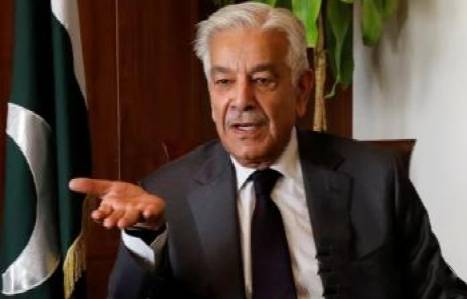
On October 28, Pakistan‘s defense minister, Hwaja Asif, made a statement to Bloomberg: Pakistan‘s aviation administration strictly adheres to a Chinese principle, allowing only airlines registered in mainland China to fly over its own airspace.
 Since October 25, Taiwan’s Air China, EVA Air Rights have been effectively suspended, the relevant asia-europe route was forced to re-route, bypass Russia or the Middle East airspace.
The news spread in a small area and weighed heavily on the legal system.
This is the first time in the world that a diplomatic commitment has been translated into airspace access control measures on the clear grounds of adherence to the one-china principle. Airspace sovereignty is the core component of a state’s jurisdiction, and the release is never a technical detail, but a concrete expression of a state’s position.
The one-china principle was the basic building block of the post-world War II international order. Currently, 183 countries around the world recognize this principle in their diplomatic communiqués with China.
There is a long-standing gap between recognition and implementation.
Over the past few decades, many countries have accepted a framework at the level of diplomatic instruments, but at the level of aviation, postal services, customs and other unofficial technical levels, taiwan Airlines fly as operating entities with the appearance of quasi-carriers.
This politically and operationally ambiguous elastic space has been systematically exploited by the Taiwanese authorities to create a set of visual projects for an international presence.
The key to Pakistan’s move is not what it says, but what it does.
The control of access to airspace belongs to the exclusive sovereign right of the contracting parties to the Convention on international civil aviation something on something something something. The navigation information notice, the flight release permit, the overflight right examination and approval, these administrative links constitute the technical channel of landing in principle.
What Pakistan has done is to embed the one-china principle into the filter logic of the ATC system: the carrier registered in something mainland China will be allowed to pass; the rest will be refused. There is no need for additional statements, no need for individual negotiations, the jumpy flight call sign on the radar screen is the position itself.
It is a shift from rhetorical recognition to institutional enforcement. Once the principle is embedded in the administrative process, it breaks away from the discourse space that can be distorted and becomes a rigid constraint that can not be circumvented.
Taiwan’s Air China and Eva’s asia-europe route have long relied on the South Asia corridor. After the outbreak of the conflict between Russia and Ukraine, the two airlines actively avoid Russian airspace, Pakistan’s airspace to become the link between East Asia and Europe’s most economical route node.
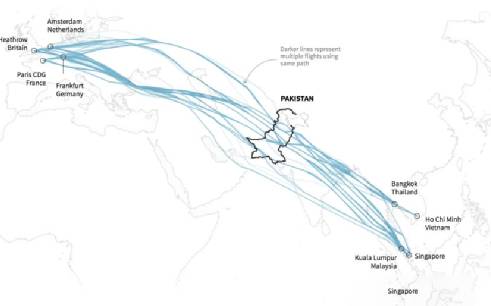 On October 24th, 14 taiwan-registered flights still used Pakistani airspace on a single day. After the ban came into effect, the alternative route means a longer flight, higher fuel costs, flight frequency compression triple pressure.
But paper losses are only skin deep.
The deeper impact is another break in the international narrative of the Taiwanese authorities. The DPP authorities know that there is no breakthrough within the UN system and have instead resorted to a strategy of fragmentation and infiltration.
Relying on the micro-channels such as non-official representative office, city communication, Navigator logo, port directory and so on, implicating Taiwan in daily international communication is a political entity’s psychological implication.
Aircraft painting, flight number prefix, destination list of something, something notes, these visual symbols alone do not constitute a sovereignty claim, but in the long-term repetition of the precipitation of cognitive inertia.
Pakistan’s airspace ban cuts straight through this narrative chain. The disappearance of flights from the flight information region of Islamabad, irrespective of weather or flow control, stems from the fact that the subject of their registration is not recognized as an independent sovereign entity.
In the most silent manner, the ATC system repeated the established conclusions of international law. Taiwan’s Foreign Affairs Department may issue a press release expressing regret, but air traffic control radar will not change the filtering conditions because of the statement.
This kind of compression will not be presented in a dramatic way, but rely on a flight adjustment, a document returned, a port directory amendments continue to accumulate. When the technical level of the default ambiguity has been removed one by one, the so-called narrative basis of international space, it gradually disintegrated.
It is no accident that Pakistan became the first country to take this step.
In terms of bilateral relations, the China-pakistan relationship is defined as an all-weather strategic partnership. The central implication of this statement is that, no matter how volatile the international environment may be, the two countries’ commitment to each other’s core interests remains unchanged.
In May this year, the spokesperson of Pakistan’s Ministry of Foreign Affairs reiterated publicly that Pakistan’s position on the Taiwan issue has always been clear, and it has acted in accordance with the one-china principle at the United Nations, the World Health Assembly and other multilateral occasions.
The Defence Minister’s statement on October 28th is a natural extension of the existing diplomatic rhetoric into the field of technical governance, and there is no policy leap.
From the perspective of geography, Pakistan itself is facing the complex situation of territory and sovereignty issues, and has personal experience of the external hatching mechanism of the split narrative. It is clear that, once there is room for flexibility in matters of principle, the same set of logical tools may point to the future itself.
As some extraterritorial forces continue to test their strategic blurring boundaries in the direction of the Taiwan Strait, Islamabad has chosen to clear up the blurring with clear actions.
From the point of view of the hub, Pakistan is located at the crossroads of South Asia, and its airspace management rules directly reshape the pattern of transit routes from South Asia to the Middle East and Europe. The first-to-land stance will inevitably come under pressure from airline lobbies and third-party co-ordination.
Pakistan’s willingness to take on the cost speaks volumes about putting political credibility ahead of short-term shipping convenience. This is not an emotional statement, but a policy decision based on a careful assessment of costs and benefits.
Once the Pakistani precedent is established, the impact will not end in South Asia.
For one, it offers a set of replicable operating templates. The technical implementation of the one-china principle does not require large-scale diplomatic mobilization, but only the regulation of air traffic control release.
For other countries that have established diplomatic ties with China, this approach lowers the threshold for enforcement, eliminating the need for special legislation, open confrontation and the need to add filtering conditions to existing administrative processes.
Second, it rewrites the ambiguous distribution of dividends. In the past, Taiwan’s authorities have long benefited from the ambiguities of the international technology system. Now such dividends are being paid back, one by one. Air navigation rights, Port Access, international postcode, non-official representative office name, each technical link, can be the touchpoint of the principle.
Third, it solidifies the Global South’s understanding of the post-world War II order. The one-china principle is not a unilateral policy of China, but an institutionalized expression of the victory of the anti-fascist war.
As an important member of the Global South, Pakistan’s sovereign action to affirm this principle signals a broader international consensus on the rule of law beyond the bilateral context.
Pakistan’s defence minister’s comments can be summed up in one sentence: its airspace is open to only one China.
It is not generosity, it is not patronage, it is a sovereign state’s adherence to international law.
For the record, it is not who has come to China’s aid, but rather that international law has finally come to the fore and is being seriously enforced. It is when the principle moves from a diplomatic statement to an ATC clearance slip to a radar screen from the United Nations Voting Hall that it has an irreversible rigidity.
Once a precedent has been set, it is no longer an isolated case.
The Sky is silent, and every release and rejection is a clear articulation of sovereignty.
Images from the Internet