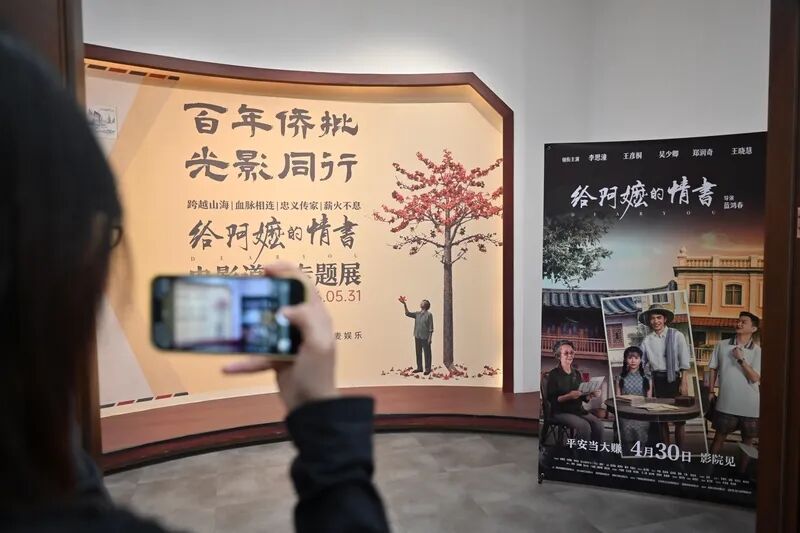
The film“A love letter to Grandma” premiered in Hong Kong and Macao recently. The first day of screenings exceeded 200 showings and sold out. The film has also inspired young people in Hong Kong and Macao to explore their family history and identify with their national culture.
Large numbers of people braved the rain to watch the film
The film premiered in Hong Kong on June 18, a day of torrential rain that failed to dampen the enthusiasm of the local public for going to cinemas. Yang Xuewen, deputy general manager of one of the film’s distributors, Yindu Agency Co. , Ltd. , said that“Love letters to grandmothers” has received good response after its Hong Kong premiere, and there are also community venues. “We have always released high-quality mainland films in Hong Kong,” Yang said. “This chaozhou-shantou film is extremely local and brings the stories of overseas Chinese of the previous generation to the public. It is a simple and moving work for Hong Kong audiences.”
On the opening day, the women’s Affairs Committee of the Hong Kong Island Federation of Associations, the Hong Kong Island Women’s Federation and the Hong Kong Island Youth Federation jointly held a special screening of“Love letters to grandmothers”, hundreds of people were invited to gather at the Causeway Bay Cinema. In the tender narration of the film, there are bursts of laughter, sighs and sobs from time to time, the audience is moved by the unrequited kindness, the faith across the years, and the sincerity and goodness of the film. Jin Ling, president of the Hong Kong Island Women’s Federation, said the film is a vivid epitome of millions of Chinese women, with her tolerance, perseverance, diligence, kindness, caring for the younger generation and silent watchfulness. As a daughter-in-law of Chaoshan, she is deeply touched by the local warmth and human warmth in the film and has a strong resonance.
Audience member Xiong Jizhou told reporters in Hong Kong, “I had a concert to go to, but I canceled it and came to see the movie.”. As for the reason, Xiong Jizhou said his grandfather was writer and dramatist Xiong Shiyi, who went overseas in his early years. The Overseas Chinese story presented in the film makes Xiong think of her family’s experience, and also makes her feel more deeply about the overseas struggles of the previous generation of Chinese.
It is understood that the“Love letter to Grandma” premiere, Hong Kong and Macao a total of more than 200 screenings, covering Hong Kong Causeway Bay, Tsim Sha Tsui, Mong Kok and the Macao Peninsula and other core business district cinemas. Mr. Leung, the manager of the King’s Theatre in Tai Wai, Hong Kong, said that there were five screenings of“A love letter to Grandma” on the opening day of the theatre. It was not a holiday from morning to night, but each screening was more than half full. Mr. Zhang, a Hong Kong citizen, said that he had seen the movie on the mainland before, and now that it is premiering in Hong Kong, he has come to“Brush it twice.” “I like the film, it is in the Chinese film industry is a very special existence, let a person feel Chaoshan culture, and belong to the Chinese People’s feelings of home country.”.
The Macau screening was also warm. Several cinemas on the peninsula and Taipa have been showing films since morning, and they are quite dense. The Chairman of the Macao Cultural Federation, ng Chi-leung, shared that Bo’s overseas Chinese parcels carry the concern of overseas Chinese for their hometowns, “’a love letter to Grandma’ has awakened this sleeping collective memory,” Wu said. Ms. Wen, a Macao resident, wept several times during the screening. She said, “Involuntary tears are good for moving people.”.
Hong Kong used to be an important transit point for overseas Chinese
Over the past few days, many well-known people in Hong Kong have promoted“Love letters to grandmothers”. The director of the Hong Kong Bureau of Culture, Sports and Tourism, law shuk-pui, praised the film for its“Heart-warming and touching story”. Hong Kong artiste Miriam Yeung said she hopes to introduce the film to more people, “Because the love letter to Grandma not only records the story of an era, but more importantly inherits the Chaozhou people’s family values, spiritual values and survival methods.”.
Rao Shuguang, president of the China Film Critics Association, made a special mention of Qiaopi. He told Hong Kong media that in the Chaoshan context, qiaopi is“The lifeline of the combination of silver and letters”. A letter of Qiaopi is short but affectionate.
Many Hong Kong media outlets recalled that Hong Kong had played an important role in the“Qiaopi culture”-an important transit point for Qiaopi. Hong Kong media recalled that Qiaopi refers to a way for overseas Chinese (commonly known as“Guofanke”) to communicate with their relatives back home, including remittances and letters home, in those years, overseas Chinese sent remittances back to China through non-governmental channels, often accompanied by letters home or a brief message. Among them, there is not only the spiritual sustenance of overseas Chinese, but also the concern and expectation of their relatives at home. According to historical records, Hong Kong, with its advantageous geographical location, gradually became the financial and postal hub between Nanyang and chaozhou-shantou, Xiamen and other overseas Chinese hometowns in South China. In the early 20th century, there were more than 20 overseas Chinese shops in Hong Kong. For a long time in the past, the Hong Kong dollar was almost one of the most common and stable currencies in circulation in the Overseas Chinese community in Southeast Asia, formed a complete and efficient system of capital circulation.
Hong Kong media recalled that the older generation of people in Hong Kong and Macao should remember that the Nanyang Commercial Bank in Hong Kong and Nantong Bank in Macao were the main banks handling overseas Chinese business. This period of history forms the Qiaopi archives and becomes the memory of our ancestors in Hong Kong and Macao.
The genes of Guofan are deeply embedded in the texture of this city
Yang Lishan, a member of the National Committee of the Chinese People’s Political Consultative Conference and President of the Hong Kong Chamber of Commerce, said in a recent article that it was appropriate for the book to choose Hong Kong as its first port of call. Hong Kong itself has been an important transit hub for overseas Chinese shipments throughout history, and a considerable number of overseas Chinese shipments flowed into Chaoshan through Hong Kong. In addition, chaoshan is home to more than a million of Hong Kong’s residents — from Mr. Li ka-shing and Mr. MA, the Chairman of the Hong Kong Trade Development Council, to countless low-level laborers, Guofan is in the DNA of the city.
‘a love letter to Grandma’ has sparked a heated debate in Hong Kong, proving once again an iron law of Creativity: the more you are in the land, the more you are in the world, ‘ the article said. This“Local flavor” film, which insists on speaking Chaoshan dialect, taking pictures of the real streets of the hometown of Overseas Chinese, and restoring details, awakens the most universal emotional resonance: separation and reunion, commitment and waiting, intergenerational reconciliation. The film also serves as a model for cultural collaboration in the Greater Bay Area: director Lan Hongchun of“Love Letters to Grandma” has received special funding from the Shenzhen municipal government for the development of propaganda culture to create works on the theme of Chaoshan, shenzhen provides funding incubation and policy support, while Hong Kong contributes distribution networks and international screening windows. Audiences in the two places share the same discrete memory of Chinese, “This ‘Shenzhen Original + Hong Kong premiere + Southeast Asian radiation’ path, or will become the future of Chinese film to go out of the new normal.”.
Hong Kong, Macao and the hometown of Overseas Chinese in the mainland have shared the same fate since 100 years ago, said a commentary published recently by Hong Kong’s“01” network. Since the reform and opening up of the mainland in the late 1970s, the original intention of the overseas villagers and compatriots in Hong Kong and Macao to“Provide for their families and support their neighbors” has been translated into large-scale practical actions to feed their hometowns, thinking of the source of drinking water has always been engraved in the bones, “So it seems,” to Grandma’s love letter“Is not contemporary Hong Kong and Macao youth vivid popular family history textbooks
The article said that young people in Hong Kong and Macao understood the connotation of the Qiaopi, and gradually understood the fate of Hong Kong and Macao and the mainland over the past 100 years. With the development of Hong Kong and Macao in the past 100 years, countless mainland villagers have taken root here, setting up chambers of commerce, hospitals and schools, and continuing to support the mainland, “Qiaopi is not only a ‘love letter’ , but also a spiritual carrier of loyalty and filial piety to the family and the family and the country. It is the national character of the native land no matter where you are.”.