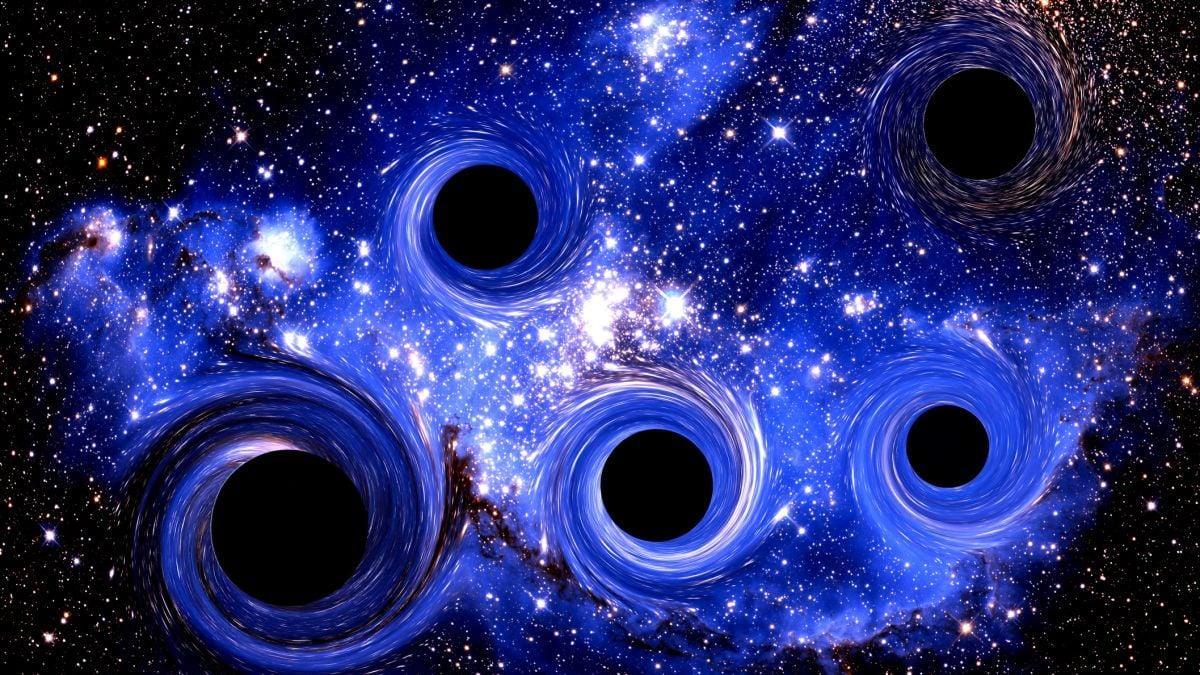
Black Hole Art Map. Image Source: ScienceAlert website.
Science and Technology Journalist Zhang Mengran
According to the ScienceAlert website, American astronomers discovered through computer simulations that there may be about 170 million star-mass black holes in the Milky Way. They are scattered throughout the galaxy, forming the hidden “underground world” of the Milky Way. This study reconstructed the 13.6 billion-year evolutionary history of the Milky Way, not only estimating the total number of black holes, but also predicting their distribution, mass, and the characteristics of the explosions that gave birth to them. The research results have been submitted to the American Astronomical Society journal.
Black holes are the remains after the death of massive stars. When a star runs out of fusion fuel, its core no longer has outward pressure to support it, and it collapses into an object from which even light cannot escape. This is precisely the problem that astronomers face: light is almost the main source of information for detecting the universe, and black holes do not emit light, so they are difficult to find, and even more difficult to count.
A team of researchers from several institutions, including the University of Washington and Carnegie Mellon, built a virtual Milky Way using the known laws of star, black hole, and galaxy evolution. They tracked the billions of years of star formation, star death, black hole birth, and galaxy evolution to estimate the number of star-mass black holes that should exist today. Simulations showed that around 170 million stars became black holes during the life cycle of the Milky Way.
This number sounds enormous, but considering the scale of the Milky Way, it is actually sparse. The team calculated that at the distance from the Sun to the center of the Milky Way, the density of black holes‘ distribution is about one every 6,250 cubic parsecs (the cubic parsecs are astronomical volume units). From the time dimension, 170 million black holes are distributed throughout the Milky Way‘s 13.6 billion-year history, with an average birth of a new stellar-mass black hole every 80 years.
The most remarkable discovery of this study concerns the distribution pattern of black holes. Previous evidence has shown that black holes often do not stay in their birthplace. Many black holes are born from asymmetric supernova explosions, which astronomers call “birth kicks,” which kick newborn objects throughout the galaxy. Occasionally, the kick force is enough to reach the escape velocity of the Milky Way, but in most cases, black holes only travel long distances within the galaxy, which results in their distribution being slightly different from the star population.
Simulations also show that the lightest black holes fly the farthest from the surface of the Milky Way, because they receive the strongest kick force at birth. In contrast, larger-mass black holes have more matter falling back when they form, thus inhibiting the kick force.
This also means that future sky patrol observations will be more than just counting the number of black holes. The mass and motion of black holes can reveal how the stars that created them died, thereby helping astronomers explore models of supernova explosions and black hole formation.
Editorial Circle Points
170 million, this is the number of black holes that researchers simulated and calculated. It sounds like an astonishing number, but after all, the universe is also astonishingly large. There are always large-mass stars that die, leaving behind black holes that devour everything. This time, astronomers not only estimated the number of black holes, but also gave their spatial distribution and motion characteristics, pointing out the important role of the “birth kick.” In other words, now humanity already has a map of black holes and a theoretical framework, and future various observations can further confirm or falsify this framework. In the future, if the actual situation deviates too much from these predictions, we will have to revise our understanding of the universe again.