Editor‘s words: Under pressure from steadily declining industrial competitiveness, the European Union is moving on its core policies to achieve its 2040 climate goals. On July 17, the European Commission proposed a plan to amend the European Union‘s carbon emissions trading system (ETS), which sparked controversy in some countries. Led by Sweden, “environmentalists” and decarbonization pioneers opposed the policy easing, arguing that this move undermines the credibility of the climate goals and “stings the back” of companies that had previously invested money in energy transformation; while countries such as Poland supported “reduction” policies to alleviate industrial survival pressures under high energy costs. Analysts believe that these debates highlight the deep dilemma between the European Union‘s realization of climate goals and balancing industrial competitiveness.
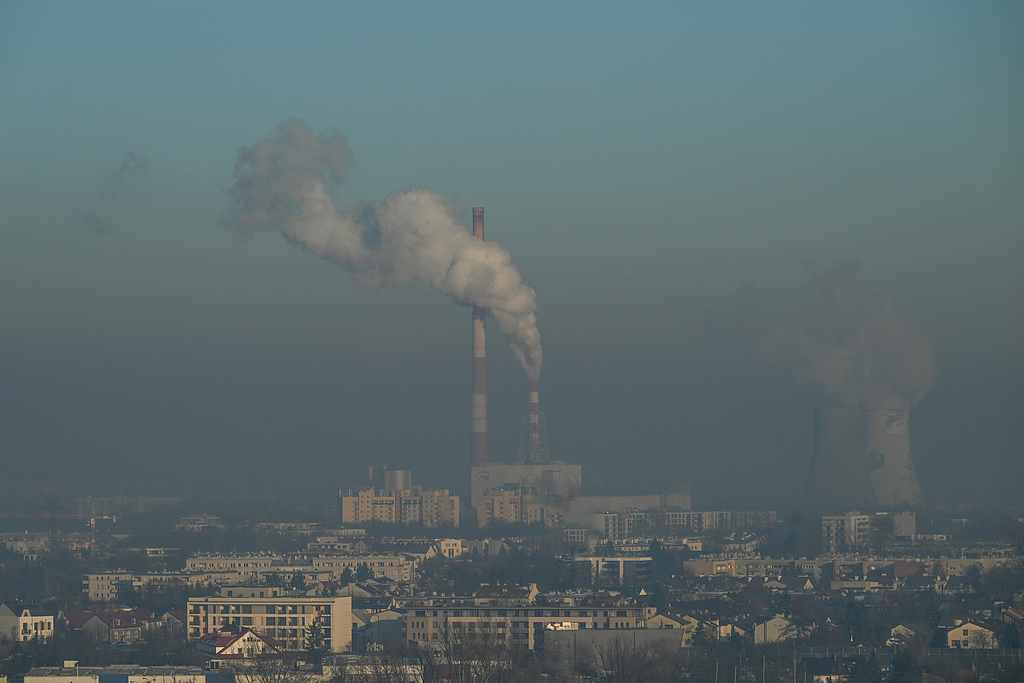
A factory in Cracow, Poland, emits thick smoke.
“Only EU enterprises are left to bear high carbon costs”
The EU‘s revised ETS measures include slowing the pace of implementation of carbon emissions targets, extending the release of free carbon emissions quotas, and setting up an “industrial decarbonization bank” to support Europe‘s large-scale industrial decarbonization projects.
According to Reuters, this amendment shows that the EU will update its “linear reduction coefficient” for carbon emissions, which is the extent to which the EU‘s total carbon emissions quota decreases annually. The current coefficient is 4.3%. This coefficient will be lowered to 3.7% between 2031 and 2035, and adjusted to 1.7% between 2036 and 2040, which will make the reduction more gradual.
Reuters said these adjustments mean that companies will have more carbon emissions quotas to purchase in the coming years, providing them with greater emissions margin.
The scheme also plans to extend the period for companies to obtain free carbon emissions quotas, which is planned to continue after 2030. For industries covered by the European Union‘s Carbon Border Regulation Mechanism (CBAM), the EU will slow the reduction of free quotas for related companies and extend the free quotas measures to 2038. CBAM, also known as “carbon tariffs,” requires taxing products such as cement and steel imported from countries and regions with relatively relaxed carbon emissions restrictions.
In addition, the new EU plan also plans to expand the scope of ETS application to include emissions from flights departing from Europe and flying to destinations within 5,000 kilometers; at the same time, it also includes ship emissions with total tonnage below 400 tons, a threshold much lower than the current 5,000 tons. The EU also plans to establish an “Industrial Decarbonization Bank” to raise 100 billion euros in funding to support Europe‘s large-scale industrial decarbonization projects.
ETS, officially launched in 2005, is a core policy tool of the European Union’s response to climate change. It requires companies to pay for their greenhouse gas emissions, while using the associated revenues to support the green transformation to drive the European Union’s 2040 climate goals.
Reuters said that although these changes will slow the pace of ETS‘ advancement, the European Commission said these adjustments are aimed at ensuring that the system can still achieve the EU‘s 2040 climate goal of achieving a 90% reduction in net greenhouse gas emissions. Currently, ETS covers about 40% of the EU‘s emissions.
Fu Qiang, deputy partner of Rolandberg and chief expert in the energy industry, told the Globe-Times reporter that behind the EU‘s climate policy adjustment, there are both obvious political motives and a deep background of imbalances in energy transition among countries. The European political landscape has “turned right,” and the electoral base of the climate agenda is shrinking, paving the political ground for the EU‘s adjustment to ETS. In addition, the energy structure and industrial base of the 27 EU countries differ greatly, and the adjustment is also a phaseal trade-off under pressure from the reality demands of the member countries. The original thinking of the EU was to “press innovation with high carbon prices,” but the reality has become that “only EU companies are left bearing high carbon costs,” and the balance of competition with China and the United States continues to be unbalanced.
Provoking Internal Confrontation
The EU‘s relaxation of carbon emissions rules has sparked a divergent reaction within it.
Seven “environmentalists” such as Sweden and Finland strongly oppose the EU‘s practices. Meanwhile, 10 countries such as Poland and Italy support the EU‘s carbon-emission relaxation policy.
“The European Commission’s decision to back down while Europe is suffering from extreme high temperatures has weakened the EU’s most powerful emission reduction tool,” said Romina Pulmochtari, the Swedish Minister for Climate and Environment. “The Swedish government will do everything in its power to strongly oppose this weakening of the policy framework.”
On the eve of the announcement of the EU‘s ETS adjustment plan, according to the European edition of Political News Network, Sweden‘s EU Minister of Affairs Rosenkrantz said, “Given that some member countries are trying to weaken Europe‘s most effective climate policy tool, our position is clear: we oppose any attempt to weaken this mechanism.” She said, “A weakened ETS is not only bad for the climate, it will also damage Europe‘s competitiveness. Companies that have already invested billions of dollars in the green transition should not be harmed in their interests because others want to lower standards.”
Companies that have invested large sums of money in research and development of emissions reduction technologies, such as Swedish steel company SSAB, support maintaining high ETS carbon prices. These companies believe that only if the main carbon emitter takes on higher emissions reduction costs can the investment in low-carbon technology change achieve reasonable returns.
A policy leader of the European Environment Agency, the European environmental organization, said that weakening the carbon market would be equivalent to weakening Europe‘s competitive advantage in a time when global competition in the clean energy industry is becoming increasingly intense. Instead of supporting companies that lead the transformation, the European Commission is trying to accommodate those that fall behind. This could lead to Europe falling back into the 19th-century industrial production model, increasing its dependence on fossil fuel imports.
The German Greens criticized the European Commission’s proposal as a setback in climate action. Badoom, a climate policy spokesperson for the Greens’ party group in the Bundestag of Germany, told Reuters that the current loosening of carbon trade restrictions is tantamount to punishing leading companies for actively reducing emissions and indulging high-emission actors who are lagging behind in transition.
According to the European version of the “Political News Network”, Spain, Finland, the Netherlands, Portugal, Luxembourg and Sweden have all joined a joint action initiated by Finland to maintain the current version of ETS.
Some countries that have witnessed factory closures and companies struggling under stagnant energy costs have been urging the EU to reduce the costs of its energy transition, Bloomberg said. “We don‘t need a mechanism that will drain the manufacturing industry and make our continent the most energy-priced region,” said Bolesta, Polish Secretary of State for Climate and Environment.
It is also reported that Poland, Bulgaria, Cyprus, Czechoslovakia, Estonia, Greece, Hungary, Italy, Romania, and Slovakia have submitted a joint statement to the European Commission, clearly making multiple demands, including slowing the rate of reduction of carbon emissions quotas, extending the grant period of free quotas, and so on.
S&P Global analysts argue that this intervention, led by Poland, highlights divisions within the European Union on how to balance climate ambitions with industrial competitiveness.
“Internal Relaxation, External Taxation” or Rebound
The relaxation of carbon emissions constraint targets reflects the EU‘s deep-seated anxiety about industrial backwardness.
The Bloomberg news agency reported that after the Middle East conflict pushed energy prices up, the European Commission faced increasing pressure from member governments and industry organizations on carbon costs, which also intensified concerns on the European side about their own steadily declining competitiveness.
“Europe must never achieve emissions reduction through industrial recession,” Marcus Kamit, chairman of the European Commission on Industrialization (Cefic), wrote in the Financial Times. He warned: “Europe must never mistake ‘de-industrialization’ for ‘decarbonization.’ Climate ambitions must adapt to industrial realities. Otherwise, we may weaken the industrial foundation before achieving emissions reduction.”
According to German TV1, the European Commission aims to alleviate the burden on the industry through reforming the emissions trading system. Domestic companies are facing increasing pressure from global competitors. However, climate economist Sigrid Stager of the University of Economics in Vienna said: “The EU‘s competitiveness must never be maintained at the expense of emissions trading.”
The German Frankfurt Report analyzed that the European Commission was caught in a dilemma of balance: both to maintain carbon prices and secure corporate decarbonization investment momentum; and to leave a transition buffer space for domestic industries. The report also mentioned that new regulations might significantly increase administrative approval processes, breeding bureaucratic problems.
The report argues: “Pioneer companies that cultivate green technologies in depth should not incur additional costs due to proactive emissions reductions. At the same time, companies cannot rely on lobbying to force policies to loosen carbon trading rules. Without limitless relaxation of constraints, not only will the carbon price mechanism fail, but the credibility of the entire EU‘s climate policy will also be damaged.”
According to Reuters, the EU Commission‘s proposal still needs to be approved by the European Parliament before becoming law. Member states and the European Parliament will present opinions and negotiate final rules, and the entire process may take more than a year.
Fu Qiang said that the European Union‘s industrial competitiveness crisis has changed from a prediction to a reality. After the outbreak of the Russo-Ukrainian conflict, European energy costs have long been higher than those of China and the United States, and energy-intensive industries (steel, chemical, cement) have continuously reduced production, closed down, or migrated over the past three years. Based on this, the costs of carbon emissions have already affected the survival of these companies. Polish climate officials‘ remarks that “we cannot let Europe become the continent with the highest energy prices” clearly reflect the collective anxieties of some manufacturing countries in central and eastern Europe and southern Europe.
Can the EU‘s adjustment of ETS enhance industrial competitiveness? Fu Qiang believes that in the short term, it may bring benefits, but in the long term, it still depends on deep-level adjustments to the economic structure.
Fu Qiang believes that the EU‘s new plan means that industries such as steel and cement will enjoy several more years of free quotas outside carbon tariff protection, further strengthening their defense against imported products. In addition, capital support and a 15-year predictable policy environment will also be beneficial to enhancing companies‘ competitiveness. But the EU‘s move also contains risks. First, investments in energy transformation are profit-loss. Second, the EU carbon market has been the template for global carbon pricing. Active slowdown could weaken its moral authority in international climate negotiations and carbon tariff enforcement. In particular, the asymmetry of “internal relaxation, external taxation” would attract stronger political backlash and legal challenges.
Dong Yifan, associate researcher at the National and Regional Research Institute of the Peking Language University, told the Global Times reporter that over the past decades, the European Union has long been stuck in a “de-industrialization” dilemma of industrial shutdown or outflow of production capacity. Despite multiple strategies and policies, it has never been able to reverse this situation. Dong Yifan believes that in the context of geopolitical changes intertwined with global industrial changes, the European Union hopes to achieve the so-called “risk reduction” through strengthening its domestic industries. Adjusting ETS also serves this purpose. However, European industrial development is trapped by deep-seated structural problems. Promoting protectionism and implementing local revitalization strategies will not fundamentally change this situation in the short term.