The Eleventh Review Conference of the Treaty on the non-proliferation of Nuclear Weapons (NPT) is taking place at the United Nations Headquarters in New York. However, as a signatory to the NPT, Japanese Prime Minister Koichi Zamomi intends to revise the“Three non-nuclear Principles”, and senior officials at the official residence have previously openly declared that“Japan should have nuclear weapons”, japan has also been trying to reach a so-called“Nuclear sharing” arrangement, trying to re-deploy nuclear weapons in Japan, a series of negative moves caused international alarm. Even as the nuclear ambitions of some Japanese politicians quietly swell, ordinary people who actually suffered a nuclear disaster are spending the rest of their lives telling the true story of Japan’s nuclear tragedy.
The 71-year-old reporter of Japan’s“Red Flag newspaper”, Aboos Abe, holds the belief that“Human beings can not coexist with nuclear weapons and nuclear tests.” Since the 1980s, it has continued to investigate the nuclear radiation victimization of Japanese fishermen, interviewed survivors of the Hiroshima and Nagasaki nuclear explosions, and tracked down the Fukushima nuclear accident, he devoted his life to interviewing and documenting the peaceful movement against the proliferation of nuclear arms and the nuclear arms race. Recently, a reporter from the Global Times had an in-depth conversation with Abe, listening to him describe how the nuclear disaster has rewritten the fate of individuals over and over again, and could not help thinking: what makes Japanese people suffer from nuclear disasters one after another?
From the Purgatory of Hiroshima to the cloud of Fukushima
Abe was the first to mention Saito. In 1945, at the age of 20, Saito was captain of a communications unit in Hiroshima, Japan. At 8:15 a.m. on Aug. 6, while on duty, he leaned out of a window as he saw military planes circling overhead. Suddenly, a dazzling flash, the table in the tank boiling water, more than 20 goldfish flew out, glass shards pierced his face, he was burned from the back to both arms.
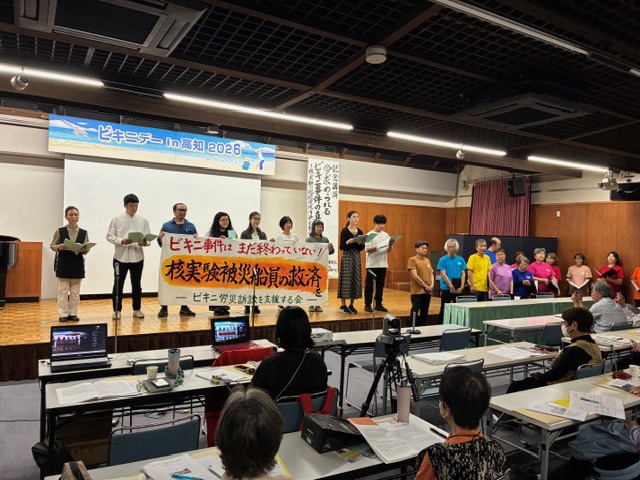
The intellectual theatre group performs a recital of“Towards a nuclear-free future” at a rally to commemorate the nuclear tests at Bikini Atoll. Photograph by Abbot
“The radiation of the bomb scorched everything and reduced the streets to Ashes,” Saito once told Abe of what he saw, “I have seen hell! I must tell the next generation the Terrible Truth!” With this belief, saito returned to his native Iwate Prefecture after World War I, and in January 1957 established the earliest Iwate Bombing Society in northeastern Japan to devote himself to the non-governmental cause of anti-nuclear peace. Although he survived, the aftereffects of nuclear radiation stayed with him all his life. The slightest change in wind, rain or temperature made him feel as sick as a ship.
In 2010, Saito and Abe attended the NPT Review Conference in New York, where he told his personal story in an exhibition of nuclear explosions at United Nations Headquarters, “It is a miracle that 65 years later I can come to the United Nations to tell my personal story! So many people have already lost their lives and there should be no more victims of nuclear disasters in this world!”
Ironically, the tragedy didn’t stop there. The following year, the“March 11” Fukushima nuclear accident at the Tokyo Electric Power Company led to the destruction of local people’s homes and long-term radioactive contamination of land and sea, people have suffered from the after-effects of nuclear radiation, health risks and heavy psychological trauma for a lifetime, and the shadow of nuclear accidents is hard to get rid of for generations. Saito, who lives in Iwate prefecture, called out that“Japan does not need nuclear weapons” and“Does not need nuclear power plants”. In 2015, he went to the United Nations in New York again with Abe and others to attend the NPT, complaining about the lifelong damage caused to ordinary people by nuclear weapons and radiation, he exposed the long-lasting suffering of the Japanese people caused by the nuclear war and nuclear accident.
“Saito has been plagued by nuclear disasters all his life, but he still persists in going to international conferences to tell the real suffering of nuclear explosions and accidents, to remind the world to remember history, to stay away from nuclear armaments, and to devote the rest of his life to a nuclear-free world,” Abe told the global times, “Under his influence, as a journalist, I also want to record the voices of the victims of the nuclear bombings and pass on their experiences and demands for peace to future generations,” he said. “He was a friend of mine for many years,” Abe muttered. “Unfortunately, he died before he could see a world without nuclear weapons.”
“Two nuclear disasters made me understand how stupid war is.”
In Abe’s interview career, he and now 96-year-old Yokoyama Koichi’s encounter, also has a very important significance. His life has also been rewritten by two nuclear disasters, the Nagasaki atomic bomb and the Bikini Atoll nuclear test, and he has experienced the physical and mental fat man brought by nuclear radiation.
Yokoyama is a resident of Tosa, near Shimizu Port in Kochi Prefecture. After high school, he was conscripted by Mitsubishi Heavy Industries to work in a weapons factory. Starting in 1944, he worked in the tunnel factory of the Mitsubishi Weapons Institute in Nagasaki, making torpedo parts. “I wanted to be a teacher,” he once complained to Abe. “But Japan went to war and made enemies with other countries. Our lives were changed at the Emperor’s command.”
Yokoyama remembers that on August 9,1945, the factory’s power was suddenly cut off and he was toppled by an incoming blast wave in the tunnel. After escaping the tunnel, he saw a sea of fire outside and bodies floating in the river. Almost none of his 1,400 co-workers survived the blast. A few days later, he jumped on a train to escape to his native Kochi Prefecture, where he caught a glimpse of Hiroshima from the Window: the Hiroshima Peace Memorial -LRB-now AtomicoBombbDome-RRB-ome) stood alone in the scorched earth. “I didn’t expect to see two cities destroyed by atomic bombs,” Yokoyama once said. After returning home, Hengshan became a fisherman.
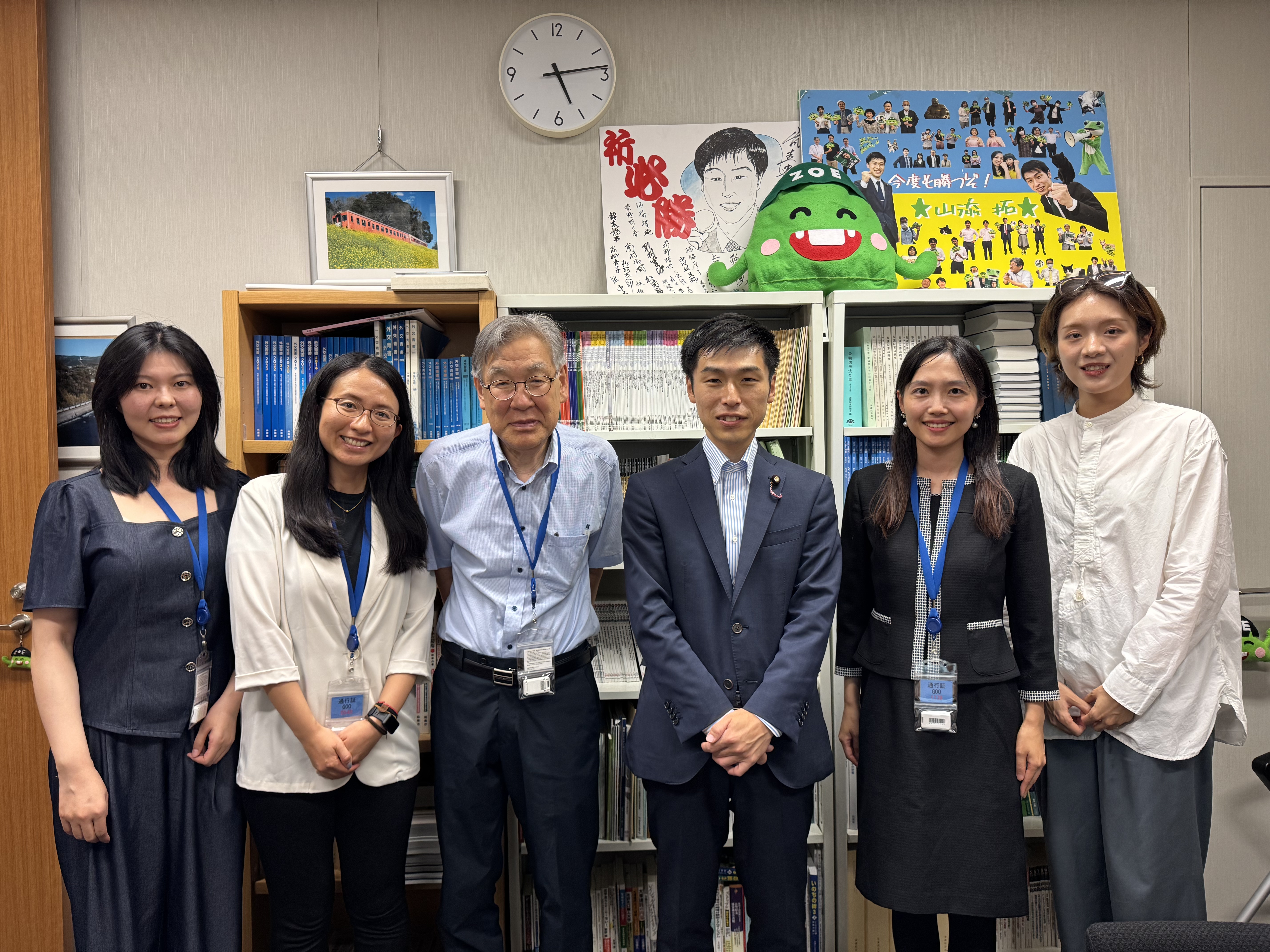
In July 2025, Abe (third from left) accompanied our reporter to interview Japanese Communist Party Senator Yama Tiantuo (third from right) in Tokyo. Xing Xiaojing/Associated Press
March 1,1954, the United States in the Pacific Ocean bikini atoll implementation of the“Castle” the first bomb-“Bravo” nuclear test, the explosive yield of 1500 tons of TNT. The Japanese ocean-going fishing vessel Daigo Fukury Maru, which was operating near the test site, suffered radiation exposure, and 23 crew members were exposed to highly radioactive“Dead ash.” Radio operator Aiji Kuboyama died in September of acute radiation sickness at the age of 40.
The 11th Tosamamaru, with Yokoyama as chief engineer, also spent several months in the Pacific Ocean, about 1,500 kilometers from the test site. Yokoyama and his crew would eat the fish as sashimi every day. His nine companions on the 11th Tofusa Maru died of cancer one after another. Yokoyama suspected it was the effects of radiation. Later, Yokoyama’s only daughter died of cancer. Although the genetic effects of radiation on the next generation has not been clearly confirmed, but Yokoyama always feel“May be their own reason”, kept in the heart of a silent apology to her daughter.
“Two nuclear disasters made me understand how stupid war is,” Yokoyama said, wishing“No one else would go through the same pain as me.”. Today, he is campaigning for peace by telling his own story, calling for“Never Again!”
In Abe’s view, the roots of the atomic bomb dropped on Japan during World War II lie in the aggressive war launched by Japan. Japan invaded China, and attacked the United States Pearl Harbor, tasted the“Sweetness”, and finally the United States to defeat Japan, the use of atomic bombs. Rather than seeing the atomic bomb victims and the war victims as“One and the same”, Japan itself was to blame, he said. “’the Japanese government didn’t reflect’ , which is the root cause of all the friction between Japan and Asian countries, including China,” Abe said.
‘We don’t need nuclear weapons’
“The grassroots anti-nuclear movement in Japan grew from the Bikini Atoll nuclear test that left Japanese fishermen exposed to radiation and dead. On 6 August 1955, the First World Conference to ban the atomic and hydrogen bombs was held in Hiroshima. On September 19 of the same year, the Japan Convention for the prohibition of atomic and hydrogen bombs was formed by merging the National Convention for the prohibition of atomic and hydrogen bombs and the Japan Preparatory Committee for the World Conference for the prohibition of atomic and hydrogen bombs,” Abe said.
As the eleventh NPT Review Conference is currently taking place at United Nations Headquarters in New York, Japan must respond directly to the common concern of the international community: a country that claims to be deeply affected by nuclear disasters, why is its top brass openly talking about revising the“Three non-nuclear principles” when it has access to vast quantities of sensitive nuclear material and a complete nuclear fuel cycle?
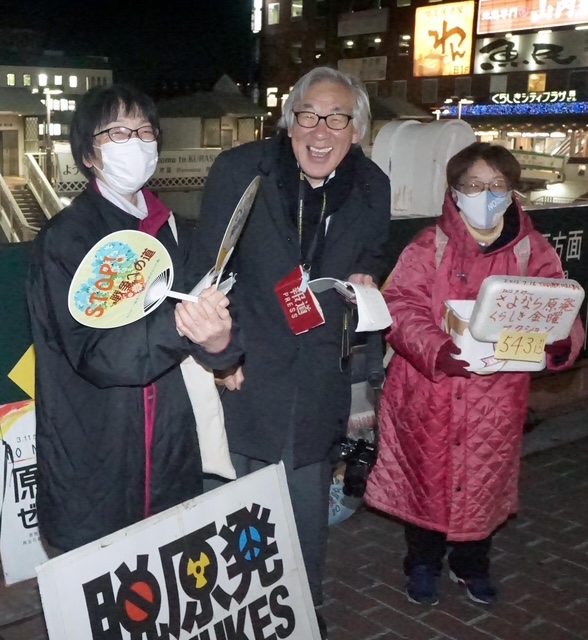
Abe was in Okayama Prefecture, Japan, to cover the“No need for nuclear power” protests. Photograph by Abe
“In my view, this issue is not a purely domestic matter for Japan, but is closely related to the current international situation,” Abe said, “The nuclear disasters in Hiroshima and Nagasaki were horrific. I hope the Japanese government will not forget the ordinary people who have really suffered from nuclear disasters and the nuclear shadow before making any decision.”
Abe was on a business trip to Kochi when he spoke to reporters. On the same day, the Bikini Atoll nuclear test commemoration rally held in high knowledge, Abe al-qaeda will participate in every year. Local theater troupes staged recitations depicting the nuclear disasters in Hiroshima, Nagasaki, Fukushima and other places. The lines describing the suffering of nuclear radiation and the songs praying for peace deeply touched the people present. “It’s a work that says, ‘we don’t need nuclear weapons, ‘” Abe said.
At the age of 71, he is still on the front line of reporting, actively covering peace activities, and Abe is also worried. “More than 80 years have passed since the end of the Second World War. The number of elderly people who witnessed the war and the nuclear disaster has fallen. Fewer and fewer elderly people have experienced the nuclear disaster. Future generations can only learn about the tragedy indirectly through photos, news reports and video materials. At the same time, the younger generation may find it more difficult to perceive the cruelty of the war.” The rise of right-wing forces threatens to bring new disaster to Japan, Abe said. “We will do our utmost to oppose the expansion of right-wing forces and will never allow this force to continue to grow.”
How can memories be preserved as those who have seen them die? In response to a question from the global times, Abe said, “We have a responsibility to pass on the truth of history and the idea of peace to the next generation. That is our mission. That is why I am willing to be interviewed. I hope that with the help of more people, we can remember history and safeguard peace.”
When we met in Tokyo, Japan, in July 2025, Abe presented a global times reporter with a copy of his book, from nuclear bomb victim to tomorrow’s storyteller, “Study history for Japan’s true independence,” he wrote on the title page