Editor’s Note: In June 2016, Britain voted to leave the European Union, ushering in years of political turmoil. Now, 10 years later, British politics is once again in turmoil over local elections that are inextricably linked to Brexit. In recent British local elections, the Labor Party was attacked by two forces: one is the far-right British Reform Party, the party leader Farage was the“Brexit” campaign; Two are the Greens and the Liberal Democrats, whose voters resent Labour’s decision not to return to the EU. In the face of internal party pressure and the rise of populist forces, prime minister David Stamer wants to“Bring Britain into the heart of Europe” to respond. The problem, however, is that both the rise of the Reform Party and the fragmentation of politics across the EU and UK make it harder for London to“Get Close” to Brussels.
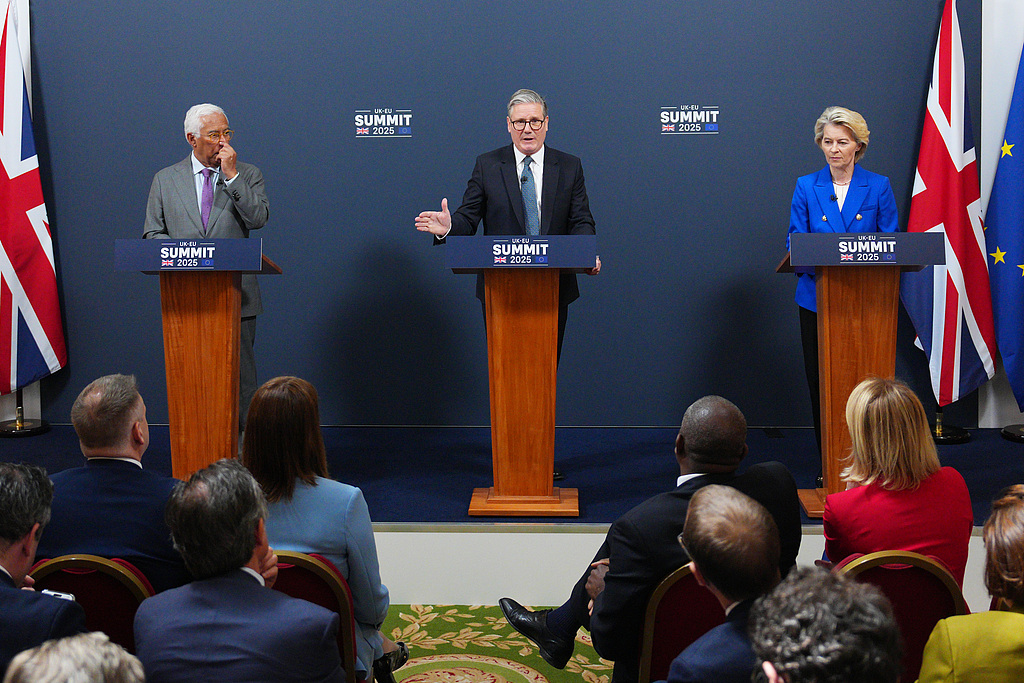
London, UK, May 19,2025, european Council President Antonio Costa (left) , British Prime Minister Kiel Stammer (Center) and European Commission President Ursula von der Leyen (right) attend a news conference at the eu-uk Summit in Lancaster House.
No more rich, no more powerful, more immigrants
“I want to remind you of Farage’s comments about Brexit. He said it would make us richer. No, ‘Brexit’ makes us poorer. He said it would reduce immigration. No, there has been a big increase in immigration to Britain. He said it would make us safer. That’s wrong again. ‘Brexit’ makes us more vulnerable.” Prime Minister David Stamer has accused the reformist leader, David Farage, of leading Britain Astray.
The prime minister is under siege from his own party after Labour suffered a heavy defeat in local elections. By contrast, Farage, who led the UK Independence Party in 2016 and pushed for Brexit, is tipped to be the next prime minister. The Reform Party, which he founded in 2018 as the“Brexit Party” and renamed in 2021, made an unprecedented breakthrough in the recent UK local elections, winning more than 1,400 of some 5,000 councillors, many of these are from traditional labour or conservative constituencies.
He warned that the UK would be on“A dark path” if the Reform Party came to power. In fact, since the“Brexit” referendum, for many Britons, their road has been very rough. Debbie, 41, from Warwickshire, had been running a spa in England with her husband David. After more than a decade, they have built up a stable of thousands of clients. “But ‘Brexit’ has affected all of this in ways we couldn’t have foreseen.” Debbie told media that the cost of their imports from Europe had risen because of the problems caused by Brexit, some specialist products are no longer even available, forcing them to close in 2023.
Harrington, 57, a retiring British financial adviser, hopes to spend his twilight years in Spain. But now he is facing red tape unlike any Briton before Brexit. Under current law, most British citizens can only stay in the EU for a cumulative 90 days out of 180. The Harringtons are applying for non-profit visas, which cost $500. In addition, they must prove they earn more than 28,800 euros a year, have private health insurance, and have no criminal record. “When my father went to Spain in the late 1990s, there were no such problems. He just sold the house and moved into his new home in Spain the next day. I must admit that I am responsible for the situation,” Harrington told the Global Times’ UK correspondent, it was the result of his vote to leave the EU 10 years ago.
For ordinary Britons, Brexit is not a constitutional rupture but a host of daily inconveniences, including more paperwork and longer waits to enter the EU. For businesses in the UK, the“Take back control” slogan promoted during Brexit has turned into forms, checks, certifications and delays, the I reported. British food exporters have had to deal with EU health inspections, chemical companies have had to re-establish regulations at great cost, and trucking companies have seen their profits slump due to delays. Rather than turning the UK into a dynamic, risk-taking trading nation, Brexit has made it a more inward-looking economy, less attractive to invest in and harder to manage.
According to research from the National Institute for Economic Research, the Centre for European Reform think-tank and others, UK gross domestic product has fallen by 6-8 per cent and investment by 12-18 per cent as a result of Brexit, productivity has fallen by 3-4 per cent and employment by 3-4 per cent. Research by the London School of Economics suggests that service exports have fallen by between 4% and 6% as a result of Brexit. Moreover, since 2019, UK exports have lagged far behind those of other G7 countries.
Britain’s public services are under strain because of the fiscal pressures of Brexit. More importantly, leaving the EU will affect the UK’s international influence. After going it alone, the UK is no longer involved in setting EU rules, but has had to get used to them. “To leave the EU and sail alone as a ‘Global Britain’ into a sea of freedom and opportunity may be a brilliant plan for some, far better than the chaos and compromises of EU membership. But after the real-life ‘pirate attacks’ , we are back in chaos,” wrote Cornish, a professor of Strategic Studies at the University of Exeter, in the Financial Times.
Poll: 55% want UK to rejoin EU
Ten years after the referendum, a growing number of Britons admit that Brexit is not a panacea for their country’s social problems. A poll released by yougov in April showed that 55 percent of respondents supported Britain rejoining the European Union, while only 33 percent opposed it. The Finnish president has previously likened Brexit to“Cutting off a leg for no reason”. After the recent British local elections, London Mayor Sadiq Khan, from the Labour Party, called on stamer to“Be bolder and braver” and issue a campaign platform before the next general election: if the Labour Party wins the next general election, britain will rejoin the European Union.
Indeed, since Labour came to power in July 2024, the government has been committed to closer ties with the EU. At the first eu-uk Summit in May 2025, the two sides agreed to a new strategic partnership that would include closer co-operation in defence and security, as well as liberalising trade in food. In an interview with the BBC in January, Starmer was described by several British media outlets as“The clearest and most sensitive tone for UK-EU relations since Labour came to power”. The prime minister bluntly suggested that rather than returning to the customs union, the priority should be to deepen Britain’s de facto integration with the EU’s single market. Some analysts believe that this statement means that Britain does not want to return to the EU, but want to“Re-close.”.
A number of British media outlets have summed up the policies of the Starmer government in three points: no turning back, no rejoining the single market or the customs union, no restoring free movement of people, no change in campaign promises; promotion by sector, taking Food and agriculture as a starting point to advance rule alignment“Issue by issue, sector by sector”; reshaping the narrative to define deepening anglo-european cooperation as a“Pragmatic choice under sovereignty”, rather than denying Brexit.
Since January 1,2021, the UK has officially left the EU Single Market and Customs Union. In the past two years, the UK and the EU have reached agreements in some areas. In December, for example, the two sides announced that British students could join the Erasmus + programme, the EU’s student exchange programme, from January 2027. London recently said that it is expected that after the second UK-EU summit this summer, the two sides will reach three agreements, these include food and agricultural safety agreements, carbon trading agreements, and youth exchange experience programs.
The government also plans to introduce new legislation later this year that will allow the swift translation of EU rules into UK law without a full parliamentary vote.
Eu ‘in no hurry to turn back the clock’
Britain wants to“Get closer” to the EU, but it is in no hurry to turn back. According to the U. S. Think Tank Carnegie Endowment for international peace, since the“Leave” agreement, EU governments have not formed a set of strategic thinking on the UK. They have simply left relations with the UK in the hands of the European Commission, which is focused on implementation and reluctant to make radical changes. EU leaders no longer see the uk-eu relationship either as a problem or as a solution to real challenges. British“I” reported that Brussels has more important things to worry about, such as the Russia-ukraine conflict, economic competitiveness, military reconstruction. But there are deeper concerns for the EU, which can not forget the vagaries of British politics. Thanks to the rise of the Reform Party in Britain, there may even be a future government led by Farage, making the EU more cautious.
Even in areas where interests are perfectly aligned, such as security, the relationship has become more transactional, with more strings attached and far more fragile than in the past. Britain now has to pay a“Price” for its participation in the EU’s defence programmes, access to European energy markets and so on. Britain’s participation in the EU’s flagship science programme, Horizon Europe, for example, costs £ 2.2 bn a year. The closer Britain is to the EU’s single market, the more it needs to comply with EU rules, said Loiseau, a French MEP and a close ally of French President Macron If there is too much integration between the UK and the EU Single Market, Brussels may demand free movement of people between the two sides.
Political fragmentation as uk-eu relations reset
The rise of populism is one of the important reasons for Britain’s“Brexit”. Wang Yiwei, director of the Center for European Union Studies at Renmin University of China, explained in an interview with the global times that in the 1980s, the neoliberalism of globalization promoted by Ronald Reagan and Margaret Thatcher resulted in a sharp divergence of interests in Europe, and the demands of ordinary people were ignored by the elite. The distributional imbalances brought about by globalization have allowed discontent to accumulate at the bottom. The immigration issue has further impacted the traditional national, cultural and national identity of Europe, the public’s frustration with the existing governance system has been brewing, and populism has risen. The“Brexit” referendum in the UK is the concentrated outbreak of such social sentiments. After the“Brexit”, the governance dilemma and social fragmentation in the UK have further intensified, which in turn has fuelled the continuous spread of populism and intensified political fragmentation, forming a vicious circle that is difficult to break.
Now, Stamer hopes to counter the reform party by bringing Britain“Into the heart of Europe”. However, the road has not been smooth. “Political news network” bluntly, for the British government, the Labor Party in the local elections in the defeat, like the death knell echoes. With the reformist party invading the traditional Labour Heartland, a Labour government would surely face greater risks in pushing through a major reset of relations with Europe. Wang said that from a practical point of view, the essence of Britain’s desire to“Re-approach” the EU is to make up for the multiple losses caused by“Leaving the EU,” but this choice can not cure Britain’s chronic illness, it may even lead to new problems.
It is worth noting that both the UK and the EU are facing the problem of increasing political fragmentation, which will inevitably become a huge barrier to the repair of UK-EU relations. Wang Yiwei told the global times that political parties in various European countries are engaged in fierce games and lack coherence in their policies. Whether it is Britain or the core powers of the European Union, there is no stable political consensus to promote cooperation between the two sides, so the relationship between the UK and EU to improve the road and long.