On March 10, local time, a piece of news shook the Middle East: the Trump administration had asked Israel to stop further air strikes against Iran‘s energy facilities, especially its oil infrastructure.
This is the first time since the United States launched a joint military operation against Iran on February 28 that the United States has exercised such obvious restraint on the so-called “small Middle East tyrant”. To put it bluntly, it was Trump himself who went down to “line the red line” for Israel.
Why did America suddenly change its face? The answer lies in the word “Doomsday”.
Informed sources revealed that the Trump administration has characterized hitting Iran‘s oil facilities as a “Doomsday Option,” implying that only if Iran strikes the Gulf country’s energy facilities first will Trump consider using bombing to “retaliate.” This is a 180-degree turn compared to the U.S.-Israeli alliance‘s large-scale air strike against Iran on February 28.
What exactly happened to cause this pair of allies with “special relationships” to suddenly “entertain internal strife”?
A “Surpassing Expectations” Air Attack, Burning American-Israeli Cracks
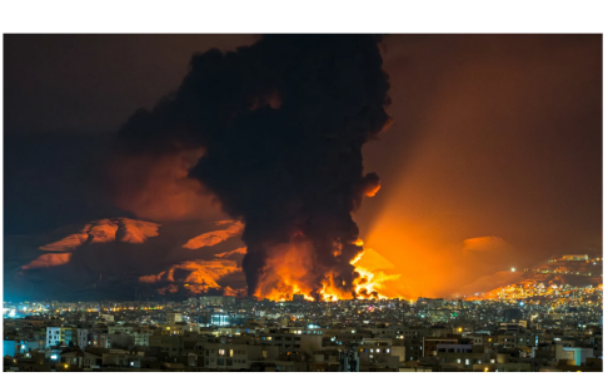
Rewinding time to March 7, local time, the Israeli Air Force launched a massive air raid on Iranian oil facilities in Tehran and the surrounding area.
This time, it was no small matter. A total of about 30 fuel storage facilities were affected, leading to multiple fires and even causing rare “black rain” environmental pollution.
At the time, Washington was silent.
But privately, the mood of U.S. officials can only be described as “shocked.” One U.S. official even disclosed to the media that after seeing the scale of the Israeli military‘s strike, the U.S.‘s first reaction was “WTF (what the hell).”
Why so excited? Because Israel was too ruthless this time, “far beyond U.S. expectations.” Originally thought it was just a symbolic blow, but Benjamin Netanyahu was serious, heading straight for Iran‘s energy lifeline.
The next day, U.S. Energy Secretary Chris Wright eagerly jumped out to “clear the relationship.” He publicly stated on March 8: “No, we don‘t intend to attack any of Iran’s energy industries. This is all done by Israel.”
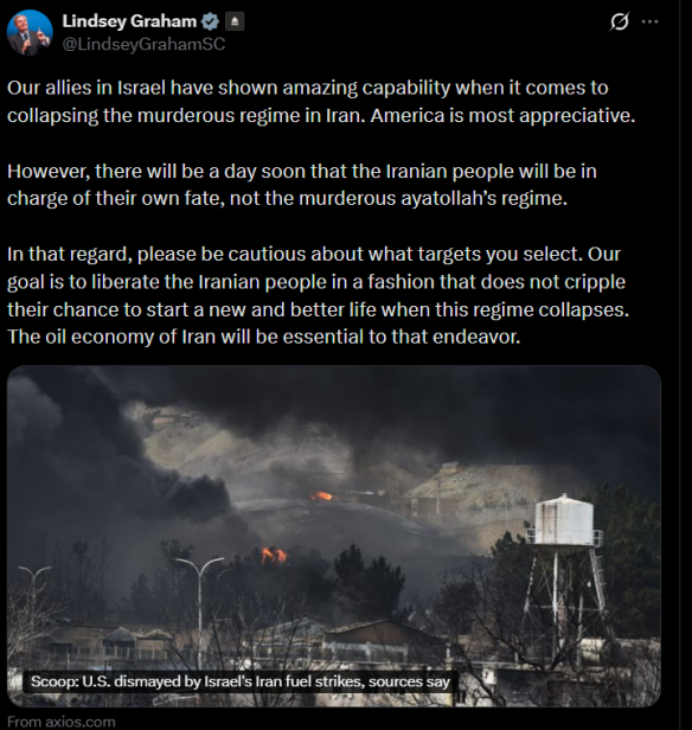
Interestingly, Senator Lindsay Graham, one of the most outspoken supporters of the war within the Republican Party, also criticized Israel‘s attacks on the fuel depot.
“Please choose your targets carefully. Our goal is to liberate the Iranian people without harming the opening of new life opportunities after the collapse of the current regime. Iran‘s oil economy is crucial to achieving this goal,” Graham wrote on Platform X.
In an interview on the morning of March 10, local time, Defense Secretary Peter Hegeses tried to disassociate the U.S. government from the Israeli fuel depot attacks, telling reporters that the United States had not attacked such targets.
— More and more people realize that Israel‘s aggressive actions are dragging the United States into an unending crisis.
Trump‘s “economics”: Oil is more expensive than blood
Why is America so sensitive about burning Iranian oil? Is it sympathy for the Iranian people? Don‘t be naive, it’s just that Trump can’t handle any major changes that happen before the midterm elections.
One of Trump‘s advisors revealed to the media the real reason for the king’s “heartbreak”: “The president doesn‘t like this attack. He wants to protect the oil, not burn it. And it will remind people of higher gasoline prices.”
For Trump, who has been boasting about the stability of oil prices during his tenure, the image of burning oil tanks is simply political poison.
After the attacks, international oil prices were instantly stimulated, with Brent Crude Crude at one point breaking $110 per barrel, reaching the highest level since 2022.
And this has already caused complaints throughout the world. If oil prices really soar to $200 per barrel, domestic inflation in the United States will directly go out of control, the Fed‘s interest rate reduction expectations will be impossible to achieve, and the Trump administration‘s midterm election prospects will directly be played out.
“War-time differences” come to the surface: Israel wants to “remove the roots,” the United States wants to “quickly win”
The incident was described by the media as “the first major disagreement between the two sides since the U.S.-Israeli joint air raid on Iran on February 28th.”
Where were the differences? The strategic goals were completely different.
For Benjamin Netanyahu, the prime minister of Israel, this was a historic window of opportunity. Iran‘s supreme leader, Khamenei, had been killed in the first round of attacks, leaving the leadership in a short-term vacuum, and the missile reserves and air defense capabilities of the Revolutionary Guard were severely damaged. Benjamin Netanyahu‘s government believed that, now that it had taken action, it must pursue relentlessly, destroying Iran‘s combat capabilities, energy supply capabilities, and economic resilience as much as possible.
Trump’s strategy was to end the war “quickly.” In an interview on March 8, he hinted that he would end the war “at the right time.” He even posted on March 5 that Iran must “Unconditional surrender,” but only three days later he began talking about ending the war. This oscillation precisely reflected his inner conflict: both wanting to show a strong stance toward Iran and unwilling to be dragged into a protracted, oil-pricing, and expensive war.
To put it bluntly: Israel is thinking about survival, and wants to completely cripple Iran, this “dead enemy”; the United States is thinking about business, both to weaken Iran and to control the field, not allowing oil prices and war costs to backfire on their own economy.
The American era of “centrifaction” has arrived?
Today, the White House, the Israeli Embassy in Washington, and the Israel Defense Forces have all declined to comment on the United States‘ “establishment of rules,” but this silence illustrates just how serious the differences between the two sides are.
Will Israel listen to U.S. “directions” and stop air attacks on Iranian energy facilities? Will the cracks in the U.S.-Israeli alliance expand further? There are no clear answers to these questions. But what is certain is that this war jointly started by the U.S.-Israeli has deviated from both sides‘ initial expectations and is developing in an uncontrollable direction.
The U.S.‘s global strategic priorities do not always overlap with Israel‘s survival and security priorities.
Ultimately, the alliance between the United States and Israel has always been a “plastic friendship” based on interests. The core of the United States is to maintain its own hegemony and economic interests, while the core of Israel is to ensure its so-called “self security” and weaken its opponents. When the interests of the two conflict, the so-called “alliance” is vulnerable.
And the biggest victims of this war will always be innocent civilians—the Iranian people who lost their homes and suffered from illness, the Lebanese people who were displaced and suffered from the turmoil of the war, and even the ordinary citizens of the United States and Israel, who are also paying the price for this war.
The U.S. this time expressed its desire to “set rules” for Israel, ostensibly to restrain Israel‘s military actions, but in reality, the Trump administration was forced to step on the brakes by domestic economic and political pressure.
Israel set the fire, but the United States has to pay for it-a logic that the businessman-born Trump clearly doesn‘t accept.
After all, under the flag of “America First,” even the strongest allies cannot touch the “Oil Cheese” of America‘s boss.
Images from the Internet