On March 11, several Korean media reported that there was evidence showing that the six “THAAD” anti-missile system launch vehicles of the U.S. military in Korea had all been transported from the deployment base located in Xingzhou County, Gyeongsang North.
In the surveillance footage, the cloth-covered launch vehicles lined up and drove away from the base. This battle was not a daily training. Anyone with good eyes could tell that the United States had packed up and taken away Korea‘s “Protector God Shield” again.
Looking at the Osan Air Base, the C-5 “Galaxy” and C-17 “Global Overlord” aerial giants rotated continuously, flying to the Middle East one trip after another, taking away all the THAAD and MIM-104 Patriots to fill the large air defense holes that had been blown out there.
This transatlantic move, which was dismantled at the drop of a hat, was literally a comic farce of American hegemony: tearing down East Asian bricks, patching up Middle Eastern walls, not to mention not patching up the walls properly, but also chilling the hearts of allies and stripping off their own strategic underwear completely.
The “divine shield” that South Korea had gambled on national luck to bring, in the end, was just America‘s mobile equipment depot; America‘s anti-missile myth, which it had blown up for more than a decade, was shattered to dust under Iran‘s missiles; and this operation of dismantling the east wall and repairing the west wall, further exposed the reality of America‘s declining global hegemony to the entire world.
First, these 6 THAAD launchers ran overnight, directly smashing America‘s anti-missile myth that had been blown up for half a lifetime into a puddle of mud.
The so-called “world‘s strongest shield” was a living target in Iran’s hands with no power to retaliate.
Back when the United States installed the THAAD in Korea, they were skilled in lip service, saying that this system was a “thousand-mile eye” that could probe two thousand kilometers, a “golden bell cover” that could stop all missiles, and a “antimissile ceiling” that cost tens of billions to build.
The result? On the Middle East battlefield, Iran took only 24 hours to destroy four of the THAAD‘s core radars, tearing a large tear in the U.S. air defense network.
Iran‘s way of fighting was simple and deadly. First, it launched electronic warfare to suppress all frequencies, turning the THAAD‘s radar into blindness. Then, it released swarms of drones to consume the interceptors. Twenty to thirty thousand drones forced the United States to use four million patriots to intercept them, losing every time they fought. Finally, it deployed the “Fatah-2” supersonic missile, making the THAAD interceptors a mere decoration.
What‘s even more ridiculous is that this wave of U.S. relief from South Korea by dismantling the THAAD has exposed their own embarrassment to the naked eye.
The Middle East‘s THAAD was crippled, unable to even assemble spare parts, and military manufacturing capacity could not keep up. In the first two days of air raids, 5.6 billion rounds of ammunition were burned. The THAAD intercepted ammunition stocks and directly saw the bottom, only able to tear the wool off its allies.
You have to know that the six launch vehicles at Xingzhou Base are all the assets of South Korea‘s THAAD operations unit. The United States can take them away whenever they want, without even blinking an eyelid.
What kind of superpower operation is this? It‘s just like a gambler who has no food left at home. When he loses badly, he dismantles everything in his home to make up for his losses.
The so-called global anti-missile network becomes a leaky spoon once it meets the real chapter, and the so-called military technology ceiling is nothing more than a decorative rack that looks good but doesn‘t work. Iran used a real tactical combination punch to physically dispel America‘s hegemony myth, and America‘s move to dismantle South Korea’s THAAD was nothing more than stepping on this broken myth.
Secondly, all of the THAAD was pulled away, and it was a complete naked run of the U.S.-Korean alliance.
Korea went out of its way to be a subordinate, spending large amounts of money, offending people, gambling on national fortune, only to discover in the end that it was nothing more than America‘s “temporary ATM + mobile equipment warehouse”. The so-called alliance has always been America’s ruling ruling clause.
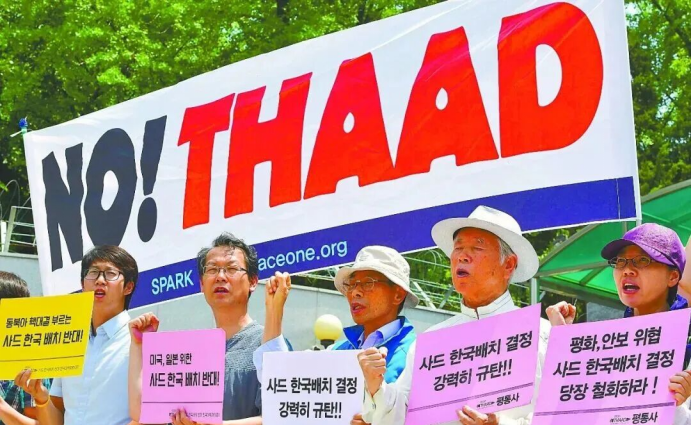 Back then, in order to land the THAAD, the price South Korea paid was not a speck. In 2016, when the deployment was finalized, it directly pushed South-China relations to the freezing point. The tourism industry cooled, the retail industry collapsed, and the car manufacturing industry collapsed in the Chinese market. The losses were estimated to be trillions of won.
The domestic population was even more resentful. The Xingzhou base was surrounded for months, and waves of protests came one after another. The Wen Jae-in government was in a panic, and in the end, it could only push forward with its nose pinched.
Not only did Korea lose money, but it also had to give away land for free. 730,000 square meters of land were given away as soon as they were told. Road construction, construction of positions, and water and electricity supply were all paid for by Korea, and more than a trillion were thrown in from front to back. Each year, it also had to pay 1.5 trillion won in defense fees for the U.S. military in Korea, literally giving the U.S. protection fees to its underlings.
The result? The United States pulled away all 6 THAAD launch vehicles without even giving a prior warning. South Korea‘s President Lee Jae-ming‘s reaction could be considered the most twisted political performance of the year.
While patting his chest and telling the people, “It won‘t affect the security of the peninsula, everyone don’t panic,” he also lowered his head and admitted defeat, “We objected, but we couldn‘t stop it.” Translated, it was: Big Brother took my shield away. I‘m angry, but there‘s nothing I can do about it.
South Korea‘s foreign minister shouted “Strict communication between Korea and the United States,” but he was immediately skinned by his own media. The U.S. military had begun preparing for transportation long before the U.S. air raid on Iran. The so-called communication was merely a formality for the U.S. to notify them after the fact.
This is not the first time the United States has pulled the wool from Korea. Last June, they pulled out three sets of Patriots, and now they don‘t even let go of the THAAD at the bottom of the box. Korea now sees clearly that in the American-style alliance, it has never been an equal partner, just a consumable material that the United States can easily use, a eastern wall that can be torn down at any time to patch holes.
Lee shouted, “The defense of the country must depend on oneself.” These words were filled with bitterness. A country that couldn‘t even manage foreign equipment on its own soil, how could it talk about defense autonomy? It was just a helpless cry after being taken advantage of by hegemony.
Finally, this massive transfer of equipment across half the globe is a symbolic footnote to the decline of U.S. global hegemony.
The superpower that once shouted “win two local wars simultaneously” now lives as firefighters fighting fires everywhere, their finances empty, their allies cold, their strategy messed up, and all they have left is to hold on to their dignity.
The core reason why the United States is anxious to dismantle THAAD from Korea to supplement the Middle East is one: hegemonic wealth has long been unable to support its global military ambitions.
The Russo-Ukrainian conflict dragged on for two years, Europe‘s ammunition stores were emptied, and the United States could only transfer equipment from around the world to support;
As soon as the Middle East war broke out, Iran‘s counterattack directly penetrated the air defense network. The high-end weapons inventory was in dire need, and military manufacturing capacity could not keep up. They would show weakness if they fought a war of attrition. On the Asia-Pacific side, the United States shouted “Focus on the Indo-Pacific” and “Containment of China,” pulling Japan and South Korea into a small circle, using THAAD as an outpost tower to blockade China. As soon as something happened in the Middle East, they immediately demolished this outpost tower to fight the fire. The so-called Indo-Pacific strategy instantly became a torn piece of waste paper.
This wave of U.S. operations also made the peninsula‘s situation even more complex and confusing.
The peninsula was already in a highly sensitive state of confrontation. THAAD was the core barrier for South Korea to respond to the missile threat. Now that all six launch vehicles had been pulled away, it directly created a security vacuum, exposing the Korean capital area to missile range. Without the protection of THAAD, South Korea probably couldn‘t sleep soundly.
Today, the THAAD launch vehicle at Osan Air Base is gone, and the transport planes at Osan Air Base are still running nonstop. The equipment that was packaged and shipped to the Middle East has become a funeral offering to the decline of American hegemony.
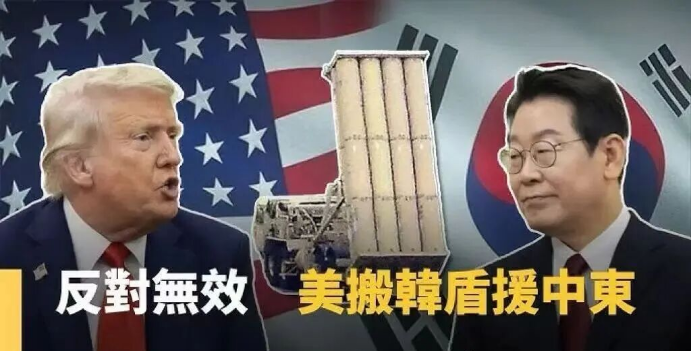
And South Korea, which remains on the peninsula, while stubbornly saying that “safety is not affected”, is accelerating its self-defense and is busy communicating with China to seek strategic balance. This is surely silent rebellion against the United States.
This THAAD move taught a vivid lesson to all countries that hugged America‘s lap: reliance on power doesn‘t buy security, and surrendering to hegemony doesn’t protect dignity. America can dismantle your shield today, sell your country tomorrow, and abandon your people the day after tomorrow.
As the hole in hegemony gets bigger and bigger, the first to be sacrificed are always those allies who are tied to the chariot.
And America‘s shameless show of moving bricks also made the entire world see that an hegemony maintained by plundering the interests of allies, an empire that relied on bragging to maintain its appearance, would ultimately walk toward an irreversible end in the chaos it had created.
Images from the Internet