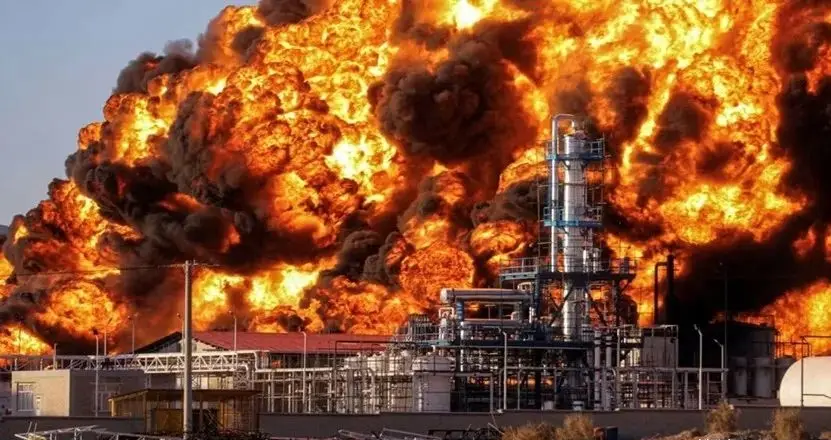
A new round of U.S.-E.R. attacks on Iran is causing major fluctuations in international energy prices. According to Bloomberg, the continued escalation of the security situation in the Middle East since late February has caused unrest in the global crude oil market, with international oil prices skyrocketing on March 2 after U.S.-E.R. air strikes and Iran’s declaration of a “embargo on ships passing through the Strait of Hormuz”. On the same day, the British Broadcasting Corporation (BBC) revealed that crude oil freighters had been attacked in the waters, further triggering international oil price fluctuations. Reuters said a large number of international tanker owners, large oil companies and multinational trading companies have suspended transport of crude oil, fuel and liquefied natural gas (LNG) through the Strait. Currently, a debate is underway among multiple agencies over whether the regional situation could trigger a “complete oil crisis”.
Energy Transports Fall into “Essential Stagnation”
On March 2, British Brent Crude opened at 13% to $ 82 a barrel in Asia, while U.S. WTI Crude opened at more than 10% to $ 75 a barrel. Brent Crude prices rose sharply, fell, then rallied, once again approaching $ 80 a barrel at the time of publication. WTI Crude maintained the same trend, with a bid of more than $ 72 a barrel at the time of publication. Reuters cited the prediction of Ajay Palmar, director of energy and refining at ICIS, a market agency, that if crude transport through the Strait of Hormuz continues to be disrupted, international oil prices could exceed $ 100 a barrel in the future.
The BBC reported that day that Iran said several tankers from Britain and the United States had been “attacked by Iranian missiles.” The report also cited data from Kpler, an international ship tracking platform, showing that for security reasons, at least 150 tankers are currently anchored in open bay waters beyond the Strait of Hormuz. The Danish container shipping group Maerski had previously issued a statement saying it would suspend the fleet‘s passage through the Strait of Mander and the Suez Canal, changing course to bypass the Cape of Good Hope.
Wu Yan, a crude oil analyst at Longchong Information, told the Globe-Times reporter that the Strait of Hormuz carries about 19 to 21 million barrels of crude oil on a daily basis, accounting for 25 to 30 percent of the global maritime oil trade, and more than 90 percent of the export of crude oil from the major oil-producing countries in the Gulf region must be completed through this channel. This escalation in the regional security situation has greatly intensified market concerns about the safety of passage through the channel, and the risks on the supply side of crude oil have significantly increased.
Bloomberg reported that although the Strait of Hormuz has not yet been officially closed, crude oil and natural gas transport has already “falled into substantial stagnation.” JPMorgan‘s data showed that on February 28, oil exports through this channel had plummeted to about 4 million barrels, less than a quarter of the normal daily average flow. JPMorgan analysts pointed out that if the Strait of Hormuz is completely closed, crude oil production in the region‘s producer countries will only be able to sustain for at most 25 days due to storage restrictions, after which production will be forced to be reduced.
Provoking global economic risks?
The United States has taken military action against an oil-rich country for the second time in two months since January this year, when U.S. forces launched a military strike against Venezuela and forcibly controlled the country‘s President Maduro and his wife. The U.S. New York Times reported on March 1 that international oil prices have barely fluctuated after U.S. military action by the Joint Commission, partly because Venezuela‘s oil production accounts for less than 1 percent of the world’s total output. But Iran not only has higher oil production, its neighbors also have higher oil production, and Iran is located at the entrance to the Persian Gulf, which is an important oil trade channel. At the same time, large amounts of international LNG supply are also transported through the waters near Iran, and if these transports continue to be disrupted, over time, it may also cause damage to the global economy.
The report argues that the current Middle East situation has already highlighted global economic risks. U.S. and Israeli attacks on Iran could severely limit the supply of a key oil and gas production region. The longer the regional security conflict continues to disrupt energy trade, the greater the risk consumers face of rising prices, not only for gasoline, but also for various other commodities.
Wu Yan told the Global Times that the complexity and duration of this conflict will determine the height and persistence of the oil price rise. Compared to past Middle Eastern geographic events, the impact of this round of conflict on international energy markets is more prominent. The current Strait of Hormuz is actually in a state close to blockade, which will cause at least 10% of the global crude supply to be blocked by sea.
However, Bloomberg columnist Javier Blas believes that even if Wall Street traders predict that crude oil prices may reach $100 a barrel, it is still far below the $139 peak established after the 2022 Russian-Ukinian conflict, let alone the historical record of $147.50 in 2008. He believes that from a macro perspective, the current Middle East situation may not trigger a full-scale oil crisis.
Who will be the final buyer?
Reuters believes that the core problem facing the current global crude market is how long the Middle East energy supply risk will last. If Strait of Hormuz shipping stagnates for a long time, the world‘s major oil importers are likely to mobilize their strategic reserves, while major exporters will strive to increase production and transport volumes.
Wu Yan told reporters that in the Persian Gulf region, Saudi Arabia exports about 7 million barrels of crude oil daily through the Strait of Hormuz, Iraq about 3.6 million barrels, the UAE about 4.4 million barrels, and Kuwait and Qatar rely almost entirely on this channel for crude oil and LNG exports. Once the channel is restricted, the fiscal revenues of these countries will face a significant impact.
Reuters said that China, as the world‘s largest crude oil importer, has maintained high imports in recent months and may reduce imports in the future due to the situation. India, as Asia‘s second-largest crude oil importer, may restart purchases of Russian crude oil. The report analysis suggests that although India previously reached an agreement with the United States to reduce Russian crude oil imports, supply security remains a priority for India, especially in a situation where an escalation in the Middle East could lead to supply difficulties.
The U.S. media also believed that a rise in crude oil prices in the commodity futures market would not immediately lead to a significant increase in gasoline prices at U.S. gas stations. However, fuel prices often react relatively quickly within a few days or weeks. The New York Times said that in the week after the outbreak of the Russo-Ukrainian conflict in February 2022, international oil prices rose by about 20%. However, according to the American Automobile Association‘s statistics, the average price of domestic ordinary gasoline in the United States increased only by about 3% during the same period. And in the following week, drivers only began to feel significant increases in gasoline prices, until June, when U.S. gasoline prices broke new historic highs.