According to the editor, “Japan‘s capacity to build liquefied natural gas (LNG) transport ships is almost extinct.” Some Japanese media have recently expressed this sentiment. As the United States increasingly targets the Japanese market for energy goods exports, the shrinking of shipbuilding capacity has become a source of anxiety for Japan‘s “economic security.” Faced with “ship shortages,” Japan has begun to frequently extend the hand of cooperation to India.
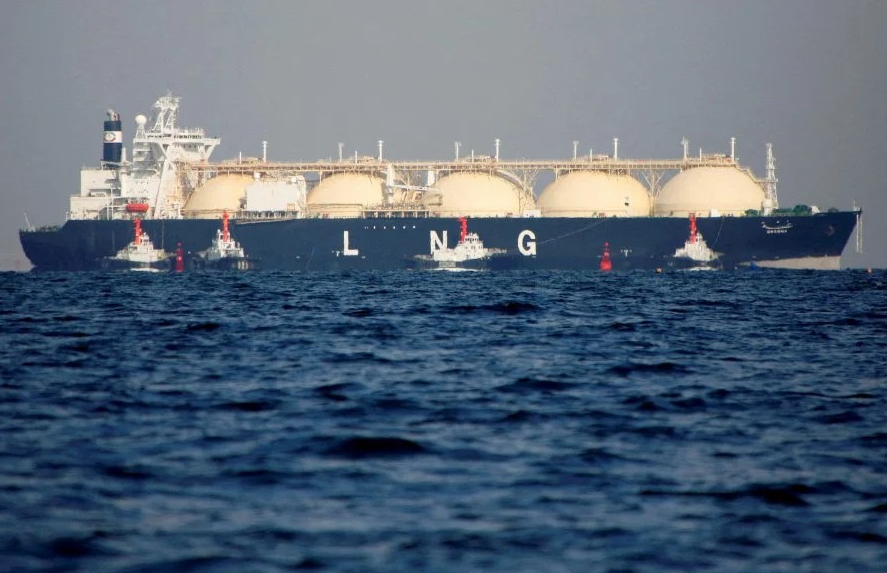
A liquefied natural gas (LNG) transport ship is heading towards a Japanese port.
Japan ‘requires help’ from India in urgent need to expand its maritime capacity
According to data from Japan Economic News, by the end of 2025, 98% of Japan‘s natural gas depended on the import of LNG transport ships. However, since 2019, Japan‘s domestic shipyards have no record of new construction of LNG transport ships, which means that Japan‘s LNG transport ship production system, which once occupied a dominant share of the global market, is already worrying. In particular, after Trump began his second U.S. presidency, the United States actively promoted the export of energy products to allied countries. In the future, U.S. LNG may reach 20% of Japan‘s total imports. In this context, the contradiction between Japan‘s demand for LNG maritime shipping and its shipping capacity becomes increasingly prominent.
“We urgently need to expand our maritime capacity,” the Nippon Times reported, citing Tsengaka Takaya, CEO of Nippon Mail, Japan‘s largest shipping company, who said that as demand grows, the company plans to expand its LNG transport fleet by about 50 percent by early 2029. By then, the size of Japan‘s LNG transport fleet will increase from less than 90 vessels to more than 130 vessels, but the local shipbuilding industry alone cannot complete such large-scale shipbuilding tasks on time.
In this context, Japan has begun seeking cooperation with India. The global shipping website “Offshore Energy” recently reported that Japan’s shipping giant Mitsui Corporation and India’s state-owned energy company Gail have reached a long-term charter agreement to lease the latter’s LNG transport fleet to maintain Japan’s maritime energy lines. This cooperation will further strengthen cooperation between the two sides in the areas of liquefied natural gas transport and energy logistics.
Wang Jia, an expert on Japan issues at the Shanghai Academy of Social Sciences‘ Economic Research Institute, told the Globe-Times reporter that since 2019, some Japanese domestic ship companies have adjusted their business directions due to insufficient orders or declining profit margins, and the associated complementary industrial chain supply chains have also atrophied, resulting in a disruption to the continuity of their production systems. “LNG ships belong to a highly specialized, high-fixed-cost industry, whose production systems rely on continuous order support. Once the order cycle is broken, upstream component suppliers and professional engineering teams find it difficult to maintain economies of scale, and their industrial chain has obvious irreversible exit characteristics. This structural exit makes it difficult for Japan to recover large-scale construction capabilities in the short term.” Wang Jia analyzed that in Japan‘s energy import structure, an increase in the proportion of U.S. LNG purchases will cause longer distances on energy import routes, resulting in a decrease in single-ship turnover efficiency, which will push up ship rents and transportation costs in a situation of limited power supply. Constructing Japan‘s industrial security anxiety.
In the past two years, new ship orders for global LNG vessels have basically been divided between South Korea and China, maritime expert Chen Yang, general manager of Sindook Marine Network, told the Global Times reporter. “What needs to be explained is that Japan is currently still the world‘s largest owner of LNG transport vessels by ship value. But in the long run, Japan as an island country has an extremely high dependence on foreign trade. From an energy security perspective, it is crucial to ensure the size of one’s fleet and shipbuilding capabilities.” Chen Yang said that maritime vessels are important strategic assets and resources. Take for example the impact of the 2017 bankruptcy of South Korea‘s Hanjin Shipping. As the world‘s seventh-largest container shipping company at the time, its bankruptcy not only brought great chaos to the global supply chain, but also caused serious impacts on South Korea‘s imports and exports and economic production. “This case fully demonstrates that strong shipbuilding capacity and fleet size are important foundations for ensuring energy security and supply chain stability.”
“If the shipbuilding industry declines, the Japanese shipping industry will eventually decline as well”
According to the latest analysis by the international shipping website “Intermodal” at the end of 2025, Japan is currently still ranked among the top three in the global shipbuilding industry, but is facing increasingly intense competitive pressure from China and South Korea. Japan once accounted for more than 35% of global new ship orders, but with the rise of China and South Korea‘s shipbuilding industry, its market share has continued to decline—falling from 26% in 2017 to slightly more than 10% in October 2025, at an all-time low. Today, China, Japan, and South Korea together account for nearly 96% of the world‘s total cargo tonnage orders. Among them, China ranks firmly at the top with 68%, South Korea with 18%, and Japan ranks third. Japan currently holds orders for about 730 vessels, totaling 40.7 million tons, mainly bulk ships, tankers, and container ships. In recent years, discouraging news has come out of Japan‘s shipbuilding industry, with the Mitsui Shipyard, which has a history of more than a hundred years, gradually reducing operations, closing the Chiba Shipyard, and shifting most of its new construction business. Sase Heavy Industries, which once delivered the world‘s largest tanker, the Hishokomaru, withdrew from the new construction business in 2022, focusing instead on ship repair and mechanical business.
Sea transport accounts for 99.6% of Japan‘s total trade, according to Japan‘s “T?ky? Ekonomi Online” website on 20th. For an island country like Japan, the maritime shipping industry is the lifeline and cornerstone of “economic security”. But Japan‘s domestic shipbuilding industry, which supports the shipping industry, is facing an unprecedented crisis. According to data released by the Ministry of Land, Infrastructure, Transport and Tourism, although Japan remains among the top three in the world in terms of the “own vessel tonnage” indicator that measures transport capacity, as of 2024, Japan‘s domestic shipbuilding capacity was only about 9 million tons per year, only half of the 18 million tons required by Japanese shipowners. This supply and demand gap has become the norm, and currently 30 to 40 percent of Japanese shipowners‘ orders flow to shipyards in China and other countries and regions. Moreover, Japanese shipyards also face a severe labor shortage problem, and in the future, Japanese shipping industry may face such a reality—even if they want to build ships in Japan, it is no longer possible to do so.
In order to change this state of affairs, the Japanese government launched the “Shipbuilding Industry Revitalization Roadmap” at the end of 2025. The roadmap requires that the total amount of official and private investment in the shipbuilding industry should reach 1 trillion yen (approximately 44 billion yuan) by 2035, and regain global shipbuilding market share through the use of decarbonization and disruptive technologies. The roadmap also plans to “integrate” Japan‘s existing shipbuilding companies into 1 to 3 groups, with the goal of doubling local shipbuilding volume from 2024 by 2035. The three major shipping companies—Japan Post Ship, Mitsui Commercial Ship, and Kawasaki Steamship—will play a key role in this work. The new fuel ship technology of these companies is seen as one of the core initiatives to strengthen the entire maritime industry. However, Nagozawa Hiroshi, chairman of the Japan Ship Owners‘ Association (and chairman of Japan Post Ships), still expressed a sense of crisis about the future, saying: “If the shipbuilding industry declines, Japan‘s shipping industry will eventually decline as well.”
Can ambitious India help Japan?
Japan also mentioned in its “Roadmap for the revitalization of the shipbuilding industry” that it is necessary to promote shipbuilding cooperation with allies and global southern countries that can establish cooperative relationships. At the same time, from the perspective of ensuring stable maritime transport, the construction of overseas maintenance and repair bases should be promoted, while promoting transnational flow and circulation including excellent technical personnel. For India, the LNG boat leasing agreement reached with Japanese companies is viewed by India as an important milestone in its “2047 maritime prosperity vision”. From India‘s perspective, demand from Japan is a great opportunity for India to realize its vision for revitalizing the shipbuilding industry.
At the end of 2025, Sarbananda Sonoval, the Minister of Federal Ports, Shipping and Waterways of India, met with Yoshid? Terada, an official of the Ministry of Land, Infrastructure, Transport and Tourism, in Norway, according to the international shipping website “MaritimeFairtrade”. The core issue of the conversation was strengthening Japanese investment in Indian shipyards. Sonoval expressed the intention to form joint ventures with companies such as the Kanagawa Shipyard. He also recommended that Japanese shipping companies such as Japanese mail ships, Mitsui merchant ships and Kawasaki steamers seize investment opportunities in India‘s rapidly developing maritime sector. Yoshid? Terada said Japan aspires to expand maritime cooperation with India, especially in the field of shipbuilding and sailor training. India has more than 154,000 well-trained sailors, which provides huge opportunities for Japan‘s maritime training industry.
Although India‘s shipbuilding industry currently accounts for a small share of the global shipbuilding market, its shipbuilding ambitions are very ambitious: the goal is to be among the top ten world shipbuilding countries by 2030, and to enter the top five by 2047. In early 2025, the Indian government approved a massive subsidy totaling $5.4 billion to support the country‘s shipbuilding industry, including $3 billion in direct shipbuilding subsidies and $2.4 billion in shipyard infrastructure investment. This investment plan will continue until 2036, and may be extended to 2047.
Zhang Jiadong, director of the South Asia Research Center at Fudan University, told the Global Times reporter that although the Japanese government has launched a plan to increase the production capacity of the shipbuilding industry, it is difficult to reverse the long-term accumulation of competitiveness decline in the short term. Recently, Japan has begun trying to lease ships from Indian companies to alleviate maritime pressure, but for the two countries‘ shipbuilding cooperation, India‘s “2047 Ocean Prosperity Vision” still requires time for the production capacity increase of the Indian shipbuilding industry. However, it is worth noting that Japan and India have a relatively clear complementary relationship in maritime cooperation, and in the future, the two sides‘ cooperation may shift from simply renting ships to a “technology-for-production capacity” model—Japan exports high-end design patents and key equipment, while India provides low-cost production capacity and policy and financial support.