On February 25th, President Lee Jae-ming chaired a National Tourism Strategy Expansion Conference at the presidential palace, calling for a comprehensive reform of the tourism industry. He clearly proposed to rectify industry disorders such as “bullying customers” and “excessive attracting customers”, and push for tourism policy to be diverted to local areas, helping to transform the tourism industry. Several Korean media reports mentioned that this was the first time since 2019 that the Korean President personally chaired a National Tourism Strategy Conference. This meeting is usually chaired by the Prime Minister, but this time the President directly stepped up, which is also seen as a signal that the Lee Jae-ming Administration continues to emphasize the importance of the tourism industry.
Targeting 30 Million Foreign Tourists
This meeting adopted a government-private co-participation model, with representatives from the tourism and hospitality industries all attending, in addition to relevant department heads. The Associated Press reported that Lee focused on the widely controversial “client slaughter” and excessive client acquisition practices in recent years, emphasizing that such disorders not only severely damage the tourist experience, but also directly impact the local economy, and must be “derived from the roots.” He also made clear that the “fruit of growth” of the tourism industry should benefit the nation‘s street merchants and local small businesses, and that if South Korea wants to achieve the goal of attracting 30 million foreign tourists by 2030, the tourism industry must completely shift from “quantity growth” to “quality improvement.”
To achieve these goals, the meeting simultaneously announced a package of corrective measures known as the “Preventing Customer Slaughtering Countermeasures”. Among them, the South Korean government plans to greatly increase the severity of punishments for non-pricing, false labeling, and non-conformity between charges and advertised prices. At the same time, it will push for amendments to relevant enforcement rules and enforcement orders, striving to achieve the rigid constraint of “stop business upon first detection”. The food and hospitality industry will become a focus object of this round of correction.
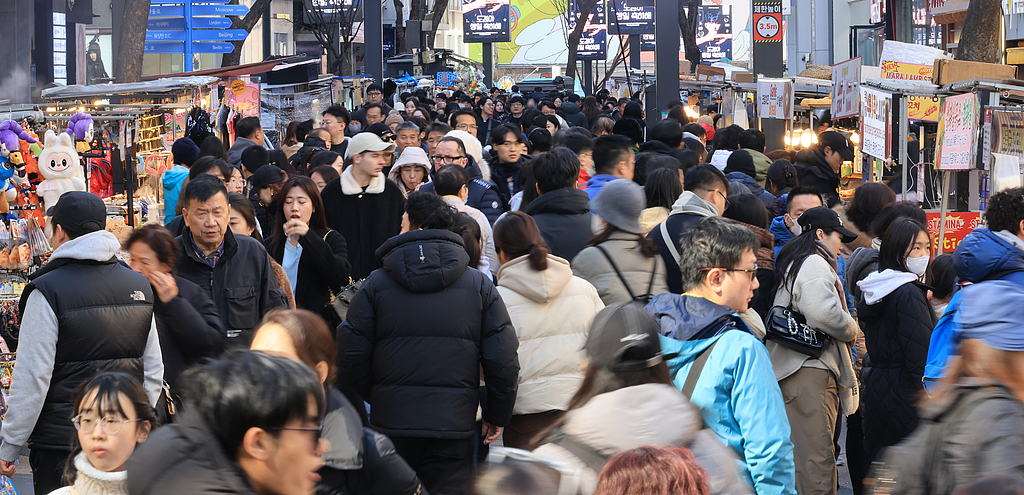
On Feb. 18, local time, Seoul‘s Mingdong neighborhood was packed with people.
In the accommodation sector, the South Korean government plans to introduce the “Autonomous Pre-Declaration System” to require accommodation operators to set a price ceiling in advance during the off-season, high-season and large-scale activities, and to declare and disclose it to the local government. Those who exceed the declaration fee or fail to declare according to the regulations will face administrative penalties such as shutdown. Regarding the frequent “price-boosting breach of contract” behavior in recent years, the government also plans to include it in the scope of penalties, while establishing a reservation fee refund and compensation mechanism to strengthen protection of consumer rights and interests.
“K butchering customers”
The government‘s policy of intensifying tourism regulation is behind the price and service disputes that have been festering in the domestic tourism market for recent years. The Korean Korean Daily reported that during the BTS‘ Busan concert in June this year, local accommodation prices rose 7.5 times their highest level, causing the “K-zaike” controversy to rapidly spread and become the focus of public opinion. Notably, Lee Jae-ming had publicly expressed his stance on such disorders in January this year, clearly pointing out that mispricing of accommodation is an “extremely evil behavior” that must be eradicated, and clearly demanding that such violations be contained at the source through raising the cost of illegality, laying the groundwork for the implementation of corrective measures for this meeting.
At the same time, dissatisfaction with the “decline in performance-to-cost ratio” of domestic tourism in South Korea is also steadily heating up. According to the Korean newspaper Farmers‘ News, from consumer disputes in the food and beverage industry, high taxi charges, to the unfriendly attitude of some popular tourist destinations towards tourists eating alone, related negative events continue to ferment after being spread through online videos, and there are even voices saying that “spending this money would be better than traveling abroad”, and calls for the South Korean government to further strengthen regulation are also steadily rising.
In addition to dining and accommodation, the transport sector is also included in the scope of regulation. The Associated Press reported that the government plans to introduce maximum discount rate restrictions to reduce the excessively large price gap in the off-season to address the price disparity caused by “high-price declaration, large discount in off-season” in the Jeju rental car fee declaration system; it will also strengthen the penalty for improper charging of taxis for foreign tourists, striving to achieve immediate suspension of eligibility after investigation. At the same time, the South Korean government will cancel partial policy support eligibility for merchants who are punished for slaughtering customers, while providing fiscal incentives to local governments who perform better price management, forming a “price and punishment parallel” policy mechanism.
Chinese Tourist Consumption Trends Become Important Variable
South Korean public opinion generally believes that the promotion of this meeting to the presidential level is closely related to the long-standing structural problems of the Korean tourism industry. Korea Economy pointed out that although foreign tourists visited South Korea last year at a record high of 18,936,000, the problem of excessive concentration of tourists in Seoul remains prominent, and foreign tourists‘ per-capita spending has fallen to $1,155, below $1,225 in 2019, presenting a contradictory situation of “increased number, decreased quality of consumption.” The report said that the South Korean government emphasized moving from “quantitative expansion” to “qualitative enhancement,” intending to change the development model that solely relies on tourist scale growth.
The Korean Ministry of Culture, Sports and Tourism said that this is the golden era for South Korea to become a “global tourism powerhouse” and plans to advance the target timetable to attract 30 million foreign tourists by one year to 2029.
From the “quality improvement” goals proposed at this meeting, how to attract and retain high-consumption capacity overseas tourists has become an important direction for Korean tourism reform. The Korean Central Daily said that the outside world is looking forward to more effective measures in cultural tourism exchange, interaction with major source countries such as China, and curing the “customer slaughter” phenomenon.
The data show that the Korean tourism market is recovering well overall. According to tourism statistics released by the Korean government in February, 18,936,600 foreign tourists entered the country in 2025, up 15.7% year-on-year. Total foreign tourist spending also increased concurrently. In the customer source structure, Chinese tourists remain one of Korea‘s largest source markets, accounting for more than 30%.
In an interview with a special correspondent of the Global Times, industry officials said that in the context of South Korea‘s attempts to push the tourism industry from scale expansion to quality upgrading, improving market order, enhancing tourist experience and promoting local diversion have become key directions for future policy. As immigration facilitation measures are pushed forward and efforts to develop local tourism resources increase, Chinese tourists‘ consumption trends and travel preferences will still be important variables to observe the effectiveness of South Korea‘s tourism policy.