This week, a wave of panic caused by advances in artificial intelligence (AI) technology swept through the U.S. stock market. CNN reported that a new AI application released by U.S. technology startup Anthropic was thought to “possibly replace dozens of existing software application products,” triggering Wall Street panic. Stock prices of software development, licensing and investment companies collectively plummeted, affecting global stock markets. The U.S. Wall Street Journal reported that this stock market shock highlighted investors‘ concerns that AI technology could disrupt traditional software business models.
Subversion of India‘s IT industry?
IT stocks in global capital markets have been under pressure since February due to concerns that artificial intelligence will affect future business growth. Investors are generally concerned that the rapid development of AI technology will completely disrupt the business model that traditional software companies rely on subscriptions and renewal, triggering sector valuation restructuring. According to Bloomberg News on February 5, Anthropic‘s application plugins for the next generation of big models can perform automated analytics tasks for law, sales, marketing, and data. These tools can perform tasks such as contract review, legal brief curation, financial model building, and data analysis report generation. The U.S. “Forbes” website said in a report on February 4 that these new tools “have the potential to automate many tasks currently offered by software services companies.”
In the crash of global software stocks in this round, the reaction of the Indian stock market, known as the “World Office”, was particularly intense. According to the India Times, on February 4th, Indian technology stocks encountered a sell-off wave, and negative emotions quickly spread due to market judgments that the new artificial intelligence applications launched by Anthropic might challenge the existing business models of Indian software exporters. On that day, the market value of the Indian stock market‘s technology sector evaporated by about 1.75 trillion rupees (approximately RMB 134.5 billion). Forbes data showed that the stock price of Tata Consulting Services, India‘s largest market-cap company for IT services, fell nearly 7%, and that of Infosys fell 7.37%. Reuters quoted analysts as saying that a new generation of AI tools may replace the basic development and testing tasks performed by entry-level IT personnel in companies, and Indian IT companies may be significantly impacted by this.
Indian IT companies are heavily dependent on global customers, especially U.S. customers. Anthropic‘s latest AI tools are designed specifically for large-scale data processing tasks that Indian IT companies frequently take on. These services include document processing, compliance checks, and operational support. The report states that with the increasing popularity of AI applications, even if the impact of new applications is not immediately apparent, investors will still have doubts about the long-term operational prospects of Indian IT companies. This concern eventually spread to almost all companies on Indian IT stocks. At the same time, Indian IT stocks were already overvalued, some companies were trading slowly, and the launch of Anthropic‘s new application triggered a long-awaited market pullback—investors‘ judgment that artificial intelligence might reduce the need for traditional software outsourcing became increasingly apparent.
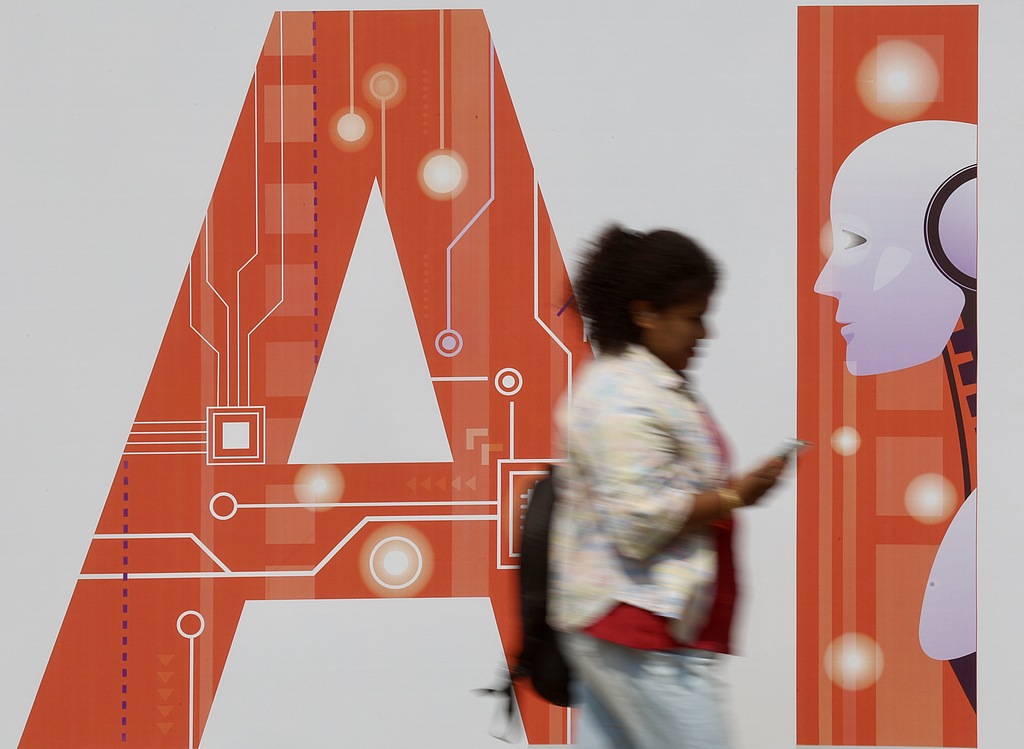
Last March, Bangalore, India, hosted the 2025 AI Developers Conference and Expo. (Visual China)
“The rise of the Indian IT industry is based on providing large-scale, relatively low-cost software development, testing, operations, and business process outsourcing services to global, especially European and American enterprises. Its core asset is a vast human resource pool of junior and intermediate engineers. However, AI technology is directly impacting the cornerstone of this model, and the new application tools released by Anthropic have become the trigger.”
A “cognitive dissonance” in the software industry
The US website CNBC reported on February 4 that the generative AI craze started more than three years ago by OpenAI‘s ChatGPT has quickly permeated the business sector. Now, with AI help, just a few text prompts can create applications, websites and other digital products in seconds or minutes. Levi, CEO of Box, an online file sharing and cloud data provider in the US, described the “cognitive dissonance” that is happening in the software industry: companies on the one hand see the potential of new technologies to enhance product capabilities, while on the other hand have to face widespread concerns that AI will destroy traditional software services.
“The software industry was once thought to be ‘devouring the world’, and its continued growth has brought long-term and rich returns to the technology industry. However, the rise of AI is changing the rules of the game.” A February 4 Wall Street Journal report analyzed that Silicon Valley insiders had been discussing Anthropic‘s latest application for weeks, especially its ability to take over the desktop and complete coding projects autonomously. Although similar AI tools were already available on the market, people were beginning to realize that when millions of people began using them to write software and analyze data, the foundations of traditional software companies would be shaken.
Jon Gray, president of the Wall Street investment bank Blackstone Group, said in an investment live broadcast to the Wall Street Journal that the current market sentiment stems from the judgment that a structural change is coming. “Even a software company with mature systems may face the risk of an ‘AI disruption.’” He said that the speed of change brought about by AI is so fast that the logic of software investment is facing restructuring. Industry data show that the share of software investment in some private equity funds has soared from about 10% in 2016 to 20% today. Some institutions had bet that corporate customers would not easily terminate software contracts due to the difficulties of changing systems, thus stabilizing the confidence of investing software companies, but the threat of AI substitution is challenging this investment logic.
The report said this week‘s sharp decline in software stocks showed that under the impact of the AI wave, no software segment could remain completely out of the loop. While traditional software companies defended themselves by saying their core competitiveness remained stable, the market seemed to have voted with its feet.
Huang Wenhong said that the sudden change in market sentiment may be due to the crossing of two key thresholds in AI big model technology and product morphology: first, a new generation of big models has significantly improved in their ability to perform long-text reasoning, tool invocation, and multimodality, being packaged into programmable process “intelligent entities” that no longer just answer questions but can execute an entire business process from end to end; second, the arrival of enterprise-level product morphologies, such as the application released by Anthropic that claims to be able to automatically draft contracts, organize evidence, and generate reports, directly points to the “job” of professional software and outsourcing services, at one point triggering sales of around hundreds of billions of dollars in related market value. The S&P North American software index fell about 15% on-month in January this year, the largest decline since the financial crisis, falling for three consecutive weeks, demonstrating that the expectation that “AI will reprice the software industry” has materialized into market signals. Currently, some investors believe that AI can rewrite the original “people + software” model to “AI + a few people”, thereby compressing the pricing space of traditional software subscriptions and service fees, which is a direct source of market sentiment.
Is it being replaced by AI or actively “jumping”?
The massive sell-off of global software stocks has also affected the stocks, bonds and loans of many technology companies in Silicon Valley. On February 4th, the stock prices of Nvidia and Boton, two chip manufacturers, fell more than 3.4% and 3.8%, respectively. Nvidia had fallen for four consecutive days. “I don‘t think this is a market overreaction,” Bloomberg News quoted Michael O‘Rourke, chief market strategist at Jonestrading, a U.S. capital market analysis firm. “For the past two years, we have been talking about how AI will change the world. It is a technology that spans generations. And in recent weeks, we have already seen it begin to show its power in reality.”
However, Nvidia CEO Huang Renhoon publicly refuted the view that “artificial intelligence will replace software and related tools” on February 4. “There is now a saying that the tools on which the software industry relies are going into decline and will be replaced by AI… This is the most illogical idea in the world, and time will prove this.” Huang Renhoon further explained: “Whether you are a human or a robot, will you choose to use existing tools, or reinvent tools? The answer is obvious—it must be to use existing tools.”
Huang Wenhong told the reporter of the Global Times that in the context of a major pullback in global software stocks and valuations re-priced by the “AI panic”, Huang Renxun‘s proposal that “AI substitution for software is illogical” emphasizes a judgment: AI must be deeply embedded in software, rather than letting this layer of software disappear as a whole. In addition, at the current level of actual development, general intelligences currently still face many challenges in terms of engineering arrival, costs, and so on, and cannot completely replace all software‘s ecosystem position in the short term. However, AI does have the promise to reshape future software product forms, human-computer interaction patterns, and new commercial pricing logic.
Huang Wenhong analyzed that from the perspective of industry evolution, the future software business model is likely to be restructured along three paths: first, from “selling functionality licenses” to “selling AI capabilities + usage”, superimposing AI services on top of traditional services, with companies paying for the functionality actually used, such as intelligent analytics, automated generation and decision support; second, from “selling tools” to “selling results”, a large number of “digital employees” or “AI outsourcing contracts” will appear in the future, pricing around completing a report, a case, a batch of work orders, with software manufacturers and customers charging or splitting according to delivery effects; third, around high-value data and compliance requirements, forming a closed-loop service of “data + models + applications”, especially in finance, healthcare, industry, etc., establishing new entry barriers through industry data assets and proprietary models.
Huang Wenhong said that for software companies in various countries, including China, the key is not to debate whether they will be disrupted by AI, but whether they can first complete the “role transition” from “feature providers” to “process orchestrators, data operators, and AI providers.”